Archaeologists in Israel have discovered a crucial missing piece in the puzzle of the history of writing: letters that are preforms of today’s alphabet and provide a connection between hieroglyphics and the alphabet. Recognizable symbols on a fragment of a vessel dating back 3,450 years demonstrate the evolution of writing systems from hieroglyphics, a visual script, to the alphabet, a more abstract and flexible system. However, they also provide credence to the theory that the southern Levant was an important center for alphabet creation.
Despite the widespread use of the alphabet and written language today, their histories remain shrouded in mystery. Examples include the mysterious symbols left behind by the Indus people about 5,000 years ago, yet it is not known whether these symbols ever developed into a true script. Around the same period, the Sumerians created their cuneiform script, the Egyptians began using hieroglyphs, and the Minoans used not one but two essentially untranslated writing systems.
Where did the alphabet originate?
While these writing systems existed, they were not alphabets. Typically, they were visual or symbolic representations of words or concepts. The Egyptians laid the groundwork for a notation that would employ a small set of standardized symbols to reflect the vastness of the human linguistic repertoire. A shortened set of characters was constructed about 4000 years ago as part of their hieratic alphabet, although it was not fully developed at the time.
Nonetheless, the Levant, Egypt’s eastern neighbor, is where the alphabet was born. Inspired by the writing systems of Egypt and the West, early Semitic societies created the world’s first real alphabet there. This was a system of abstract letters based on symbols that are still used in modern Hebrew. Even today, the roots of the word “alphabet” may be traced back to the Hebrew letters Aleph and Bet. The Phoenicians played a vital role in the subsequent diffusion of this concept over the whole Mediterranean region.

Letters on a shard
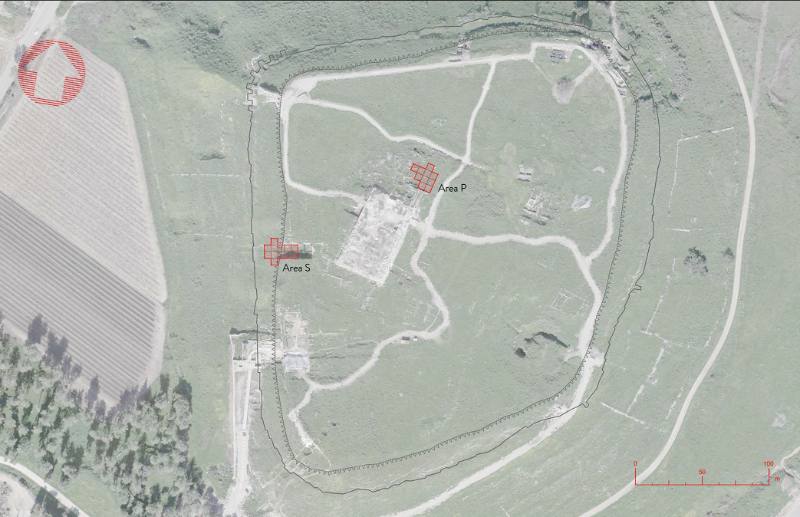
This early alphabetic symbol was found on a fragment of a vase that has been dated to 1450 BC by archaeologists. During excavations in southern Israel at Tel Lachish, the artifact was discovered by Felix Höflmayer and his crew from the Austrian Archaeological Institute. This location has long been recognized as a cultural center throughout the Bronze Age, and it is even referenced in letters written by the Egyptian pharaoh Thutmose III.
The 2018 Tel Lachish ceramic piece was found between the foundations of a city wall and a bigger structure. It is just under four centimeters in length. Some black paint characters can be made out on the interior. Two columns of three characters are shown. Along with these three, there are two more figures on each side, and a fourth in the space between the two sets of three.
Earliest proof of the alphabet
Its letters can be recognized as alphabetic characters. The first line has the letters Ayin, Bet, and Dalet. This might be rearranged to form the term “slave,” as “slave” was a common name suffix in ancient Semitic. The second line of the string produces the letters Nun, Pe, and Tav. The term for honey or nectar or a form of the verb “to turn” are both possible outcomes here, depending on the interpretation.
One of the first instances of alphabetic lettering in Israel, this clay sherd dates back to a period when its age could be confidently established. This discovery bridges the gap between more recent evidence and artifacts with contested ages and inscriptions, such as the Lachish Dagger from the 18th century BC. That’s why the shard might be a crucial piece to the puzzle of how the alphabet got where it is now.

A reappraisal of the past
The very fact that it exists compels us to reconsider the original development and dissemination of the Near Eastern alphabet. This is because, until recently, it was believed that Egyptian rule in the 14th or 13th century BC was responsible for the dissemination of the early alphabet in the southern Levant. Due to this discovery, scientists can now situate the spread of the alphabet far earlier in history.
This new discovery establishes the existence of the alphabet one hundred to two hundred years before the Egyptian conquest of the Levant. Instead, it might be from the Hyksos era, when Semitic monarchs from Asia Minor or the eastern Levant reigned over sections of Egypt and the Levant. Therefore, the dissemination of the alphabet must be understood independently of the setting of Egyptian dominance, since the latter occurred much later, according to the researchers.
In order to understand more about this pivotal time in the development of the early alphabet, the archaeologists are looking for more digs and findings at Tel Lachish.