Finding adequate conductors wasn’t an issue in the early days of electrical engineering (the early 19th century). The issue was more with the insulation around these wires. For instance, German Samuel Sömmering describes his tinkering with sigellac, varnish, and even rubber. And both Sömmering and the Russian Pavel Schilling tested a rubber-coated wire cable back in 1811. Using silk strands as insulation was an attempt made by some of the experimenters. Later, a firm rubber-like material called gutta-percha, which comes from a plant in Malaysia, was utilized instead.
As long as the voltage (“volt number”) is not too high, isolating conductors in modern electrical systems is a breeze because of the broad variety of plastics at our disposal. Here, you’ll learn about the many cable types available. Some may be familiar to you from around the house, while others take really unique and unusual shapes.
The fundamental aspects of all cables:
- To accommodate greater currents, the cable cross-sections must be enlarged.
- The more severe the voltage fluctuations, the more complex the insulation must be.
Cable types
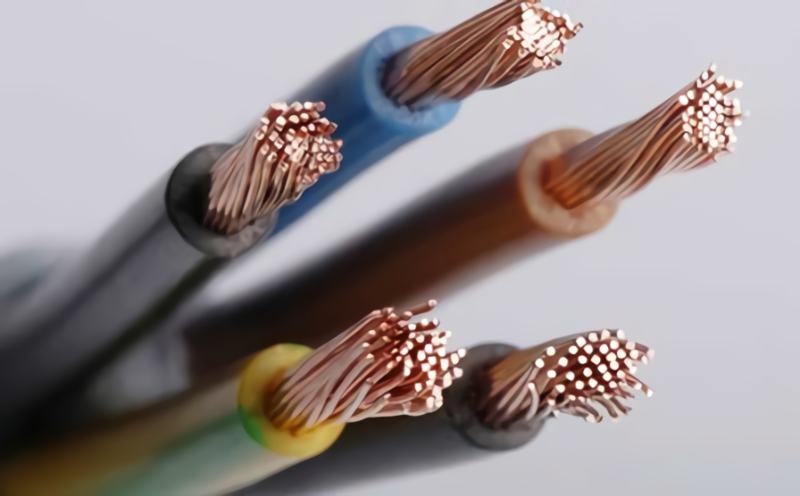
Power cords are the flexible cables that go from an electrical outlet to a household appliance. For this kind of connection, three cores of stranded copper wire (thin twisted copper wires) are encased in their own insulation tube, making for an extremely flexible and durable cable.

There are relatively rigid cables made of a thicker copper wire. These lines are often concealed inside an insulating tube that is either flush-attached to the wall or is installed externally (surface-mounted).
These lines are often housed in a unified plastic conduit. This configuration is frequently flush-mounted.
The telephone lines carry little current. So, telephone wires may be quite delicate. Typically, several separate lines will be combined into one larger bundle.
A cable is made up of several individual conductors, whereas a wire only has one. Wires are often exposed and coiled.
High-voltage cables
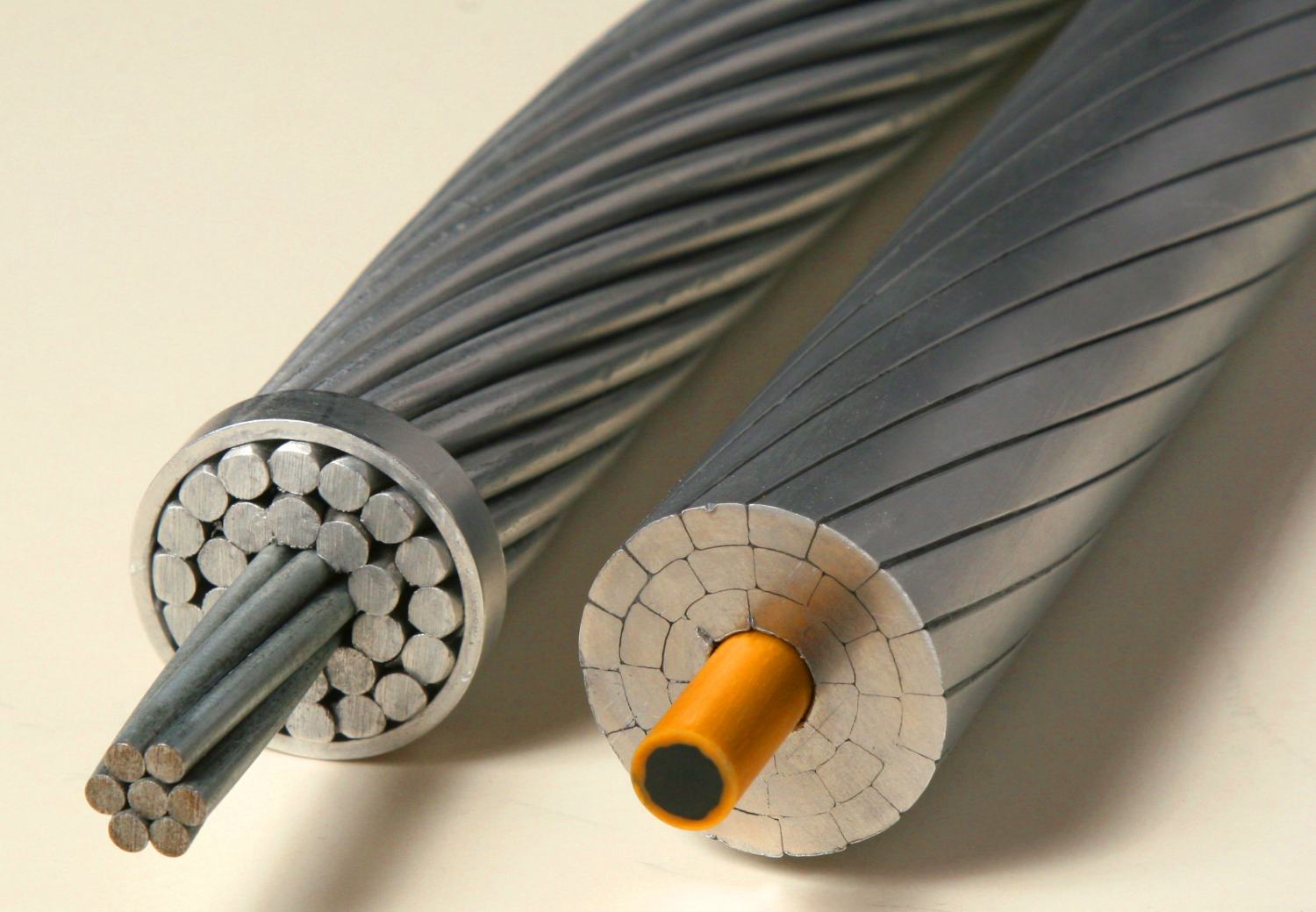
These cables are used to transport high voltage currents. Because of this, they need to have big diameters and good insulation. Most of the time, air is employed as an insulator, and thus the wires dangle freely between ceramic insulators mounted on the poles (overhead lines). These high-voltage cables also run below ground, but only in densely populated regions or places where the massive pylons would cause significant visual disruption. However, this approach comes at a high cost because of the complicated insulation required.
Copper cables would be too heavy to use for overhead lines. As an alternative, thick aluminum wires are employed, and they are strung around a steel center. The lines’ stability is ensured by this central pillar.
Submarine cables
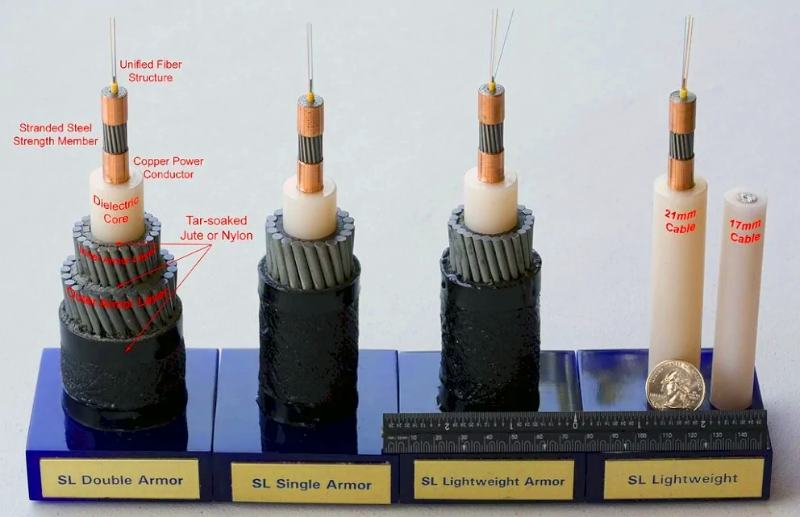
CC BY-SA 4.0, Wikimedia Commons)
In 1857, C. W. Field commissioned the construction of a telegraph wire between Europe and North America that was around 4000 kilometers long and weighed 2500 tons. It still took more than a week to send a message back then since no one had invented telegraphy. Although the telegraph wire was intended as a solution, its first implementation was a disaster. They persisted, creating new and better cables as well as vessels designed specifically for laying cables.
Despite the rise of satellite communications, numerous undersea cables are being actively maintained today for many reasons, including:
- Extremely large volumes of information can be sent over undersea cables.
- They’re built to last.
- Transmission times using deep-sea cables are far lower than those via satellite (about a factor of 3).
Undersea copper connections are being phased out in favor of submarine fiber optic cables due to the fact that larger data quantities can be transmitted with light than with electrical signals. Several tens of glass fibers, and sometimes even a hundred, are wrapped around a narrow copper tube. For further durability, the cables are reinforced with steel wires.