A fertilized egg cell must decompress its genes before it can develop into an embryo. Scientists have finally figured out how it accomplishes this feat. According to the findings, a so-called “pioneer factor” is responsible for opening the chromatin packing of the genetic material during fertilization, allowing the genes crucial for early cell division to be read. This is the only way the embryo can develop beyond the two-cell stage.
If everything goes well, a new life starts when a sperm fertilizes an egg. Things may go wrong even when the mother’s and father’s chromosomes fuse together. However, the following phases are not without their own challenges: The newly fused DNA in a fertilized egg cell has to be “awakened” before it can divide. So-called pioneer factors are responsible for reading the relevant parts of DNA during cell division.
The future embryo undergoes its first round of cell divisions shortly after fertilization. On the other hand, this requires the reading of at least some genes.
Obtaining the genetic material from its sealed packaging
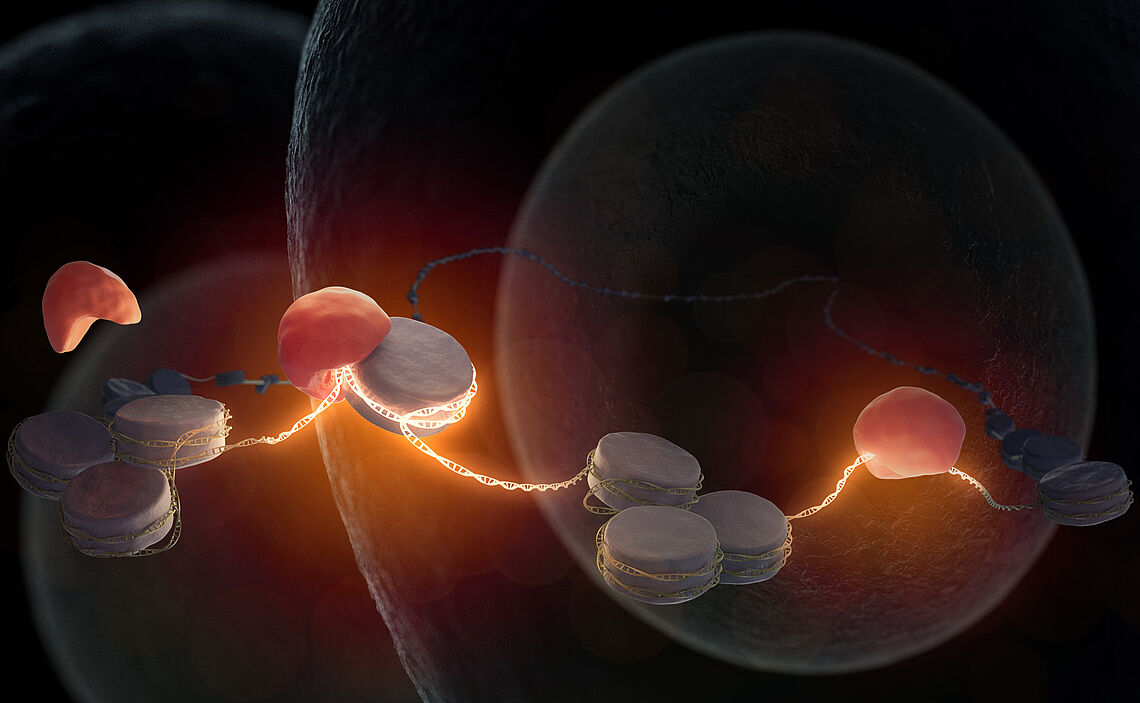
Molecules in the cytoplasm of the egg cells that are passed down from the mother are useful even during the first cell division. When an embryo reaches the two-cell stage, however, the cells are on their own. The thing is, the genetic code is not openly available in the nucleus of the cell. DNA is present as a long strand that is wrapped like a string of pearls around smaller packing proteins called histones, as explained by co-author and Max Planck Institute researcher Siwat Ruangroengkulrith.
The embryonic cells need to decode the first genes from this packing at certain locations before they can make the transcription factors required for further cell divisions. But the DNA thread is shortened by as much as 40,000-fold when twisted into histones. It was previously unclear which unpacker molecules, in the form of so-called pioneer factors, liberate the compressed genetic information and allow for successive cell divisions.
The first genes in a fertilized cell are read by a specific pioneer factor.
The key molecule
First author Johanna Gassler of the MPI of Biochemistry and her colleagues have shed light on this issue. First, scientists determined in mice which transcription factors are active throughout the development of an embryo and which genes were available for reading. Researchers sought for sequence features shared by the earliest-stage mRNA molecules they isolated and found many.
A closer look at the molecules involved has highlighted the crucial function played by one in particular: Nr5a2, the pioneering factor. Embryonic development cannot go through the two-cell stage without it, since it is essential for activating the genome at that time. This pioneering factor seems to be transmitted from the maternal egg cell to the developing embryo.
The absence of Nr5a2
Without Nr5a2, no additional embryonic processes may begin. Through their tests, they demonstrated that inhibiting Nr5a2 prevents the production of the vast majority of mRNA molecules in early embryos. Embryos are also prevented from developing further. This indicates the significance of Nr5a2 in the first stages of embryonic development.

The team was also successful in elucidating the mechanism behind this pioneering factor. Experiments have demonstrated that Nr5a2 may unlock dormant DNA sequences, allowing other genes’ transcription machinery to reach those regions. To begin the process of unpacking and reading the genetic information in embryos, the molecule docks onto the chromatin envelope of the DNA. Additional transcription factors are then released, which control further reading.
Relevant understanding of the first moments of existence
Important progress has been made toward a mechanistic understanding of the origin of life with the revelation that Nr5a2 plays a vital role in genome awakening. Researchers believe there must be more components at play, but they haven’t been able to pin them down yet.