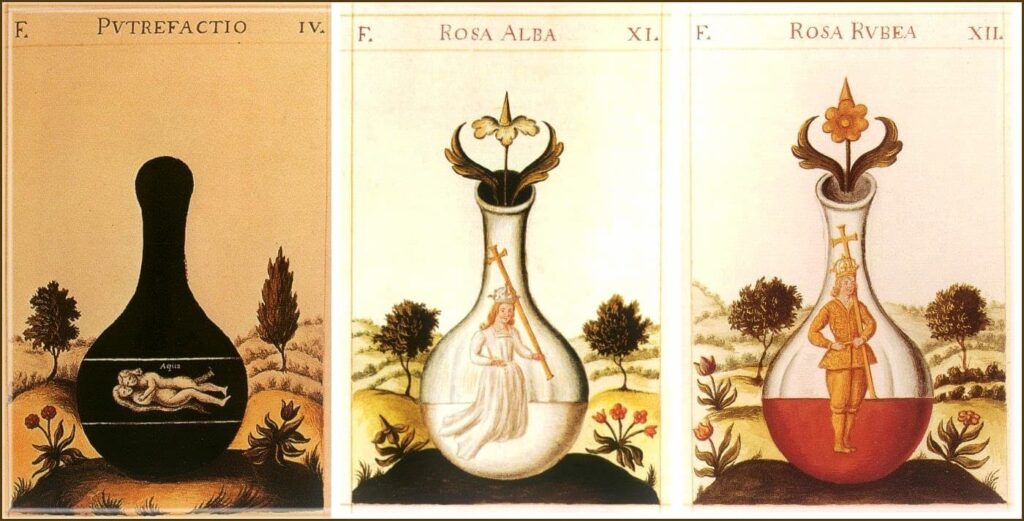
The Latin term “rubedo,” which can be translated as “redness,” signifies in alchemy the final phase of the Magnum Opus, the reddening, following the nigredo and the albedo: it is the ultimate completion of chemical transmutations, culminating in the creation of the philosopher’s stone and the transformation of base metals into gold. While the nigredo involved putrefaction and albedo distillation, the rubedo occurs through sublimation under the influence of fire, that is, the Spirit. It is symbolized by the phoenix or a pelican, an egg, a red rose, or a crowned king.
Characteristics of Rubedo
Since red is considered by alchemists as the intermediate color between white and black, between light and darkness, the rubedo represents the reunion of opposites, the closing of the circle, the union of spirit and matter, masculine and feminine, or Sun and Moon, ultimately the androgynous or rebis. After lead has been transmuted into silver, it marks the final transition to gold.
Similarly, just as the nigredo corresponded to the alchemist’s physical body, and the albedo to their soul, the rubedo now identifies their spirit, the highest part of the three constituent organs of the human being.
The alchemist’s ultimate task at such a stage of development is not only to rise above matter but also to reunite with it and redeem it after making it fertile and purified from coarse aspects. Their soul, having liberated itself from corporeality, must also die to make way for the descent of the spirit, achieving the fusion of the Self with the world.
This is akin to the initial stages of the Magnum Opus but now consciously, at a higher level of awareness, and as a result of their free will. The Self becomes an instrument of God, realizing that it is one with the world and reflecting in it—the microcosm has become the macrocosm. In Christian alchemy, the color red is equivalent to Pentecost, the descent of the Holy Spirit to Earth in the form of tongues of fire.
On a planetary level, rubedo is associated with the Sun, symbolizing fire, and the Spirit, an astral body believed to govern gold, in which the Earth is destined to reunite in the future at the end of its evolution. The meaning of red, on the other hand, refers to blood, life, fertility, and sacrifice. It symbolizes sulfur reuniting with mercury, imparting its own dye—a term in alchemy that not only involves “painting” but specifically “transmuting.”
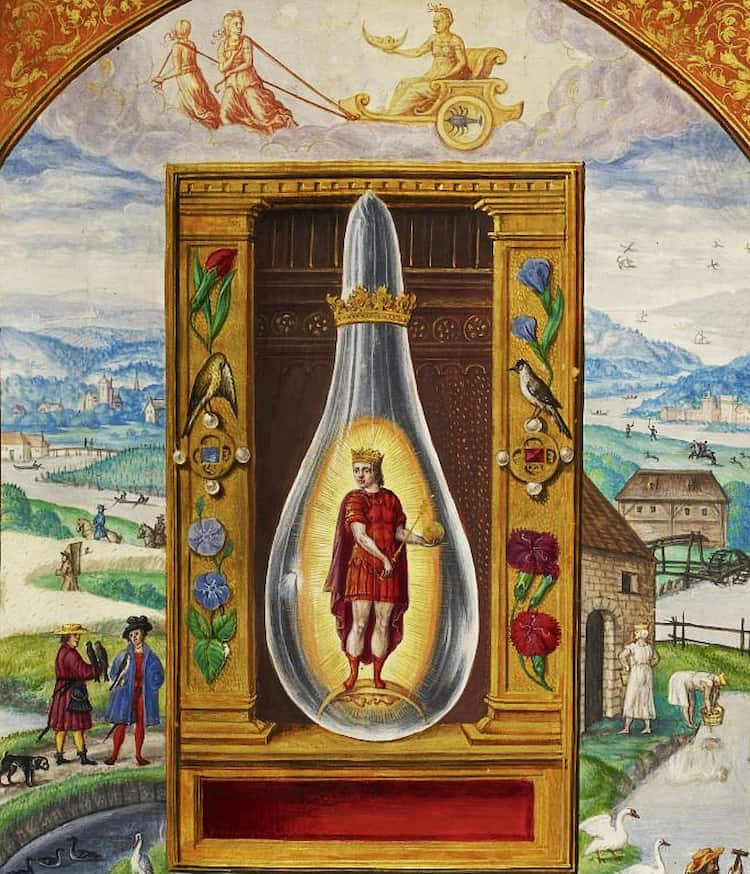
Red is also the attribute of the highest degrees of the Masonic hierarchy, and the color of the upholstery in lodges where its rituals take place. The prevalence of red is found in many national flags. For instance, Goethe considered red the quintessential color, a synthesis of opposites that “contains, in act or in potency, all other colors,” capable of giving an impression of both gravity and dignity, as well as clemency and grace.
In the Divine Comedy, rubedo corresponds to Dante and Beatrice’s entrance into Paradise. In the context of humor theory, the sanguine temperament is attributed to rubedo, or the choleric temperament.
Similarities Within a Psychoanalytic Framework
In the realm of analytical psychology developed by the Swiss psychiatrist Carl Jung, rubedo represents the archetype of the Self attained at the culmination of the individuation process. This is when the fusion between the ego and the Self occurs, symbolized by a red man and a white woman.
It signifies the union of opposites, the point at which the individual not only reclaims the unconscious material that had been deceptively projected outward but consciously reworks it at a higher level, opening up to love. In this way, one comes to discover their true nature, receiving the manifestation of the Self in its entirety.