Beneath the sun-baked quartz grains of the Namib, Kalahari, and Atacama deserts lurks an ambush predator that has elevated the game of hide-and-seek into a lethal art form: the six-eyed sand spider, known historically in arachnology as Sicarius terrosus and classified in modern taxonomy as Sicarius thomisoides (alongside its African cousin Hexophthalma hahni). Bearing a Latin genus name that translates literally to “The Assassin,” this flattened, crab-like arachnid buries itself completely under desert sand in seconds and possesses one of the most potent tissue-destroying venoms in the terrestrial animal kingdom—yet ironically poses almost zero danger to humans thanks to its shy, reclusive nature.
Why Taxonomists Renamed the “Assassin” Spider
In ancient Rome, a sicarius was a contract killer who hid a curved dagger called a sica beneath his cloak to strike unsuspecting targets in crowded streets. When nineteenth-century arachnologists studied these desert spiders, they named the genus Sicarius because of the spider’s deadly ambush strike from beneath a cloak of sand. For decades, the famous viral videos of the sand spider burying itself were labeled as the African species Sicarius terrosus or Sicarius hahni.
In 2017, however, a comprehensive phylogenetic and morphological revision of the family Sicariidae by arachnologists Magalhaes, Brescovit, and Santos discovered a fascinating evolutionary split across the Atlantic Ocean:
- True Sicarius (South and Central America): The genus name Sicarius—led by the flagship species Sicarius thomisoides inhabiting the arid coastal deserts of Chile and Peru—now applies strictly to the twenty-one species native to the dry deserts and scrublands of South and Central America.
- Hexophthalma (Southern Africa): The African six-eyed sand spiders (including the famous Namib and Kalahari desert species formerly called Sicarius hahni and Sicarius terrosus) were moved into their own distinct sister genus, Hexophthalma (“Six-Eyed”), reflecting over a hundred million years of separate evolution since the supercontinent Gondwana broke apart.
The Viral Self-Burial Dance and Microscopic Sand-Glue Hairs
Measuring up to two inches (five centimeters) across its splayed, sideways-angled legs—which give it the flat silhouette of a crab, inspiring the species name thomisoides after crab spiders—the six-eyed sand spider never spins a sticky aerial web to catch flies. Instead, it is a pure terrestrial ground hunter that turns the desert floor itself into its camouflage cloak.
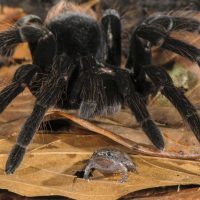
When placed on loose sand, the spider performs a breathtaking three-second mechanical ballet:
- Excavating the Trench: Using its second and third pairs of legs like rapid-fire backhoes, the spider scoops away a shallow depression in the sand while wiggling its flattened abdomen downward into the pit.
- Pulling the Blanket Over Its Back: Switching immediately to its long front legs (pedipalps and first legs), it sweeps waves of sand grains rapidly over its carapace and eyes until not a single millimeter of its body is visible from above.
- Microscopic Setae Armor: Even if a desert wind blows away the loose top sand, the spider remains completely invisible because its entire cuticle is covered in thousands of specialized, microscopic barbed hairs called setae that physically trap and hold a permanent crust of fine sand grains glued to its skin like natural ghillie-suit armor.
Potent Dermonecrotic Venom and a 15-Year Lifespan
Because the sand spider is a close evolutionary cousin of the infamous brown recluse spider (Loxosceles), both share a rare, specialized class of venom enzyme called sphingomyelinase D. Unlike neurotoxic spider venoms (such as that of the black widow) that attack the nervous system, sphingomyelinase D is a powerful cytotoxic and hemolytic agent: it dissolves cell membranes, destroys red blood cells, triggers localized blood-clotting cascades inside capillaries, and causes severe dermonecrosis (rotting and sloughing of skin and muscle tissue) alongside systemic kidney damage in laboratory rabbits.
Despite headlines calling it the deadliest spider on Earth without an antivenom, arachnologists emphasize a reassuring reality: there are virtually zero confirmed fatal human bites from Sicarius or Hexophthalma in modern medical history. Why? First, these spiders live in remote, uninhabited boulder fields and sand dunes far from human bedrooms, and when uncovered, their sole instinct is to play dead or frantically re-bury themselves rather than bite. Second, their fangs are relatively short and adapted to pierce passing desert beetles and scorpions rather than thick human skin. Capable of surviving for a full year without eating a single meal or drinking a drop of water—and living up to fifteen years in the wild, a longevity rivaled only by tarantulas—the six-eyed sand spider is a quiet, ancient master of desert patience.