Geologists have discovered the most complete geological record to date supporting the “Snowball Earth” hypothesis of the Sturtian period in the Port Askaig rock formation covering Ireland and Scotland. This is a key period when the globe was entirely covered by a thick layer of ice, between 720 and 635 million years ago, which is believed to have contributed to the emergence of complex and multicellular life.
For about 60 million years, the great Sturtian glaciation is the first of two glacial periods characterizing Earth’s Cryogenian era. These periods are nicknamed “Snowball Earth” because ice covered almost the entire surface of the globe, extending notably to the equator. For billions of years before this period, Earth had a hot and humid tropical climate, and life consisted only of unicellular organisms (cyanobacteria).
Geological records suggest that the extent and duration of glacial periods shaped continental landscapes like never before. Indeed, they are followed by significant post-glacial erosions when the ice retreats after the return of warmer temperatures.
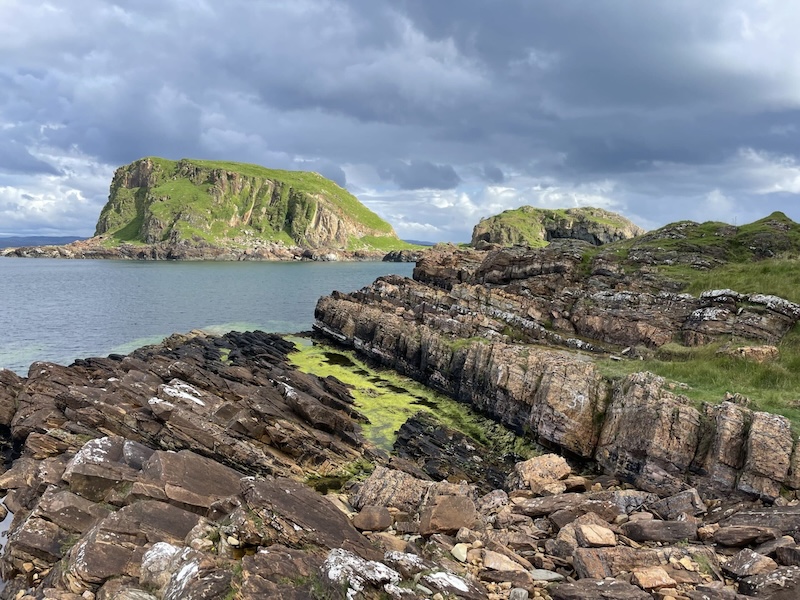
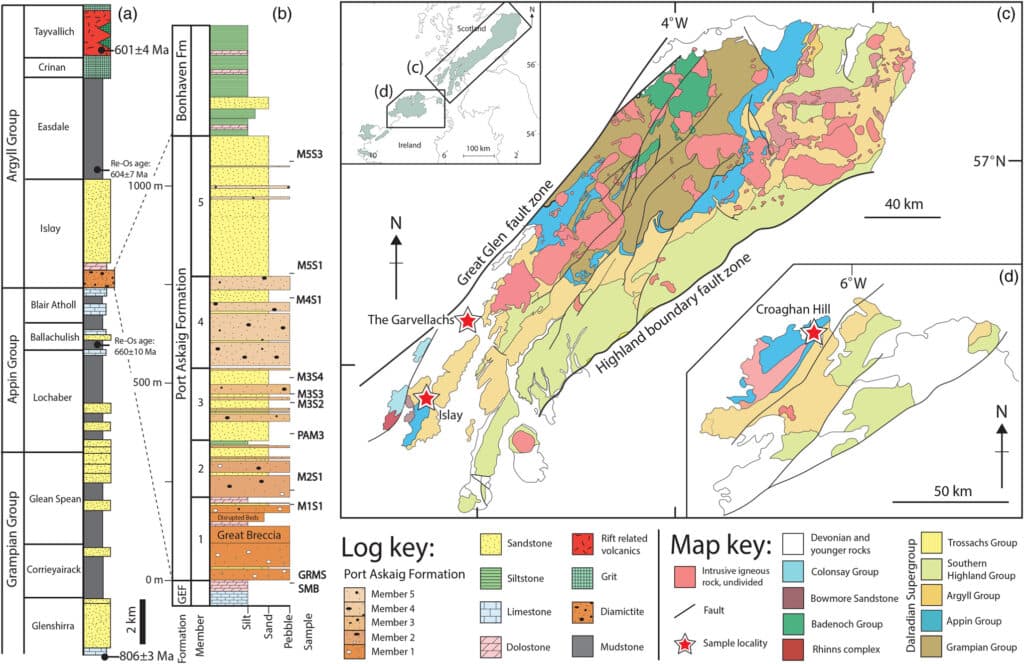
Studies have suggested that the Port Askaig formation, on the Scottish archipelago of the Garvellachs, could be one of the geological records of the Sturtian Snowball Earth. It contains geological strata alternating between glaciogenic diamictites (a type of rock composed of sediments containing particles of varied sizes) and non-glacial sandstones.

However, the consequences of glacial processes associated with such an extensive and persistent glaciation as the Sturtian are still poorly defined. By conducting new analyses of the Port Askaig formation, researchers from University College London (UCL), the University of Milan-Bicocca (in Italy), and Birkbeck University of London have confirmed that it is a unique structure reliably witnessing the transition to the Sturtian Snowball Earth.
“Most regions of the world couldn’t observe this remarkable transition because ancient glaciers scraped and eroded the rocks underneath. But in Scotland, miraculously, the transition is visible,” explains Elias Rügen from UCL Earth Sciences and lead author of the new study, published in the Journal of The Geological Society, in a UCL press release.
A Transition From a Tropical Environment to a “Snowball Earth”
To conduct their analysis, the researchers collected sandstone samples from the Port Askaig formation (1.1 kilometers thick) and from the Garbh Eileach formation, an older 70-meter formation located below. The team analyzed zircon crystals, extremely resistant minerals that can be accurately dated due to their uranium content — a radioactive element that decays into lead at a regular rate. Geochemical analyses were also carried out to date the rocks accurately.
The analyses revealed that the rocks formed between 720 and 662 million years ago. The data shows a clear transition from a hot and humid tropical environment to a Snowball Earth. The carbonate rock of the Garbh Eileach formation notably shows signs of formation in tropical waters. In comparison, rocks that formed during the same period in North America and Namibia do not show the same transition trace, probably due to erosion caused by glacier dynamics.
A Key Period That Contributed to the Emergence of Multicellular Life?
The researchers believe that this transition likely contributed to the emergence of multicellular life. Indeed, the first fossils of complex organisms all date back to the end of the Sturtian glaciation, when ice sheets began to retreat. Before this period, only unicellular organisms were present on Earth. The carbonate rocks of Garbh Eileach testify to an environment in which cyanobacterial life flourished.
“The layers of rock exposed on the Garvellachs are globally unique.
Underneath the rocks laid down during the unimaginable cold of the Sturtian glaciation are 70 metres of older carbonate rocks formed in tropical waters. These layers record a tropical marine environment with flourishing cyanobacterial life that gradually became cooler, marking the end of a billion years or so of a temperate climate on Earth,” explains Rügen.
The Sturtian ice sheets would have rapidly retreated due to albedo (the reflective power of a surface).
Multicellular life that emerged after this retreat appeared just as rapidly, considering geological time. It is strongly similar to life forms that evolved about 500 million years ago and would testify to an astonishing evolutionary adaptation. Indeed, a theory advances that the hostile environment of the Sturtian Snowball Earth would have favored the emergence of altruism (behavior of an individual that increases the selective value of another individual while decreasing its own). Thus, unicellular organisms would have learned to cooperate to form multicellular life more apt to survive environmental changes.
“The retreat of the ice would have been catastrophic. Life had been used to tens of millions of years of deep freeze. As soon as the world warmed up, all of life would have had to compete in an arms race to adapt.
Whatever survived were the ancestors of all animals,” suggests Graham Shields from UCL, co-author of the study.
The researchers believe that these results could provide strong arguments for the Port Askaig site to be classified as a marker for the beginning of the Cryogenian period. Called a “Global Boundary Stratotype Section and Point” (GSSP), it is a geological marker of global importance. It is also called a “golden spike” because a golden spike is driven into the rock to mark the boundary.