A news story emerged just a few weeks ago about how Russian factories were flaring more natural gas than before. According to new research, the prevalent practice of “flaring” in the oil and gas sector is far more detrimental to the environment than previously believed. The reason for this is that these plants convert just 91% of methane to carbon dioxide during combustion, and in rare cases, they even emit so much greenhouse gas without ever burning them. In light of this finding, the researchers write in Science that gas flaring releases five times as much methane as previously thought in the United States.
The reason for gas flaring
Since at least the beginning of the conflict in Ukraine, there has been a global shortage of natural gas, and the demand for liquefied natural gas and pipeline gas from sources other than Russia has skyrocketed. However, flaring enormous volumes of natural gas is still a prevalent practice in the oil and gas business. The flaring is sometimes needed for safety concerns to lower the building pressure. Because it is not cost-effective to collect and transport the natural gas that is produced as a byproduct in oil fields, the gas is instead flared.
Flaring involves the ignition of natural gas produced during oil extraction. This has been done since since oil was first extracted, more than 160 years ago.
Tracing the flaring
Natural gas flaring escalated in the Russian Portovaya Bay compressor facility around the end of August 2022, which also generated a lot of attention. Aside from being the starting point for the Nord Stream 1 pipeline, this complex also has a facility for the manufacture of liquefied natural gas. An estimated 4 million cubic meters of natural gas were flared there every day by Gazprom. The annual worldwide flaring of methane is estimated at more than 140 billion cubic meters by the World Bank.
The issue is that, although methane has a shorter atmospheric lifetime than carbon dioxide (CO2), its influence on climate is 20–30 times higher. During flaring, the natural gas is converted to carbon dioxide. The oil and gas sector claims that, when flares are used properly, their combustion efficiency is more than 98%. But, there is more to it.
How clean is it to burn natural gas?
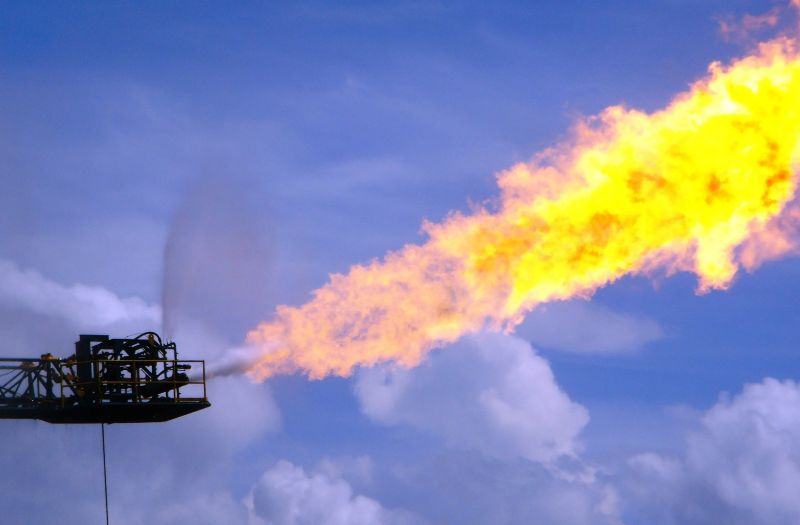
Recent research has shown that many flare facilities aren’t nearly as efficient as the industry has claimed. The Permian and Eagle Ford deposits in Texas, as well as the Bakken formation in North Carolina, are three of the greatest gas and oil-producing locations in the United States, and researchers led by Genevieve Plant of the University of Michigan looked into natural gas flaring in these areas. Just over 80% of all flares in the United States can be attributed to these two places.
In 2020 and 2021, scientists measured emissions from more than 300 flares in these regions to assess their CO2 and methane emissions. They were able to determine how much of the emitted methane gets converted to CO2 by the flaring process by comparing their quantities. If a flare is functioning as it should, a huge carbon dioxide peak and a relatively modest methane peak are to be expected, according to Plant.
Unburned methane accounts for 9% of the emissions
However, the results showed otherwise: many of the flaring facilities are inefficiently running, converting just a fraction of the methane to carbon dioxide. Some plants only managed a 60% rate of methane breakdown. Due to this inefficient process, a lot of methane escapes into the atmosphere unburned: The researchers estimated the methane emission rate from the burning flares in these three deposits to be 270,000 tons per year.
Moreover, natural gas is sometimes directly released into the environment since many of these gas venting facilities are not burning at all times. The flights made for measurements showed that between 3 and 5% of active flaring vents in the examined regions had been extinguished or were not lighted at all. Consequently, unburned methane was escaping from these vents. To put it another way, if these non-burning flares are included, methane emissions for these locations rise to tremendous 490,000 tons of methane yearly, the researchers noted.

Plant and her coworkers calculated that this equates to a 91.2 percent efficiency rate for flaring natural gas. That’s much less than the 98 percent reported by the gas and oil industries, Plant notes.
5 times higher methane emissions from flaring than expected
However, this implies that the flaring of natural gas releases 5 times more methane than was previously believed, and this is just in the United States. Thus, flaring may be responsible for between 4 and 10% of the United States’ total methane emissions alone. This reveals a previously uncalculated source of methane and proves that more methane is being emitted into the atmosphere than is being measured or accounted for at the current time.
The researchers say it’s possible a similar scenario exists in other nations. The flaring of natural gas happens in most oil and gas producing locations, but with varying degrees of control. Flaring has been assumed to be a major contributor to increased global methane emissions, with the International Energy Agency (IEA) estimating that flares emitted 8,000,000 metric tons of methane globally in 2020.
The climatic effects of excess methane are preventable
This may not seem like a lot when compared to the almost 400 million tons of manmade methane emissions each year, but it is still unnecessary and a waste. Plant claims that this particular source of methane emissions may be readily mitigated. As one possible outcome, this would call for higher standards of plant oversight and maintenance. However, the oil sector would need to reliably catch the natural gas and recycle it for use rather than wasting it.
As an illustration of how this is possible, consider Norway, where natural gas is only flared in the event of an emergency during oil production. Natural gas accounts for 99 percent of the byproducts of oil production, and almost all of that gas is isolated and reused. Research: Science, 2022; doi: 10.1126/science.abq0385