The rainbow is an amazing natural phenomenon. The conventional pattern of colorful bands results from the fundamental laws of reflection, refraction, and dispersion. And under exceptional circumstances, a double rainbow may be marveled at. How about triple rainbows, though? Can they possibly exist? Moreover, how do they form?
Formation of the Single Rainbow

Rainbows are one of the numerous natural beauties that everyone is in love with. When rain is falling, they emerge when sunlight reflects off raindrops. The majority of the color spectrum of light is absorbed by the raindrop, but a small percentage is reflected. Because of the sphere’s shape, the raindrop focuses these reflections at an angle of 138 degrees relative to the Sun. After that, there will be a rainbow seen in this intense beam of light.
When light travels through air and then enters water, a phenomenon known as refraction occurs, which is the bending of light. Every one of the sunlight’s colors is slightly distorted when it passes through water droplets. This phenomenon, known as dispersion, is responsible for the separation of colors in a rainbow.
In the droplets, the various sunlight wavelengths are each refracted a little bit differently. We perceive the normal color bands as a result of the light splitting into its colorful spectral components. The blue band is positioned on the inside and the red band is on the outside because the blue light has a shorter wavelength and is refracted more strongly in the water droplets.
Moving From a Single to Double Rainbow
A second, fainter rainbow arc can be seen beyond the first one; its colors are reversed so that red is on the inside. This is because the light is reflected twice within the droplet before it leaves.
A rainbow always appears facing a certain direction: It is situated at 42 degrees on the side of the sky that is directly opposite the sun. It is difficult to see a rainbow at noon because this antisolar point is hidden below the horizon when the sun is high in the sky.
But sometimes, in addition to the main rainbow, a second, paler secondary arc that resembles a mirror reflection of the first arc can be observed on the outer. This is due to the fact that its color scheme completely contrasts with the main arc’s. Because the secondary arcs cause two reflections of the photons within the droplet. The intensity of this second rainbow is lowered, and the order of the colors is changed as a result of the double reflection.
The Formation of the Triple Rainbow
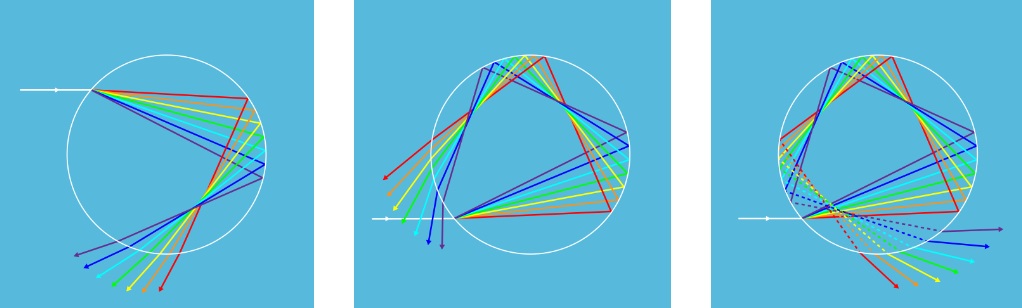
What about the triple rainbows? A rainbow may also split into two secondary arcs. This has always been recognized as theoretically possible. As a result of the sunlight being reflected three times within the droplet, a third rainbow is created. However, this time, the light beams emerge from the drop facing the sun. Therefore, we need to gaze more intently into the sunlight in order to perceive a triple rainbow.

Typically, a triple rainbow will emerge for a brief period of time when it is 40 degrees from the sun and the clouds are darker. The order of colors in the third rainbow will be just like the primary one.
The tertiary rainbow cannot usually be seen since it is only about fifth as bright as the rainbow’s main arc. It is also too difficult to see the third rainbow because it faces the sunlight. Since just five triple rainbows had been reported to science in the previous 250 years, many scientists had written them off as myths. And it should come as no surprise that the first photographic proof of a triple rainbow did not appear in a scholarly publication until 2011.
We have to be looking at raindrops at an angle of 138 degrees from the direction of the sun, or 42 degrees from the antisolar point, in order to see the arc of a natural rainbow.
Interference Arcs and Mirror Arcs
However, according to climate researchers and specialists, the far more typical occurrences of interference arcs and mirror arcs sometimes could be mistaken with a real third rainbow or triple rainbow.
When sunlight reflects off a water surface, such as a lake, the angle of entrance into the droplets changes, creating a mirror arc. Typically, the main arc and the mirror arc cross.
Contrary to actual secondary arcs, interference arcs are located on the inside of the initial rainbow and run parallel to the main arc. They create a string of successively farther-apart replicas of the initial rainbow, each of which becomes weaker and narrower. They are created by the interference—or the superposition effect—of light rays leaving the drop.
Sources:
- Gary Waldman, 1983. Introduction to Light: The Physics of Light, Vision, and Color.
- “Triple Rainbows Exist, Photo Evidence Shows,” 2011. ScienceDaily.
- American Mathematical Society. The Mathematics of Rainbows.
- Großmann, Michael; Schmidt, Elmar; Haußmann, Alexander, 2011. “Photographic evidence for the third-order rainbow”. Applied Optics.