Linen and wool were the primary components of the Viking wardrobe. The wool came from domesticated long-fleece sheep, and the weaving was done on a giant vertical loom in the house. Simple stones with holes are used to stretch the warp threads, while the weft thread is pushed through using a hand-operated shuttle and packed with a fuller (pick).
How did the Vikings produce their clothes?
The production of wadmal, a thick and toasty fabric, required this labor, which was traditionally the domain of women. This fabric had many practical uses, including but not limited to garments, tents, and sails, but it also served as a medium of exchange in legal cases and as cargo during Viking voyages.
In the Icelandic saga, The Story of Burnt Njal, the poem Darradarljod describes this craft within the setting of clan warfare. After the fight, on a Friday morning, a man named Daurrud set off. His curiosity piqued, he made his way to the pavilion and peered inside, where he observed ladies working at a loom. Men’s skulls served as the weights, their intestines as the weft and warp, a sword as the fuller (pick), and an arrow as the shuttle. Afterward, they sang out a couple of verses:
This woof is y-woven
With entrails of men,
This warp is hardweighted
With heads of the slain,
Spears blood-besprinkled
For spindles we use,
Our loom ironbound,
And arrows our reels;
With swords for our shuttles
This war-woof we work;
So weave we, weird sisters,
Our warwinning woof
The Vikings had no problem dressing up for special events, even if it meant donning silk. Trade and theft were the means by which the silk was obtained. It was brought in by Rus’ traders from Constantinople and distributed across the major markets of northern Europe.

Woolen clothes could be found in a variety of neutral tones, including brown, black, and gray. However, the materials could also be colored as a sign of wealth and success.
Blue was one of the most popular color choices. The Scandinavian woad plant was used to produce it. It had a revered shade that called to mind the deep blue of Odin’s robe. It was also common to see red among Viking clothes. It was made from madder (Rubia tinctorum plant), which could be purchased in bulk from major European trade stations.
Colors like green and yellow were also included. The yellow might come from a variety of sources, including the onion (which is grown in Scandinavia), broom, or ramie (a native Eastern Asian plant). Green was a blend of yellow and pastel.
Because it was more challenging to dye linen, it frequently retained its natural color. The Vikings’ wardrobe also included a wide variety of furs, both domestically sourced and imported, including bear, reindeer, sable, and marten.
Dress of the Viking men
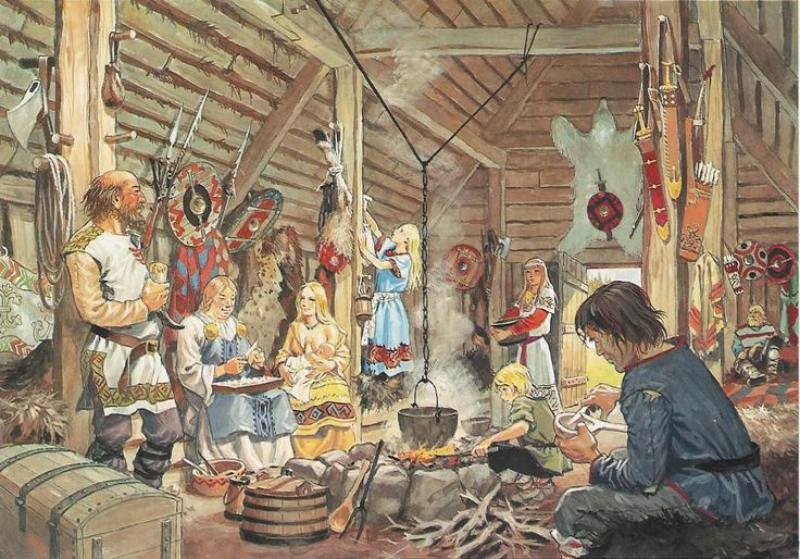
Aesthetics were important to the Vikings. They washed or showered every Saturday. On this day, both sexes took long, soapy baths to clean themselves from head to toe.
During this time, the Viking men shaved. After a quick rinse in the tub, they were ready for the ovens. A change of clothes allowed them to do the washing.
A Viking’s underwear was comprised of a basic linen shirt and warm woolen underpants, perfect for the frigid Scandinavian winter. The Vikings then put on a long-sleeved garment with a length that reached about halfway down their thighs and was held in place by a leather belt that could be embellished with bronze plates.
Then they donned a pair of trousers, which might be short and floaty, long and sticky, or short and puffy. Socks fastened with staples or straps rounded off the ensemble in the latter situation.
A long cloak, lined with fur or down, and fastened on the right shoulder with a penannular fibula, was a common way to conceal the blouse.
That way, the Vikings could simply draw the sword that’s fastened to the left side of the belt without having to use their right arm. The more well-off could be identified by the braids, embroidery, and gold and silver threads that adorn their tops and capes.
A Viking man wore leather shoes or boots, both of which had a strap that went around the ankle and folded over the instep. Carefully maintaining their beards and long hair with combs crafted from cetacean bone or elk antlers was a hobby of theirs.
It was possible that they could wear a variety of woolen caps and felt hats. When it was cold out, Viking men would be wearing mittens and large wool to keep their hands warm.
Dress of the Viking women
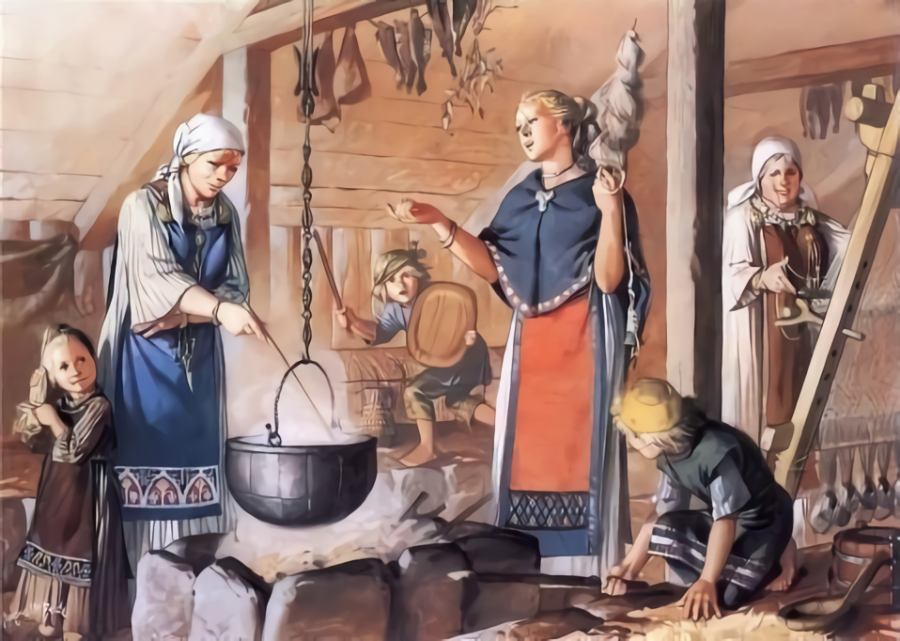
On top of her sleeved or sleeveless tunic, a Viking woman wore a chasuble garment of pleated wool, which was kept in place by a pair of frequently oval fibulae at shoulder height.
The Viking women fastened their sewing tools to the left side of this chasuble frock, which was embellished with braids and embroidery. A Viking woman wrapped herself with a shawl that she could tie around the waist or the lower back with her fibula.
As a rule, a young girl’s hair was left down, whereas a married Viking woman’s hair was pulled back into a bun, ponytail, or braid. The back of the neck was shielded by a scarf that was fastened there. She had a penchant for pearl, amber, and gold bracelets, earrings, and necklaces.
The Viking bride traditionally wore a linen veil on her wedding day, either to ward off the evil eye or because the groom had the honor of being the first to see his future wife without her veil. Since she was the head of the Viking household, she always had the keys to the house’s treasure and food storage boxes on her belt.
The military dress of the Vikings
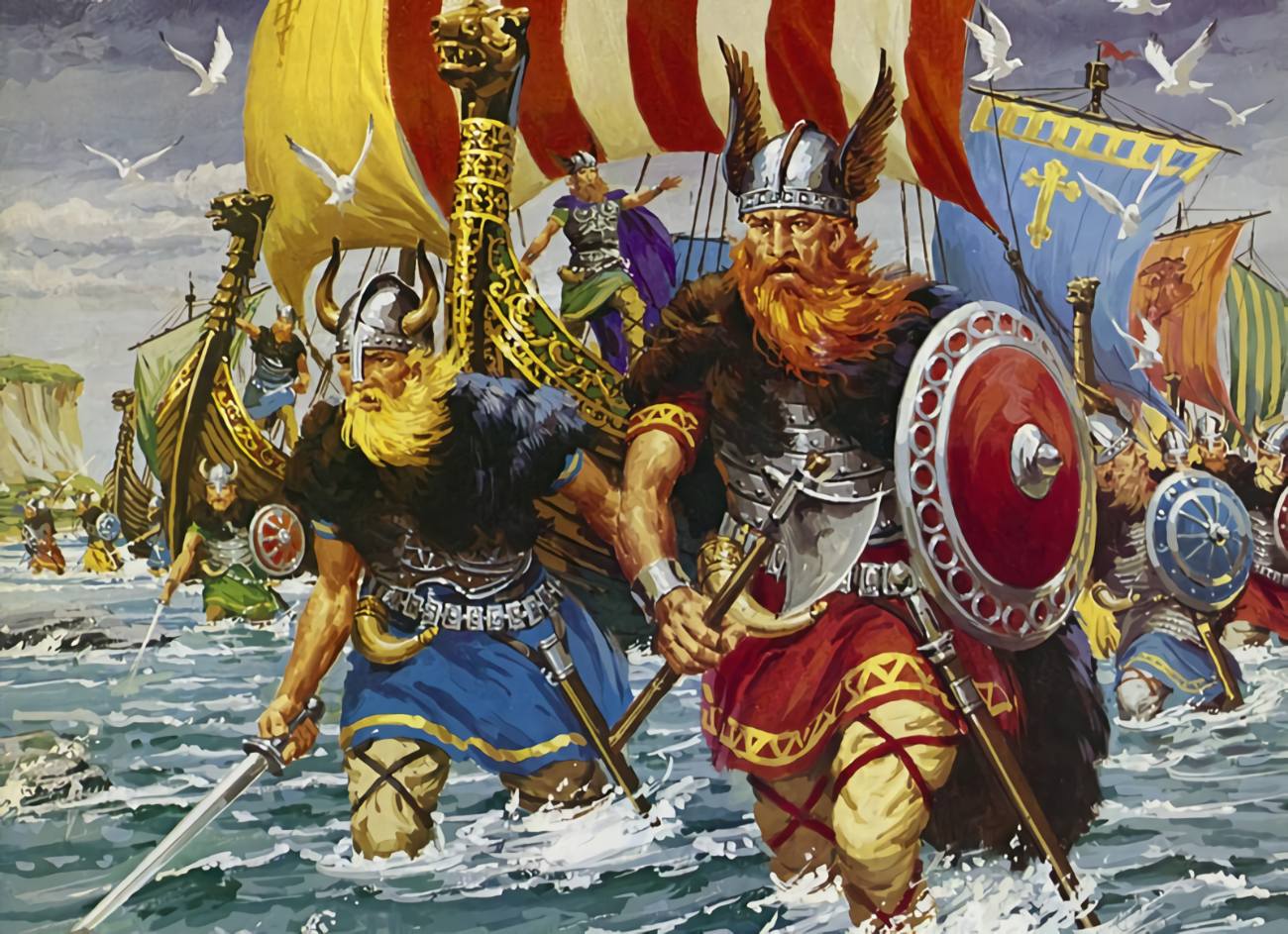
The standard Viking warrior’s arsenal included a sword, axe, spear, knife, and bow and arrows. You could protect yourself with a shield, a helmet, and a brooch. The Viking sword had two sides, and its magical strength came from the runic inscriptions that adorned them.
This wooden scabbard had fur inside and leather outside. There were several varieties of Viking axes. As the Vikings’ standard weapon, it was a fearsome one, whether short or long in the handle, with the iron more or less broad, bent, and perhaps terminated with points. It could be thrown or used as a weapon in combat.
You can think of the Viking spear as a javelin or a spear. The first was a projectile weapon, while the second was a thrusting weapon that could be used with more power thanks to the addition of stirrups.
The diamond-shaped iron was secured to the handle with nails that have spiritual and legal significance. About a meter in circumference, the Viking shield had a circular shape. It was constructed from painted wood and had a metal frame. The handle was shielded by the iron shield boss (umbo) in the middle.
The Vikings’ go-to protective gear consisted of a leather or wool cuirass and a boiled leather hat. However, a metal helmet was another option. Then, a nose extended it into a conical shape. Instead of a leather helmet, a Viking could wear a brooch, or a collection of metal plates strung together.