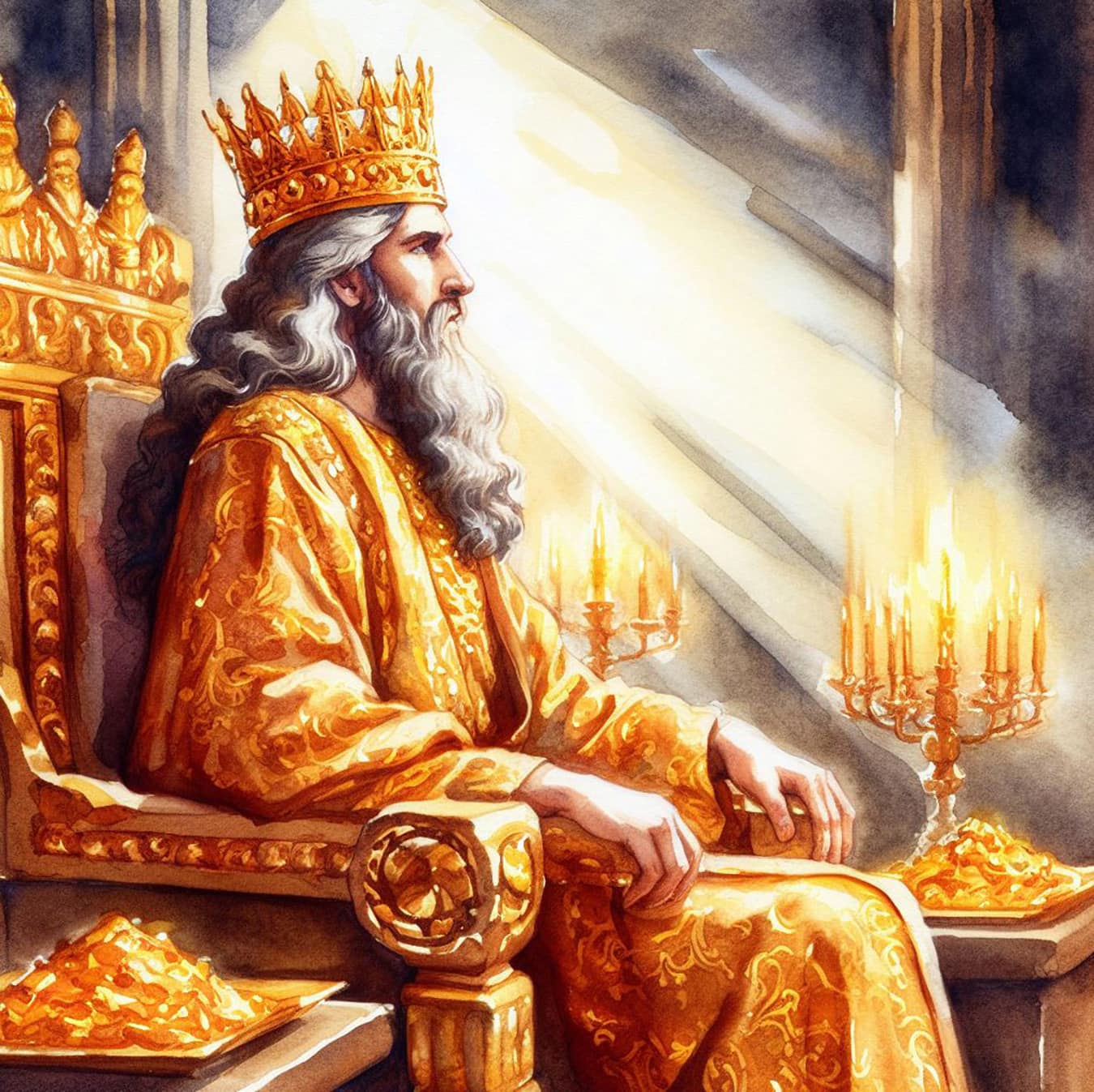
Across centuries of art history, theology, and cultural scholarship, the physical appearance and ethnic heritage of King Solomon—the tenth-century BC monarch of the United Monarchy of Israel renowned for building the First Temple in Jerusalem—have been envisioned in vastly different ways. While European Renaissance painters like Raphael and Rubens routinely painted Solomon with pale Northern European features and blonde hair, historical linguistics, ancient Near Eastern anthropology, Ethiopian royal chronicles, and poetic passages from Hebrew literature have sparked deep interest in the question of whether King Solomon was Black or possessed dark skin.
Linguistic Meaning of “Black and Comely” in the Song of Songs
Much of the textual debate surrounding King Solomon’s complexion centers on the opening chapter of the Song of Songs (Song of Solomon), the celebrated ancient Hebrew lyric poem traditionally attributed to or associated with Solomon’s royal court. In the famous declaration of the fifth and sixth verses, the speaker declares in the classic King James translation: “I am black, but comely, O ye daughters of Jerusalem, as the tents of Kedar, as the curtains of Solomon.”
Historians and Hebrew philologists point out three crucial linguistic and literary details about this passage:
- “Black AND Beautiful”: In the original ancient Hebrew text, the phrase reads Shechorah ani ve-navah. The Hebrew conjunction ve- normally translates simply as “and” rather than “but.” Early European translators chose the word “but” out of their own era’s biases, whereas modern scholars translate it accurately as “I am dark (or black) and beautiful.”
- The Female Speaker (The Shulamite): Within the dramatic structure of the poem, the grammatical gender of the adjective shechorah is feminine—meaning these famous lines are actually spoken by the female beloved (the Shulamite woman) rather than by King Solomon himself, as she explains in the very next line that the scorching sun has tanned her skin while her mother’s sons forced her to tend the family vineyards.
- The Radiant Description of the King: Later in the fifth chapter of the same poem, when the female speaker describes her royal beloved, she uses the Hebrew terms tsach ve-adom—meaning “radiant and ruddy” (reddish-brown or bronze-toned)—paired with wavy hair that is “black as a raven.”
Ancient Levantine Anthropology and Afro-Asiatic Crossroads
Stepping outside poetic metaphors to examine physical anthropology and archaeology, what did tenth-century BC inhabitants of Jerusalem and the Judean hills actually look like? Geographically, the Southern Levant sits directly on the land bridge connecting the continent of Africa (Egypt and Nubia) with Western Asia (Mesopotamia and Anatolia). The ancient Israelites spoke a Northwest Semitic language belonging to the wider Afro-Asiatic language family, which spans across both the Near East and North and East Africa.
Ancient Egyptian tomb murals—such as the famous twelfth-century BC painting inside the Tomb of Seti I and the Beni Hasan frescoes—provide vivid color portraits of how Egyptians depicted themselves alongside their neighbors. In these ancient paintings, artists used distinct skin tones for different regions: deep jet-black for Nubians (Kushites) from the south, reddish-brown ochre for Egyptians, and warm olive, copper, or light-to-medium brown skin tones with thick black beards and dark hair for Levantine Canaanites and Semitic peoples. Furthermore, ancient Israel was never genetically isolated; marriage alliances with Egyptian princesses (including Solomon’s own chief royal bride, the daughter of Pharaoh) and interaction with Cushite populations meant the royal court of Jerusalem was a diverse Afro-Asiatic crossroads far removed from pale European paintings.
The Kebra Nagast and the Solomonic Dynasty of Ethiopia
Nowhere is the historical and spiritual bond between King Solomon and Black African civilization more central than in Ethiopia. According to the Kebra Nagast (“The Glory of the Kings”), the fourteenth-century Ge’ez national epic of Ethiopia preserving much older oral and Coptic traditions, the famous ruler of the southern kingdom of Sheba—known in Ethiopian history as Queen Makeda—traveled from Aksum to Jerusalem to test King Solomon’s wisdom and marvel at his temple.
Before Queen Makeda returned home to East Africa, she conceived a son by King Solomon named Menelik I (originally named Ibn al-Hakim, “Son of the Wise Man”). Upon reaching adulthood, Menelik traveled to Jerusalem to visit his father Solomon, was anointed king, and returned to Ethiopia accompanied by the firstborn sons of Israel’s nobility—forming the Solomonic Dynasty of Ethiopia. For more than seven hundred years consecutively (and claiming three millennia of lineage), Ethiopian Emperors down to Emperor Haile Selassie I in 1974 ruled under the constitutional title “Conquering Lion of the Tribe of Judah,” depicting King Solomon, Queen Makeda, and Menelik in vibrant Ethiopian church iconography with proud African features as the literal royal ancestors of the Ethiopian nation.