The Vikings surged onto the shores of England, the Frankish Empire, and even the Mediterranean. Armed with a thirst for exploration, a fearless religion, and long-handled two-handed axes, these fair-haired men from the north struck terror into the hearts of European populations and rulers, who struggled to fend off the relentless waves of raids.
One particular weapon in the Viking arsenal gave them a massive advantage: the longship. Its speed, mobility, and simple design made it ideal for swift raids along coasts and riverbanks.
Here’s a look at the five greatest strengths of the longship—key to understanding the Vikings’ success.
1. VERSATILITY
The Viking ship was perfect for rivers
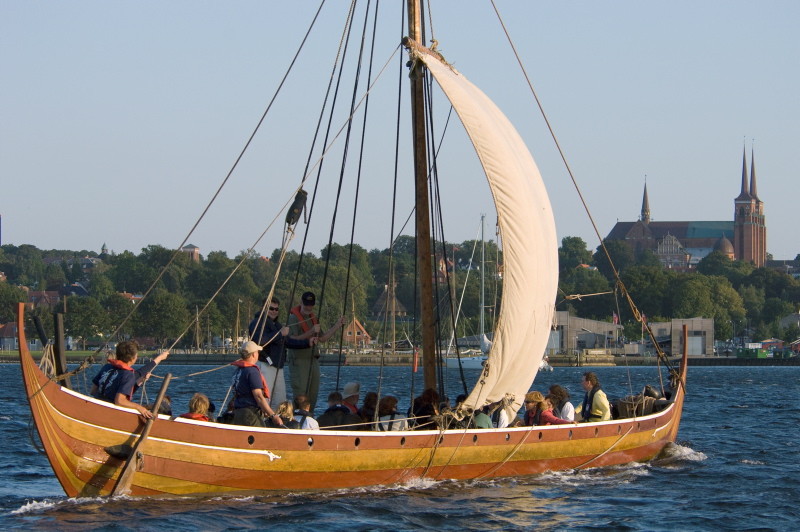
The long, slender hull and shallow draft of Viking ships—meaning the distance from the waterline to the keel—allowed them to navigate Scandinavia’s rivers with ease.
They could even traverse the wild rapids of Russia’s rivers on their way to trading hubs in the east. If they encountered an obstacle, Viking ships were light enough for the crew to haul over land.
During an experiment with the reconstructed Viking ship Helge Ask in 1996, researchers from the Viking Ship Museum in Roskilde successfully moved the two-ton vessel across a 300-meter-long land strip at Helgenæs.
The crew hauled the ship onto the shore and dragged it over land using wooden rollers greased with fat and oil.
2. SURPRISE
The keel was designed for ambush
The first recorded Viking raid occurred on June 8, 793, according to historical sources. On this day, Vikings attacked the monastery on the island of Lindisfarne off the coast of North England.
“The heathens desecrated God’s sanctuary, ravaged our house of hope, and trampled on the bodies of the saints,” a monk in York wrote about the Scandinavian raiders.
This and the following years of war and plundering were made possible by the unique construction of Viking ships. Thanks to their flat keels, the ships could sail right up to the shore and deploy warriors.
Experiments with reconstructed Viking ships in Denmark indicate that, from the moment the ships became visible from land, it typically took only an hour before the warriors stormed ashore.
3. FEAR
Decorations intimidated the enemy
The appearance of Viking ships struck fear into their enemies—a form of psychological warfare that gave the Vikings an additional advantage.
Shipbuilders achieved this fearsome effect by painting the ships and their accessories in striking colors and adorning them with carved motifs that signaled strength and ferocity.
Ships belonging to kings or chieftains were often fitted with a fearsome dragon head on the prow.
The Saga of Håkon Håkonsson describes how the Norwegian 13th-century king had “a dragon ship with thirty rowing benches; the heads and necks were gilded, and the sails beautifully painted. In addition, King Håkon had many other large and well-equipped ships; and in the sunlight, it seemed as if fire shone from the heads.”
4. SPEED
The sail provided propulsion—even against the wind
Experiments with reconstructed Viking ships have shown that they could tack against the wind—a feature that allowed them to continue sailing even in adverse conditions.
Although Viking ships were far less efficient at windward sailing than modern sailing vessels, their capabilities were sufficient to reach their destinations, even with some delay, under unfavorable winds.
With a tailwind, longships could achieve high speeds. Experiments suggest that a Viking ship could sail at up to 14 knots (about 25 km/h). The historian Adam of Bremen (1040–1081) wrote that a journey from Ribe to England could be completed in just three days.
5. SIMPLICITY
The longship was easy to build
Despite the Viking ship’s unparalleled seafaring qualities, its construction was simple and could be carried out almost anywhere near a waterway. All that was needed were trees, an axe, and a few other tools such as a plane.
The ship was built from oak logs, which shipwrights split lengthwise into planks. These planks were fastened to the keel with iron nails and then overlapped in layers using a technique called clinker building.
Construction could be completed in a relatively short time. The Saga of Olav Tryggvason states that Ormen hin Lange—one of the most famous Viking ships, which was likely about 55 meters long—was built in a single winter.