The fact that the term “Iron Lady” was first used as an insult against the promising politician Margaret Thatcher in the Soviet Union only served to increase its notoriety among the British population. It took the Iron Lady three years after joining the Conservative Party to become the first woman Prime Minister of the United Kingdom and also of the Europe.
In 1976, Margaret Thatcher was dubbed “Iron Lady” by a Soviet journalist
In January 1976, the Soviet army newspaper Red Star (or “Krasnaya Zvezda”) released an article denouncing the British politician Margaret Thatcher in response to her charge that Moscow was attempting global control. As head of the conservative party in Britain’s opposition, Thatcher had a prominent role.
The document was discovered by Robert Evans, who was the Moscow bureau head for Reuters at the time. After reading the piece scathing of Thatcher, he was inspired to write his own news. Evans rendered the original Russian headline, which was authored by an army commander called Yuri Gavrilov, as “Iron Lady Wields Threats.”
Iron Lady was a nickname that Yuri Gavrilov made up and attributed to the British.
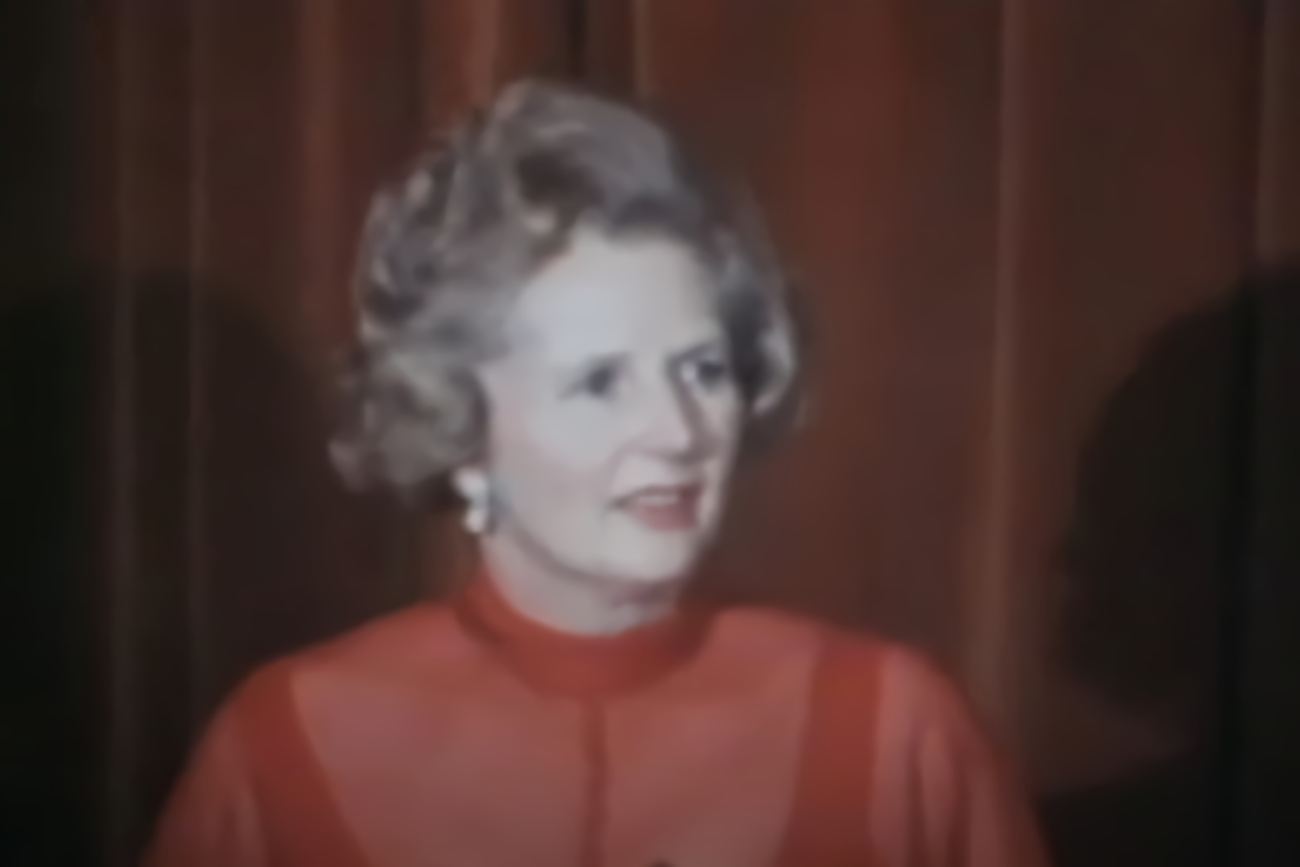
Evans’s report read: “British Tory leader Margaret Thatcher was today dubbed ‘the Iron Lady’ by the Soviet Defense Ministry newspaper Red Star.” A week later, in 1976, Margaret Thatcher made the following announcement to raucous applause at a speech at Selborne Hall: “I stand before you tonight in my Red Star chiffon evening gown. My face softly made up and my fair hair gently waved, the Iron Lady of the Western world. A cold war warrior, an amazon philistine, even a Peking plotter. Well, am I any of these things? … Yes I am an iron lady, after all it wasn’t a bad thing to be an iron duke, yes if that’s how they wish to interpret my defence of values and freedoms fundamental to our way of life.”
During the campaign that brought her to office in 1979 and made her Europe’s first woman prime minister, she was known as the “Iron Lady,” which bolstered her image at a time when she was belaboring a collapsing left-wing Labour administration as soft on the Russians.
The fact that the name “Iron Lady” originated in the Soviet Union as an insult only added to its popularity. The Iron Lady eventually became Prime Minister of Britain three years after her election to the conservative party.
Who was Margaret Thatcher?
Margaret Roberts, the future First Lady of England, was born in a tiny village in the East Midlands in 1925. Her family ran a Methodist grocery store. Her parents instilled in her the value of hard work and desire, which served her well. For her chemistry studies at the esteemed Oxford University, she obtained a scholarship in 1943. She entered her first municipal election at the ripe old age of 24. While she didn’t win that election, nine years later she was able to become a Member of Parliament for a North London district.
Her political career continued to the highest levels of the British government. In 1968, she entered politics and by 1970 had risen to the position of Minister of Education and Science, under the Pensions Minister. She became the first woman to head the Conservative Party at the age of 49, setting her on the path to Prime Minister, a post she held for three terms beginning in 1979. That she was the head of state for a western nation was a historic first for women. The United Kingdom was experiencing a crisis on several fronts, and she was put in charge of addressing them all. Her inflexibility and the unpopularity of her reforms earned her the moniker “Iron Lady.”
What was Margaret Thatcher’s policy?
The Prime Minister has adopted hard lines on a wide range of challenges facing the country’s population in an effort to turn things around. For instance, in 1982, Argentine commandos assaulted two British islands during the Falklands War with the greatest armed force since World War II. In just a few weeks, the territories were retaken at a cost of 293 British and 712 Argentine fatalities.
The uprising in Northern Ireland against British control in the early 1980s also sent shockwaves across the rest of the United Kingdom. The Iron Lady was unfazed by the demands of the hunger-striking IRA militants, who were already imprisoned. Several of them did not survive.
When it came to the economy, Margaret Thatcher wasted no time launching a radical privatization initiative. Spending on the public sector was cut in half, allowing the government to restock its coffers. Financial markets were deregulated, the labor market was liberalized, foreign investment flooded in, and the stock market skyrocketed, all despite significant periods of disfavor. She also pursued efforts to reduce the United Kingdom’s EC rebate, which she obtained in 1984.
During her second time in power, she was tested by the miners’ revolts, but she demonstrated she was unyielding by not caving to the big strikes that plagued the country. After a year of fighting, six people were killed and another 200,000 were injured before the mines were shut down in 1985.
Who succeeded Margaret Thatcher?
When John Major became Prime Minister in 1990, Margaret Thatcher stepped down as Conservative Party leader and as leader of the country. She did not leave politics entirely, however, since two years after her retirement she was made a lord of England and given a seat in the House of Lords. The Iron Lady, who was as divisive as she was revered, faded from the public eye over the years, primarily due to health concerns, and passed away at the age of 87 after suffering a stroke in 2013.
Bibliography
- Speech to Finchley Conservatives, Margaret Thatcher (admits to being an “Iron Lady”) | Margaret Thatcher Foundation
- William Tuohy, 1992. “‘Iron Lady’ Is Made Baroness Thatcher”. Los Angeles Times.
- Fiona Macpherson, 2013. “The Iron Lady: Margaret Thatcher’s linguistic legacy”. OxfordDictionaries.com.
- “Iron Lady is honoured in bronze”. BBC News. 2007.