Numerous megalithic structures dating back to the Stone Age have been uncovered by archaeologists in the Arabian Nefud Desert. Several miles in length, these complexes are made up of stone walls fashioned like funnels, with traps in the form of stars at their ends, and deep pits in between. Wild animals such as gazelles were lured into these so-called “desert kites” and slaughtered. The structures, some of which are as ancient as 10,000 years, are proof that humans were constructing elaborate, gigantic structures even then.
It’s common to think of the deserts of Africa and the Arabian Peninsula as a barren wasteland, devoid of any ancient civilizations or illustrious cultural accomplishments. But that’s not justified. Because the nomadic people of the Stone Age in the Arab and African lands also left behind some astoundingly gigantic monuments, such as large tombs, megalithic complexes, and stone circles, contrary to our frequently Eurocentric perception.
Stone Age “desert kites” were massive hunting constructions
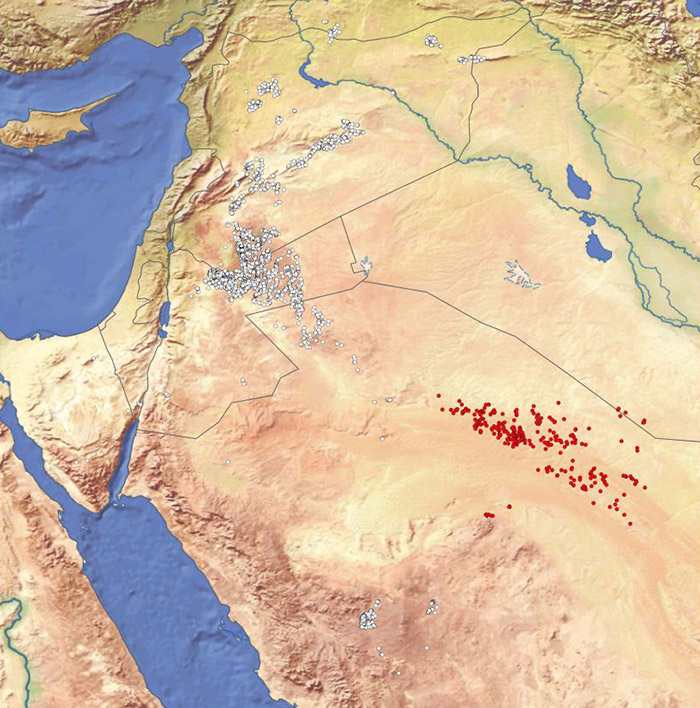
University of Oxford archaeologists headed by Michael Fradley have made new discoveries about Stone Age construction. The researchers analyzed satellite imagery of the Nefud Desert in the northern part of the Arabian Peninsula in search of buried megalithic buildings. They were on the lookout for “desert kites,” which are long stone walls in the form of a funnel that terminate in unusual enclosures.
It is often believed that these massive constructions were used as traps for hunting large game. Hunters lured animals into the enclosed head, where they could easily catch and kill their prey. A common feature of these “kites” is the presence of deep pits that acted as traps for wild animals, often located in the star-shaped or spherical end enclosure. Carbon dating suggests that the first examples of these kinds of buildings date back to the last 10,000 years or so.

Only recently have people been able to see these “desert kites,” which are often only visible from the air, in places like Jordan, the Negev Desert, Syria, and the western border of the Arabian Peninsula. Therefore, it is yet unknown whether they existed somewhere else. For this reason, Fradley and his team started their search for these kinds of buildings in the Nefud Desert, which is located in the northeastern and eastern parts of the Arabian Peninsula.
Over 350 large hunting burrows in the Nefud
As it turns out, the satellite photographs did show what the archaeologists were searching for. They found a plethora of stone circles, artificially stacked cairns, mustatil houses, rectangular constructions bounded by walls, and 354 enormous kites. Three-quarters of these hunting burrows, like those in eastern Jordan, include the typical star-shaped head enclosure. The enclosure’s original form in a given quarter is obscured by sand or the subsequent redistribution of the stones.
Sometimes the width of these structures’ main enclosures is measured in hundreds of feet. Some of these kites’ lateral funnel walls are still standing and are almost 2,5 miles (4 km kilometers) long, standing as a tribute to the extraordinary expertise with which these constructions were conceived and constructed. In order to construct such massive structures, a large number of individuals must have collaborated for a considerable length of time, similar to pyramids.
In a westward direction
Almost all of the colossal funnels of traps are oriented with their head enclosure facing west and the beginning of the funnel walls facing east, which the archaeologists believe is evidence of deliberate design. It’s one way in which these desert kites are comparable to their Jordanian and Levantine counterparts. Current theories postulate that this inclination is connected to traditional migratory patterns used by herds of ungulates in these areas.
Archaeologists believe that the east-west direction made it simpler for Stone Age hunters to hunt at dawn and sunset: the low light in the evening blinded the gazelles entering the enclosure, so they did not identify the trap. On the other hand, it’s also possible that the dawn hunt kept the wild animals from turning around and escaping.
Long-distance communication in the Stone Age
Location is also an important factor in the significance of the newly found desert kites. Discoveries like this increase the previously known range of these structures. Large hunting lodges in the Nefud Desert and on the Al Labbah Plateau provide evidence that the area was much greener and more habitable 8,000 to 10,000 years ago, despite its current arid conditions.
However, recently uncovered desert kites provide fresh insight into the cultural ties that bound the various nomad communities of that era together. The traps’ star form and orientation indicate that people from modern-day Jordan and those from the Nefud Desert, more than 250 miles (400 kilometers) distant, communicated with one another. Researchers want to determine if this link indicated the flow of people or ideas, and in what directions these interactions occurred.