By using this site, you agree to the Privacy Policy.
Accept
MalevuzMalevuz
  • HISTORY
  • SCIENCE
  • BIOGRAPHY
MalevuzMalevuz
Search
  • HISTORY
  • SCIENCE
  • BIOGRAPHY
Follow US
Malevuz > Animals > Why Do Butterfly Wings Change Color?
Animals

Why Do Butterfly Wings Change Color?

Hrothsige Frithowulf
ByHrothsige Frithowulf
History Editor
Hrothsige is a history writer at Malevus. He has a bachelor's in history from the University of Exeter. Hrothsige's areas of historical interest encompass the ancient...
- History Editor
11 December 2025
Share
4 Min Read
SHARE

Some of nature’s most eye-catching displays of color may be seen on the wings of butterflies. They have spots that are green, blue, or red, and they appear to change color as they move. Morpho rhetenor is a butterfly native to tropical regions with a brilliant blue coloration that can be seen from more than half a mile away. The work of British physicist Peter Vukusic has led to this conclusion. But where does this brilliant glow exactly come from?

Contents
  • Reminiscent of Roof Shingles
  • Butterfly Colors Change Due to Directional Reflection

Pigments are what give flowers, fur, and most other common items their colors. They seem to be different colors because they reflect just part of the visible spectrum. But butterflies and the ones that glisten in the sunlight are different from other insects. Most of the time, they lack any visible pigments. But what causes them to glow in the first place?

The famous scientist Isaac Newton began to suspect something was amiss as early as 1672. As far as he could tell, insects use small physical structures to influence light. We now know that the anatomy of a butterfly’s wing holds the key to understanding the iridescent colors it displays.

Reminiscent of Roof Shingles
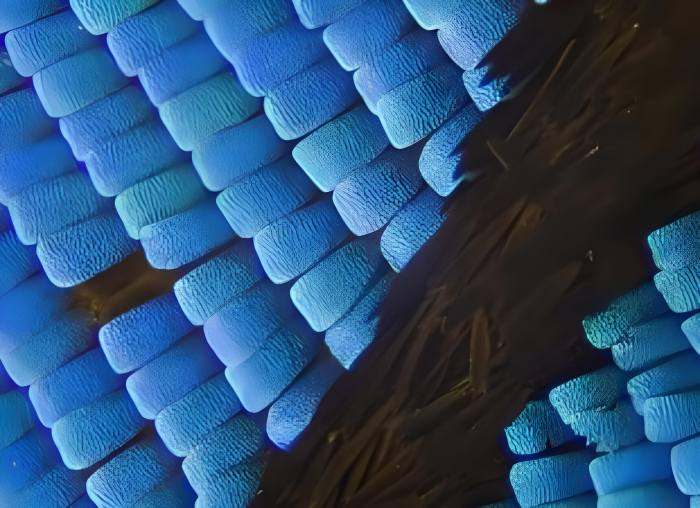
Why do butterfly wings change color?

Butterflies have thousands upon thousands of tiny, overlapping scales covering their wings. These scales are 1–3 micrometers thick and laid out in a pattern reminiscent of roof shingles. Each scale is constructed from a number of very thin layers of keratin. The protein keratin is also found in hair and fingernails. There is a minimal amount of space between each keratin layer.
More Read

Viscacha
Viscacha: They Are neither a Rabbit nor a Rat
How Many Undiscovered Species Are There?
Why Do Whales Explode?
5 Facts About Scorpions That Will Clearly Surprise You

The topmost of these transparent layers reflect some of the light that penetrates them. Keratin is penetrated by the rest. Another portion of the light is reflected from its underside as it travels through the air. Light waves that are reflected from the wing undergo a little redistribution as a result of this offset reflection. The two reflected waves no longer have parallel troughs (dips) and crests (peaks).

Scientists liken it to the action of waves on a small channel between two harbors: Sometimes a bigger wave is formed when the crests of two waves collide. And sometimes a crest and trough cancel each other out.

The nanostructure of the scales on a butterfly wing makes some colors and wavelengths of light more intense than others.

Butterfly Colors Change Due to Directional Reflection

However, the wing scales are capable of doing more, since each individual layer selectively emits the reflected light. That’s why the butterfly wing might seem brilliant blue one moment and subtly green the next time you look at it.
More Read

Fruit Fly Drosophila immigrans
Male Fruit Flies Choose Mating Over Safety, Study Shows
Plankton: The Little Life-Givers of Earth Which Are Overlooked
What Do Drone Bees Do Anyway?
5 Things to Know About the Leopard Seal

Generally speaking, pigment colors don’t shine very brilliantly due to their inefficient light reflection. By reflecting light in a specific fashion, structural colors like the ones seen on butterflies may achieve extremely high and varying intensities. Thanks to these, the male butterfly in the morphed form can still attract females from hundreds of feet away with its dazzling blue display.


Share This Article
Email Copy Link Print
ByHrothsige Frithowulf
History Editor
Hrothsige is a history writer at Malevus. He has a bachelor's in history from the University of Exeter. Hrothsige's areas of historical interest encompass the ancient world and early Europe, along with the history of modern culture.
Previous Article undersea cable How does data travel on the internet?
Next Article Why Do You Get Glassy Eyes When You Have A Fever?

Latest News

985px Landing of Lieutenant James Cook at Botany Bay 29 April 1770 painting by E Phillips Fox

Top 10: The Greatest Knights in History

Knights were the medieval equivalent of elite soldiers, and many…

List
3 November 2026
Charles Rolls driving a Peugeot 1896
List

10 of the Craziest Laws in History

For more than 4,000 years, humans have devised new laws…

18 October 2026
Ikinci Meksika Imparatorlugu
History

Why Did the Second Mexican Empire Collapse?

The Second Mexican Empire did not collapse because of a…

14 April 2026
A painting depicting Aboriginal Tasmanians attacking John Allen’s Milton Farm near Great Swanport in 1833.
History

Colonialism in Tasmania

The colonization of Tasmania was not a simple story of…

14 April 2026

You Might Also Like

44000-Year-Old Mummified Wolf
Animals

44000-Year-Old Mummified Wolf Discovered Well-Preserved

29 August 2024
Culpeo An Andean Wolf or Jackal in the Skin of a Fox
Animals

Culpeo: An Andean Wolf or Jackal in the Skin of a Fox

26 October 2026
aedes aegypti larvae mosquitoes edited
Animals

Where Do Mosquitoes Go in the Winter?

11 December 2025

Why Do Some Female Spiders Eat Their Mates?

11 December 2025
  • Privacy Policy
  • About us
  • Editorial Standards

© Malevuz. All Rights Reserved.

Welcome Back!

Sign in to your account

Username or Email Address
Password

Lost your password?