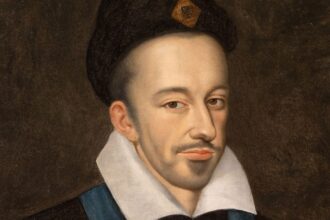
Christiaan Huygens, also known as Christianus Hugenius, was a Dutch astronomer, mathematician, and physicist who was born (April 14, 1629) and died (July 8, 1695) in The Hague. Huygens is widely regarded as one of the most accomplished scientists and mathematicians of the 17th century, despite the fact that he never used the “infinitesimal calculus” that was established during his lifetime. While studying the effects of elastic impact, he developed a concept of relativity and built the first pendulum clocks, cementing his place in history as the creator of the wave theory of light. He made significant astronomical discoveries using telescopes that he refined.
Christiaan Huygens’ origin and education
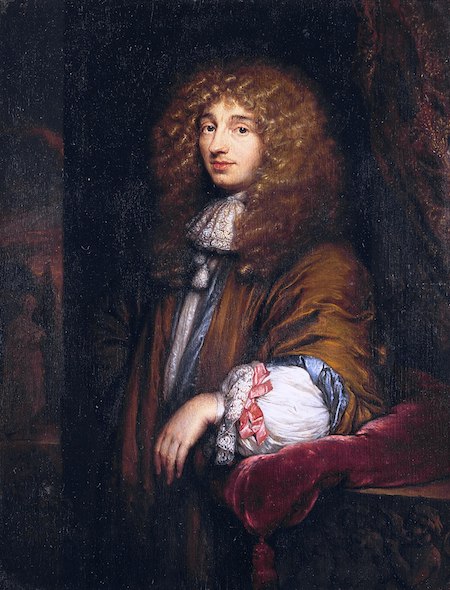
Huygens was born the son of Constantijn Huygens, who was a linguist, diplomat, composer, and the leading poet in Holland at the time. Christiaan’s early exposure to famous people like Rembrandt, Peter Paul Rubens, and René Descartes was made possible by his father’s extensive network. Throughout Christiaan’s childhood, he received instruction from his father. Later, he attended the University of Leiden to study law, but he quickly shifted his focus to the “hard sciences” instead.
In 1651, he published his first paper on the squaring of cones in which he demonstrated a flaw in a supposed proof of the squaring of the circle. In addition, he tackled the π (pi), worked on logarithms, and laid the groundwork for the infinitesimal calculus, which was later developed by Gottfried Leibniz and Isaac Newton.
One of the earliest works on probability theory, De ludo aleae (Dice Theory) was published under his name in 1657. This was preceded by correspondence between Blaise Pascal and Pierre de Fermat, the contents of which, however, Huygens claimed to know nothing about. Examining the answers to the five questions at the conclusion of his book suggests that he was conversant with Pascal’s theories but unfamiliar with Fermat’s combinatorial techniques.
Turning to the natural sciences
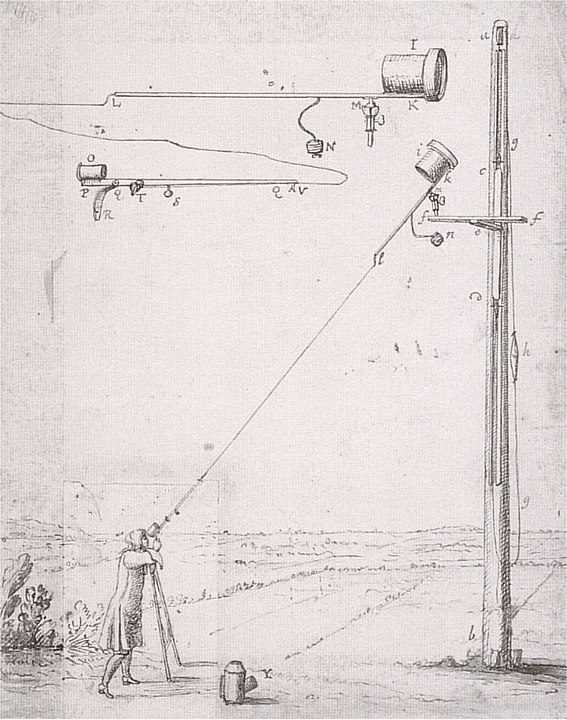
Telescopes piqued Huygens’ interest in natural science, optics, and astronomy, all cutting-edge disciplines at the time. He spoke with Antoni Van Leeuwenhoek, the preeminent microscope lens grinder and designer of his day. Huygens briefly studied microscopic items as well.
His first telescope was built with the help of his brother, Constantijn Huygens Junior. However, he soon started grinding lenses for telescopes on his own. As a result of his work on the wave theory of light, Huygens was able to grind lenses with fewer aberrations and create more precise telescopes; his findings also contributed to an improvement in picture clarity for the camera obscura and the magic lantern. Huygens’ Principle, which was named after him, was the foundation of wave optics. Huygens, like many other scientists of his day, postulated the existence of an aether that both light and gravity traveled through.
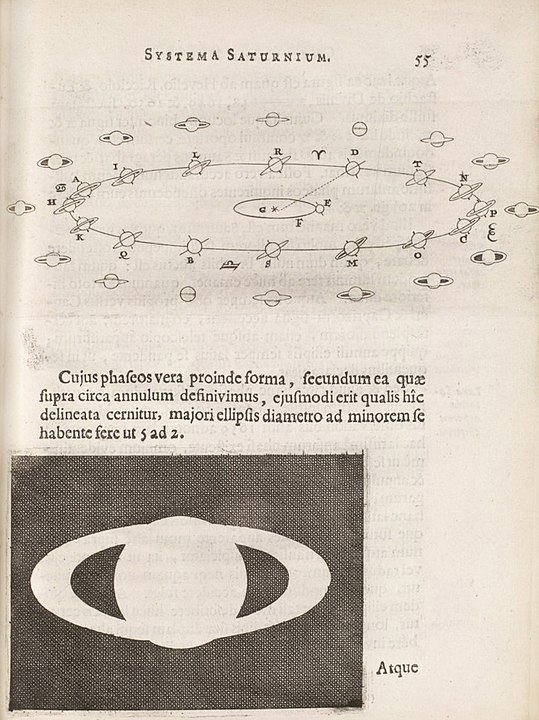
Titan, a moon of Saturn, was first spotted by Huygens in 1655 with his homemade telescope. As a result, Saturn joined Jupiter as the only other planet except Earth with a detectable moon (Galileo Galilei had already discovered the four largest moons of Jupiter in 1610). In addition, because of to the enhanced clarity of his telescope, he was able to confirm that what Galileo had mistakenly labeled Saturn’s “ears” were, in reality, the planet’s rings.
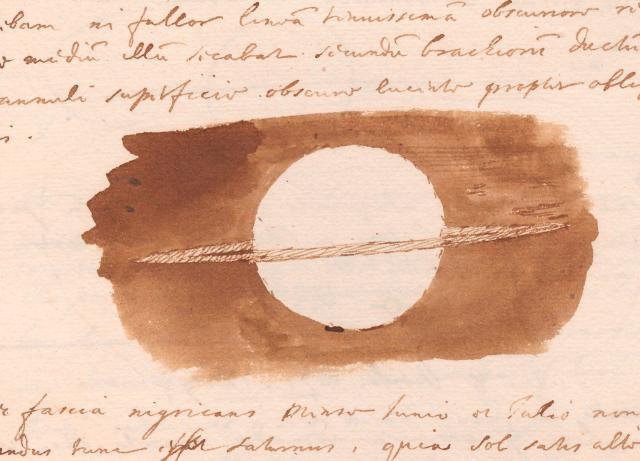
The inexplicable disappearance of the rings every 14 years, Huygens discovered, was owing to the fact that they were then viewed precisely from the side, but were too thin to be seen from Earth, proving that the rings had no connection to the planet.
Huygens also resolved the brightest portion of the Orion Nebula as an extended luminous zone, and he discovered the rotational motion of Mars and calculated the rotation period (Martian day) at roughly 24 hours. The Huygens Region is another name for this area. He proposed that Venus was shrouded in clouds and identified many nebulas and double star systems. The fifth largest impact crater on Mars also bears his name (Huygens Crater).
Mechanics, pendulum clocks and exoplanets
Huygens’s passions extended beyond astronomy to include mechanics. He worked on the law of inertia and centrifugal forces, and he developed the laws of impact. With the knowledge he gained from studying oscillations and pendulum motions, Huygens was able to create accurate pendulum clocks. Even though he never really constructed it, Galileo had indeed planned a clock like that. However, Huygens was able to submit a patent application for his timepiece. Salomon Coster’s clocks, which he commissioned, were more accurate to within 10 seconds each day; this was a level of precision that wasn’t matched for another century. Subsequently, he built pocket timepieces that used hairsprings and balancing wheels.
Using the knowledge that the evolute of a cycloid is again a cycloid, Christiaan Huygens was able to publish a very precise pendulum clock using a cycloidal pendulum in his work Horologium Oscillatorium in 1673. However, the benefit of improved precision in his design was outweighed by the drawback of bigger friction.
Even more recently, Huygens was identified as the creator of the first known clock for estimating longitude, which included numerous ground-breaking approaches. In 1690, Huygens published his last scientific work, in which he theorized that extrasolar planets and life may be commonplace in the cosmos.
The accurate derivation of the principles of elastic impact, using a principle of relativity, can also be traced back to Huygens (Galilean transformation). Published in 1669 (in Philosophical Transactions of the Royal Society), and posthumously published in 1703 (in De Motu Corporum), his findings date back to the 1650s and rectify the incorrect approach of René Descartes.
In June 1663, the Royal Society welcomed its first two scientists from outside of England: Christiaan Huygens and Samuel Sorbière (1617-1671). When the French Academy of Sciences was established in 1666, Huygens was named its first director. The great Isaac Newton proclaimed him the most graceful mathematician of his day.
Acoustic
Huygens found the correlation between the speed of sound, the length of a pipe, and its pitch. He worked hard on mid-tone tuning, and in 1691 he figured out how to split the octave into 31 equal steps to correct the Pythagorean comma error in the tonal system of music.
Retirement
Huygens’ health worsened in the 1680s, and he stopped leaving his home as regularly. Christiaan Huygens spent the final years of his life studying the field of music theory. Christiaan Huygens died at The Hague in 1695, single and childless.
Christiaan Huygens’ writings
- 1650 – De Iis Quae Liquido Supernatant (about pieces floating over liquids). (Link)
- 1651 – Theoremata de Quadratura Hyperboles, Ellipsis et Circuli. (Link)
- 1654 – De Circuli Magnitudine Inventa. (Link)
- 1654 – Illustrium Quorundam Problematum Constructiones. (Link)
- 1655 – Horologium (about the pendulum clock). (Link)
- 1656 – De Saturni Luna Observatio Nova (Discusses the recent sighting of Saturn’s moon Titan and provides details on its discovery.) (Link)
- 1656 – De Motu Corporum ex Percussione. (Link)
- 1657 – De Ratiociniis in Ludo Aleae). (Link)
- 1659 – Systema Saturnium. (Link)
- 1659 – De vi Centrifuga. (Link)
- 1673 – Horologium Oscillatorium Sive de Motu Pendulorum ad Horologia Aptato Demonstrationes Geometricae. (Link)
- 1684 – Astroscopia Compendiaria Tubi Optici Molimine Liberata. (Link)
- 1685 – Memoriën aengaende het slijpen van glasen tot verrekijckers. (Link)
- 1686 – Old Dutch: Kort onderwijs aengaende het gebruijck der horologiën tot het vinden der lenghten van Oost en West. (Link)
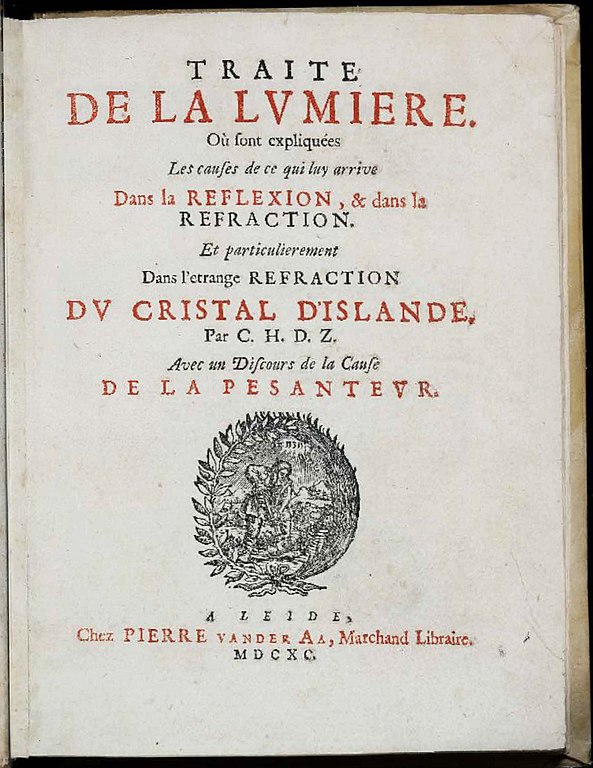
- 1690 – Traité de la Lumière.
- 1690 – Discours de la Cause de la Pesanteur. (Link)
- 1691 – Lettre Touchant le Cycle Harmonique. (Link)
- 1698 – Cosmotheoros.
- 1703 – Opuscula Posthuma with De Motu Corporum ex Percussione and
- Descriptio Automati Planetarii.
- 1724 – Novus Cyclus Harmonicus. (Link)
- 1728 – Christiani Hugenii Zuilichemii, dum viveret Zelhemii Toparchae, Opuscula Posthuma.
Bibliography
- “Huygens, Christiaan”. Oxford University Press.
- “Huygens”. Merriam-Webster Dictionary.
- Hugh Aldersey-Williams. (2020). Dutch Light: Christiaan Huygens and the Making of Science in Europe.
- Treatise on Light by Christiaan Huygens. Gutenberg.org.