In the guise of someone: A book on astronomy authored by a man named Alimberto Mauri and published in 1606 is actually the work of the well-known academic Galileo Galilei. A historian from Italy has discovered this. Not only are the substance and manner very similar to earlier works by Galileo, but the scholar also obviously took criticism of this work extremely personally since he expressly alluded to it in his notes.
As a mathematician and physicist, Galileo Galilei invented the laws of falling bodies, which were subsequently adopted and improved by Isaac Newton. He is widely regarded as a scientific pioneer and a revolutionary in astronomy. He also found proof for the heliocentric world view from his observations of Venus’s phase change and Jupiter’s moons. Despite his efforts to shield himself via self-censorship and pseudonyms, this led the polymath into a confrontation with the Church.
Unidentified astronomer’s treatise
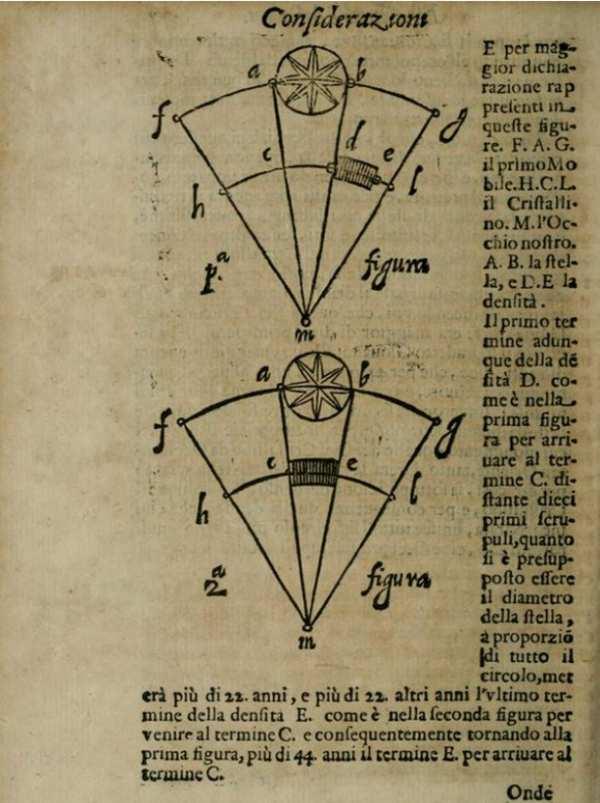
It has now been determined that Galileo Galilei was almost certainly the author of the 1606 astronomy book Considerazioni Astronomiche. This essay recounts some recent astronomical discoveries and includes speculation about the existence of mountains on the Moon and the possible physical principles that govern the apparently erratic orbits of certain heavenly entities. The author of this book is credited as Alimberto Mauri, a name widely believed to be a pseudonym.
Even when he was still alive, Galileo was thought to be the real author of this astronomical book. Alimberto Mauri, the supposed author and a colleague of Galileo’s at the University of Padua, was characterized as someone who pretended to be an astronomer but was really a professional mathematician, much like Galileo. This was seemingly supported by the discovery of a contemporaneous letter a few years ago that made reference to Galileo’s authorship; however, this letter has now been shown to be a fabrication.
Controversy about the existence of a “new star”
Historian Matteo Cosci of Venice’s Ca’ Foscari University analyzed several unpublished historical papers housed in Florence’s Central National Library in order to shed light on the subject. A supernova, visible to the naked eye, was observed in 1604, and Galileo kept meticulous records and notes of his observations and ideas on the phenomenon.
Scholars at the time had many different theories on what this “new star” may be. For at the time, conventional church doctrine was that the firmament formed a rather stable “shell” surrounding the geocentric cosmos. This was a point of contention for Galileo, notably with the Florentine philosopher Lodovico Delle Colombe. Many of Galileo’s responses and criticisms of Delle Colombe may be found in the notes he took, which have since been reviewed by Cosci.
Insinuations of treachery
The intriguing part is that Galileo responds to critiques of the Considerazioni Astronomiche in a few of these notes, identifying himself as the author. In one section, he notes “places where [Lodovico Delle Colombe] speaks of me with contempt.” Cosci discovered, however, that these quotes really correspond to sections of Delle Colombe’s book in which he attacks Alimberto Mauri, the purported author of the Considerazioni Astronomiche, rather than Galileo.
So, why did Galileo take this criticism so personally? Historian Cosci claims this proves Galileo Galilei wrote the Astronomical Treatise under the alias “Alimberto Mauri.” After a careful re-examination, Cosci notes that there are notable similarities in substance and style between Mauri’s treatise and Galileo’s publications, lending credence to this claim.
It’s “Mauri” for Galileo Galilei
A further hint is that in his replies (called “Riposte”), Lodovico Delle Colombe referred to Galileo as “Mr. Mask,” “a mask named Mauri,” and “Cecco”—the latter of which was a pseudonym, previously unmasked, that Galileo employed for several astronomical publications. A version of the “Riposte” in which a student credited these ideas to Galileo may also be found in the archives. Also, it’s odd that a secretary of the Grand Duke of Venice who was friendly with Galileo signed off on the printing release (Imprimatur) of the astronomical book.
Cosci concludes that this evidence strongly implies that Galileo Galilei was really using the alias Alimberto Mauri. The academic apparently produced the astronomical book under a pseudonym to avoid offending his supporters in the Republic of Venice. Specifically, Venice had a grudge against the Roman Curia since the Pope’s treasurer in Rome—and therefore a member of the Roman Curia—received a copy of the Considerazioni Astronomiche as a gift.
If Considerazioni Astronomiche is really Galileo’s work, it provides a richer context for understanding the famed scientist’s first investigations in the field of astronomy. In his subsequent publication, Sidereus Nuncius, Galileo revealed the specific dates, methods, and findings of his telescopic observations, as noted by Peter Barker of the University of Oklahoma. But from the vantage point of Considerazioni Astronomiche, we can see the motivation behind his findings.