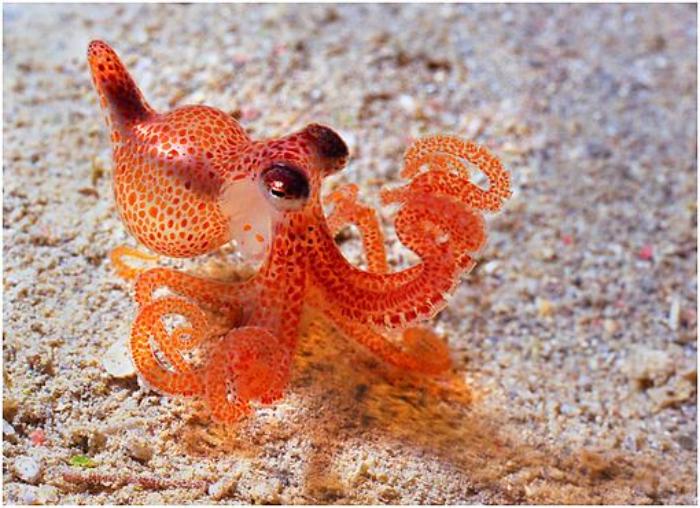
The startling similarity between us vertebrates and the invertebrate octopus is that little snippets of RNA may play a critical role in the formation of huge brains. This is due to the fact that octopuses’ nerve tissue and brains contain more active microRNAs than those of any other invertebrate. Indeed, their collection of these proteins is the third greatest in all of life. This may be the key to understanding the extraordinary intelligence shown by these cephalopods.
No other animal group has the same genetic structure as the octopus, and no other invertebrate has developed such a sophisticated neurological system or as much intellect. Sea creatures like the octopus, squid, and cuttlefish have remarkable cognitive abilities. They are numerate and handy with tools. Octopuses have more neurons and neurological connections than rats and canines, respectively.
Utilizing miRNAs as a Target
But why squid have developed such enormous, sophisticated brains, and how, is still only partly known. Researchers headed by Grygoriy Zolotarov of the Max Delbrück Center have therefore explored a particularly specific component of the cell biology of the sick: microRNA. Unlike messenger RNA, which contains genetic instructions for making proteins, these RNA fragments do not. However, they can bind to this mRNA and control how much of its information is translated into proteins.
Researchers Zolotarov and colleagues examined miRNA expression in 18 tissues from O. vulgaris, the common octopus, and O. bimaculatus, the California two-spotted octopus. What this showed was that there was something remarkable going on in the octopus tissues, where over 138 different families of microRNAs were all actively working. In addition, 90 of these microRNA families were previously unknown.

The number of microRNAs in the neural tissue of an octopus is higher than that of any other invertebrate.
MiRNA Repertoire Growth Is Exponential
After that, they compared the octopuses’ microRNA repertoire to that of the primordial, low-intelligence mollusk Nautilus and the dwarf squid Euprymna scolopes. The researchers report discovering 90 novel microRNA families, 12 of which were also present in Nautilus and the dwarf squid, and are therefore representative of the core cephalopod repertoire. 35 microRNA families were solely found in octopuses, whereas 43 were present only in octopuses and dwarf squid.
The research found that the amount of microRNAs has expanded drastically throughout the history of evolution, from primitive cephalopods like Nautilus to complex, high-functioning squid with a massive brain. This is the biggest microRNA family growth outside of vertebrates, and the third largest in the animal world overall. No other invertebrate animal has such a vast amount of microRNAs. Squid, which are classified as invertebrates like chickens, actually contain more microRNA families (138 in all) than chickens do.
Active Primarily in Brain and Nerve Tissue
This leads scientists to wonder whether the octopuses’ huge brains and extraordinary intellect have anything to do with the remarkable growth of their microRNA repertoire. To elucidate this, Zolotarov and coworkers looked at the octopuses’ microRNAs and where they are active. Of the 43 octopus-specific miRNAs examined, 34 were determined to be functional in nervous system tissues. The average expression level in neural tissues was 13-fold higher than in other types of tissue.
Accordingly, microRNAs very certainly serve an important function in the maturation of brain and neural tissue. Researchers conclude that the rapid expansion of the squid’s microRNA repertoire supports the idea that microRNAs and the specific neuronal processes they regulate are important to the formation of sophisticated animal brains.