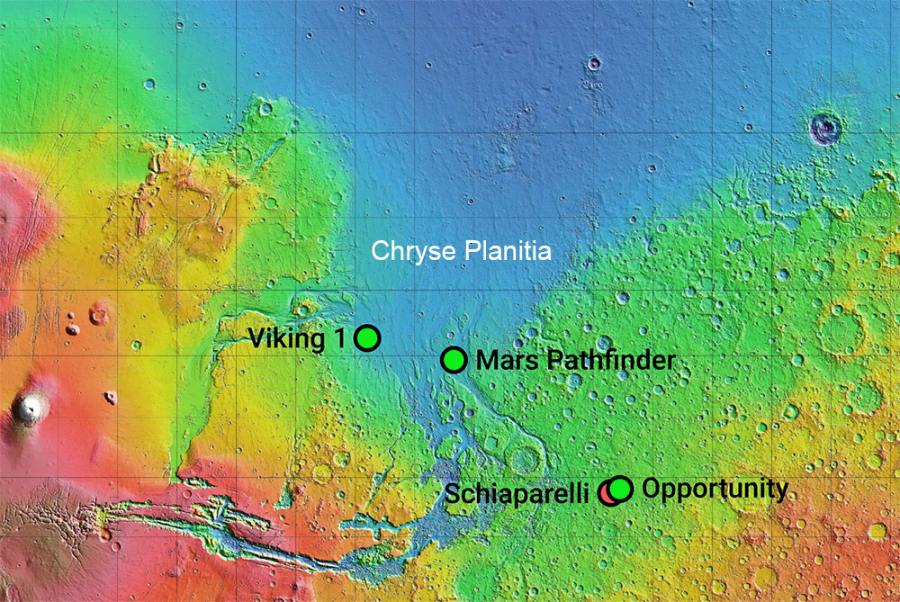
A megatsunami as high as 820 feet (250 meters) may have swamped areas of Mars about 3.4 billion years ago. Planetary scientists have decided that an asteroid impact was responsible for this disaster, since they found similarities between it and the collision that ended the Cretaceous era on Earth. The team reveals in Scientific Reports that the impact into the shallow waters of the northern ocean of Mars produced flood trails that went as far as the landing sites of NASA’s Viking and Pathfinder spacecraft.
The early Martian environment was not just far more humid and temperate than it is now. Perhaps even a shallow ocean covered its northern plains. It’s possible that this northern sea on Mars once spanned 20% of the planet’s surface but swiftly evaporated. The primitive river mouth and shoreline relics along the margin of the Chryse Planitia depression provide evidence for this.
Martian history includes two prehistoric tsunamis
But that’s not all; huge asteroid impacts may have also caused devastating tsunamis on early Mars. A few years ago, researchers uncovered the first evidence of two such megatsunamis. As a result, around 386.000 square miles (close to a million square km) of the coastal regions of Chryse Planitia and Arabia Terra were inundated by these tsunamis 3,4 billion and 3 billion years ago. Tsunamis might have traveled as far inland as 310 miles (500 km) in certain spots.
The most recent of these two Martian tsunamis may have originated in Lomonosov Crater, as was discovered in 2019. This crater, measuring about 75 miles (120 km) in diameter, seems to have been formed when an asteroid impacted shallow water, as shown by its shallow rim and erosion lines. However, Alexis Rodriguez of the Planetary Science Institute in Tucson, Arizona, and his coworkers claim that the source of the ancient megatsunami has remained unknown.
Signs of recent floods are evident
So, the planetary scientists looked at fresh data and photographs of the Chryse Planitia area acquired by a number of Mars spacecraft. High-resolution geologic maps and elevation models were used to search for landforms indicative of flooding during the period of this tsunami, as well as evidence of the direction of water flow during that time, such as streamlined eroded plateaus.
From Kasei Valles in the planet’s northwest to Ares Valles in its southeast, their mapping shows an 800-mile (1,300-km) zone where catastrophic flooding occurred on Chryse Planitia. Some debris and current tracks observed by the Viking 1 and Pathfinder spacecraft may be attributed to the fact that their landing sites are located in the foothills of these flood basins.
68-miles-wide Pohl crater
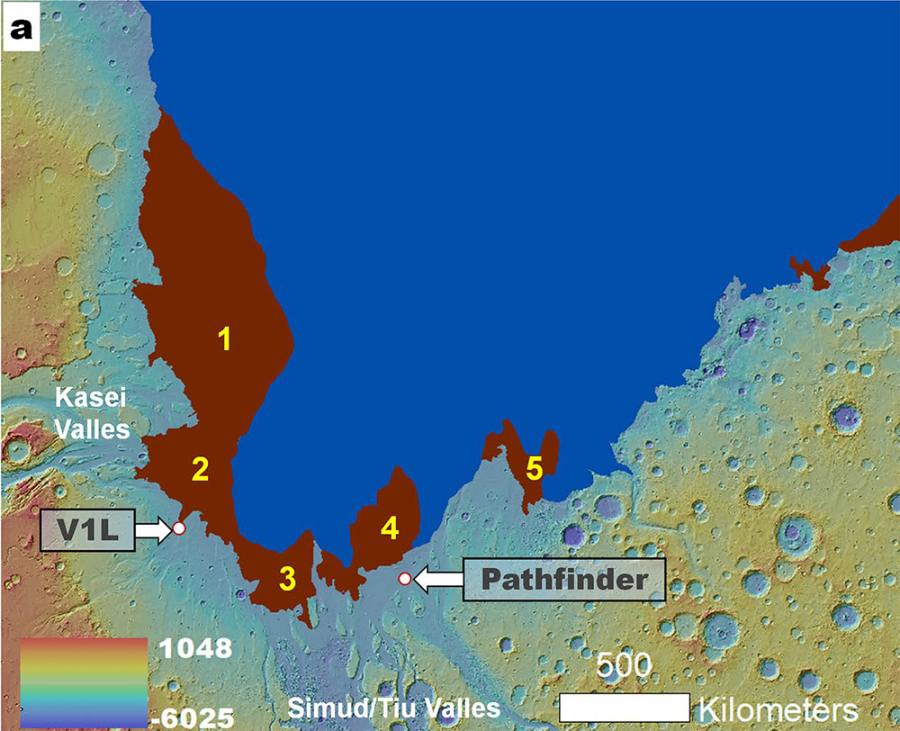
But the most important thing is that the planetary scientists were able to use the direction of the flood tracks to figure out the origin of the tidal waves, which was the impact crater. The analysis suggests that the asteroid impact that created the roughly 68-mile-wide (110-kilometer) Pohl crater in Chryse Planitia about 3.4 billion years ago was responsible for the megatsunami. The research indicates that Pohl is the only crater in the area with the appropriate regional geology to have caused the earlier megatsunami.
The researchers believe that the Pohl crater was produced by an impact in the Martian Sea due to its flat shape, position, and erosion signs in its surroundings. The triggering asteroid had to travel through the ocean around 656 feet (200 m) deep before impacting the ground. The stratigraphic context also indicates that this crater was produced by a marine impact.
Besides being partly buried by the deposits of a second megatsunami, the location of Pohl Crater, which lies on top of huge fluvial landscapes formed by ocean-generating flash floods, sets it apart from other such features. Scientists may deduce that it must have emerged sometime after the ocean but before it evaporated.
The size of the asteroid
Researchers used a computer model to see whether the megatsunami may have been triggered by an asteroid impact. The simulation revealed that a 5.5-mile-wide (9 km) asteroid would have been needed to produce the crater if the subsoil of the primordial Martian water was highly solid and thick. The force of its collision would have been equivalent to that of 13 million megatons of TNT.
However, the Pohl crater may have been formed by an asteroid little more than 1.8 miles (3 km) in diameter if the bottom of the extinct Martian sea was very soft and yielding. On impact, it would have unleashed the energy equivalent of half a million megatons of TNT. Both scenarios, though, would cause an impact large enough to set off a megatsunami. The simulation reveals that the first tidal wave height of this megatsunami was around 820 feet (250 meters) and that it was huge, very turbulent, and very powerful.
The similarities to the Chicxulub
Intriguingly, this ancient Martian impact had some parallels to the impact that decimated the dinosaurs on Earth 66 million years ago. When comparing the Chicxulub impact to the Pohl impact on Mars, the latter serves as a terrestrial counterpart. That’s because both asteroids impacted in a shallow ocean location with a water depth of around 656 feet (200 m), forming a major crater roughly 62 miles (100 km) in diameter, and generating identical megatsunamis.