Instead of using satellites, a new form of positioning system based on mobile communications might one day replace GPS, allowing for more accurate and dependable navigation in urban and interior environments. The new TNPS system can achieve positioning precision of up to 4 inches (10 cm), even across high-rise buildings, by combining local mobile communications with the fiber optic network. According to a paper in Nature, this is made feasible by using time-synchronized gigahertz transmissions.
We’ve become used to utilizing GPS systems on a regular basis, whether on our phones or in our cars. To do this, the time it takes for signals to travel from different GPS satellites to the receiver is compared. At night, however, modern satellite navigation systems have a number of drawbacks: their accuracy is limited to around 80 inches (2 m), and they typically don’t operate at all in heavily populated areas, valleys, or indoors due to the scattering or blocking of satellite signals.
As opposed to relying on satellites, a positioning system that uses mobile radio and optical fiber would not be affected by disruptions in the signal.
Therefore, scientists have been toiling away at locating systems that don’t rely on satellites and can be used everywhere, even indoors and in subterranean parking garages. Some use specialized radio sticks, while others depend on mobile communications or a wireless local area network (WLAN).
Combining wireless and optical networks
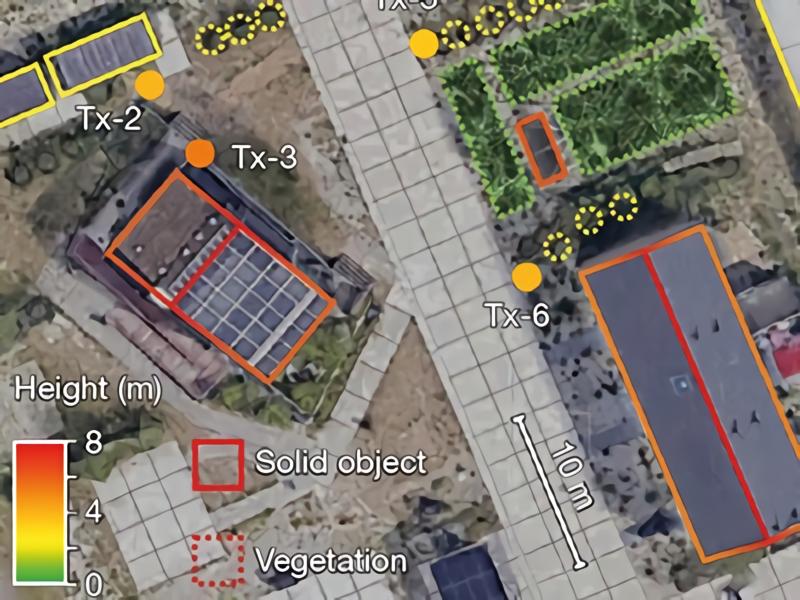
There is now a way to navigate without using satellites. The Terrestrial Networked Positioning System (TNPS), developed by a team led by the Free (Vrije) University of Amsterdam’s Jeroen Koelemeij, combines the pervasiveness of cellular signals with a runtime-based positioning approach similar to that of the GPS system (but without satellites). Mobile radio transmissions have hitherto been unable to reach the same level of precision as fixed-line communications because they lack the atomic clocks used by the latter to synchronize their signals.

The approach is to use the existing fiber-optic network in many cities and areas to reinforce the mobile signals. Using this, the mobile communications antennas may be kept in perfect temporal sync with the new positioning system. This is made possible with the help of a supplementary device that syncs its internal clock with a centralized reference clock through the fiber optic connections. Delays in the fiber optic network are continuously detected using specialized software and measurement signals, and then accounted for in the synchronization.
The end result is very precise, nanosecond-level synchronization of mobile radio signals. Koelemeij and his group report a temporal uncertainty of around 0.2 nanoseconds at an on-campus test facility. Such accuracy is essential for accurate positioning, since a timing mistake of only one nanosecond translates to a movement of 12 inches (30 cm).
Intense bandwidth and multiplexing
The mobile radio signals themselves are the second part of the new location system. In contrast to the megahertz band used by GPS satellites, the gigahertz range is where 4G and 5G networks transmit and receive their signals. Therefore, the TNPS employs a cellular carrier wave of 3.6 gigahertz and employs a method known as OFDM multiplexing to disperse the real signal among several frequency bands in a range 160 megahertz wide. Using a sequence of narrowband signals spread over a wide virtual bandwidth.
That serves two purposes at once. Receiver stations can now identify and account for interference from buildings and other barriers because of the increased bandwidth compared to GPS signals. The researchers can separate the various signal reflections, allowing for more accurate placement. The crew was able to pinpoint the vehicle’s location inside an urban setting to within 4 inches (10 cm) during a practical test.
Urban areas should have a backup to GPS
Researchers claim this technique may greatly enhance positioning, particularly in highly crowded metropolitan regions, while building on top of preexisting infrastructure. According to Koelemeij, they have implemented a system using TNPS that is as accessible as cellular and WiFi networks but provides precise location and time synchronization in the same way as GPS does. Thus, the system might function as a backup and supplement to existing satellite navigation systems.
According to the study, the TNPS technology may be easily incorporated into existing cellular infrastructure. This is due to the fact that the transmissions are sent in underutilized frequency bands of the mobile radio spectrum. In addition, the time synchronization protocols utilized are widely adopted, easily accessible, and work with the wavelengths of conventional fiber-optic transmissions. According to Koelemeij, such signals are already a part of trans-regional optical networks capable of transmitting massive volumes of data in tandem.
The findings hint at a future in which telecommunications networks would provide not just data transfers, but also precise and reliable time and location determination that is not reliant on the Global Positioning System (GPS).