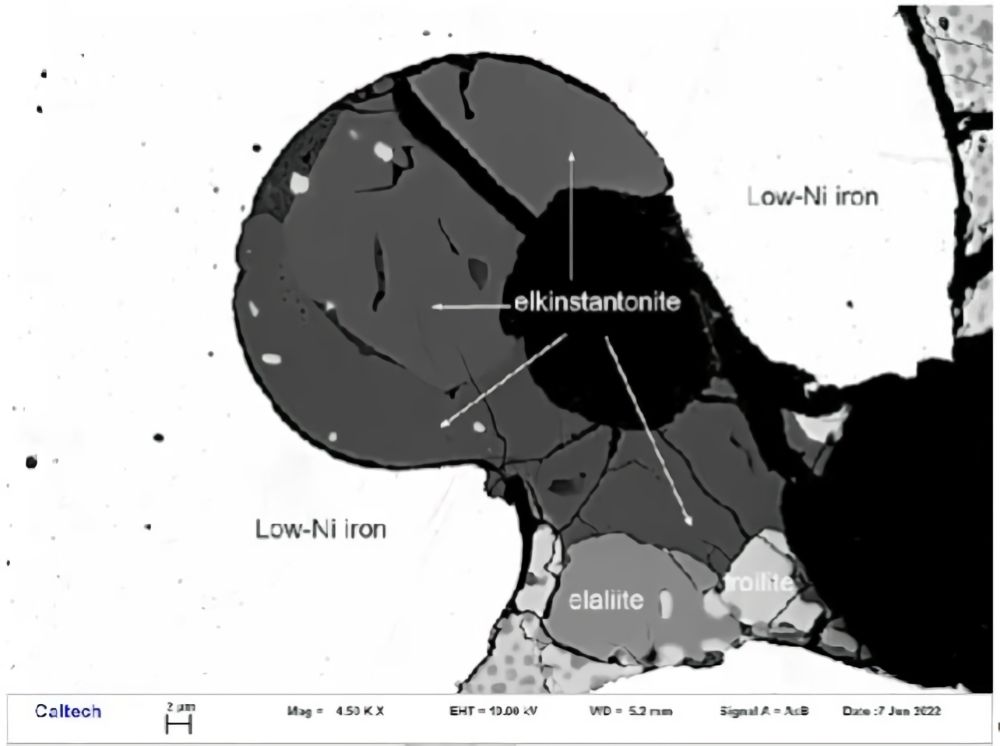
The scientists have identified two previously unknown minerals in a massive iron meteorite, with preliminary evidence pointing to a third. Iron, phosphorus, and oxygen molecules were extracted from the 15-ton El Ali meteorite that was discovered in Somalia. Elaliite and elkinstantonite are the new iron minerals discovered, and they seem like substances only made in the lab.
One of the biggest meteorites ever discovered on Earth contains extraterrestrial iron compounds.
In comparison to other planets in the solar system, Earth likely has the greatest variety of mineral types. There are around 6,000 named kinds, and it’s possible that another 1,500 are waiting to be discovered. Geological processes, including volcanism and plate tectonics, as well as the interaction of water and solids, all played a role in the formation of the crystalline substances. The production of many minerals, however, has also entailed biological processes and human intervention.
Meteorite minerals are a subset of this larger class; they are unique crystal formations created solely inside meteorites and asteroids. Extreme pressure and heat from the collision were all that was needed to generate many of them, including several quasicrystals. Some others have been here since the solar system’s primordial cloud.
In a Somali desert
Now, a team of scientists led by Chris Herd of Canada’s University of Alberta has found two previously unknown meteorite minerals. As part of their research, they had analyzed a chunk of an iron meteorite called El-Ali. In the Somali desert, camel herders discovered this rock over a century ago. It weighed 15 tons, measured 2 meters by 1 meter. The iron-containing rock was put to use for a variety of purposes, including knife sharpening.

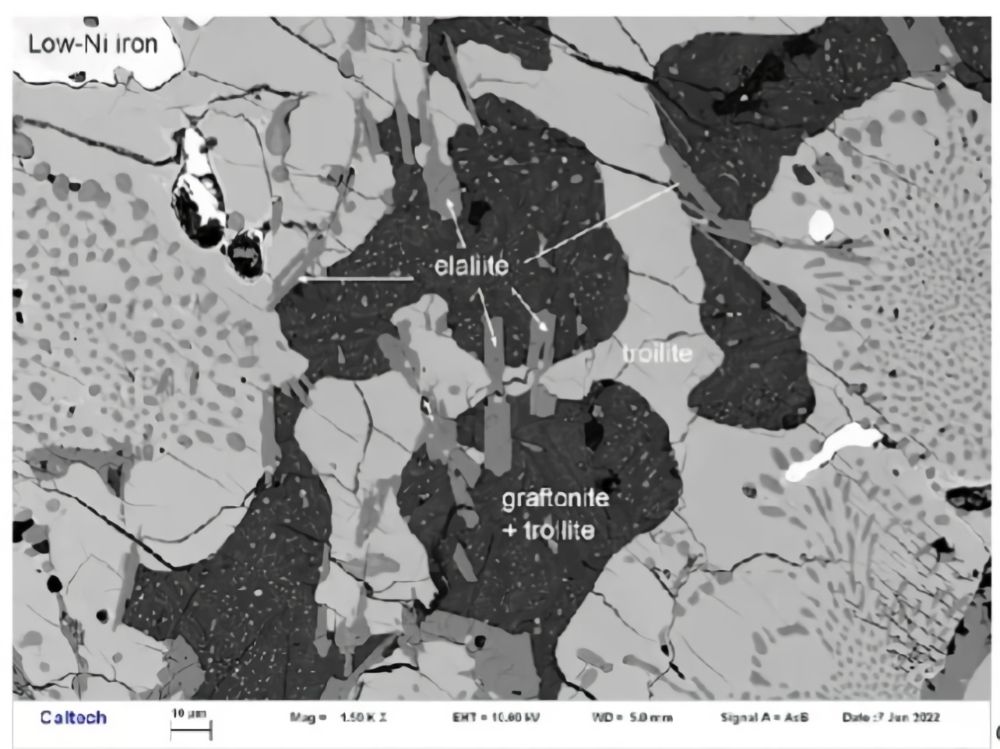
The El Ali meteorite, along with many other iron meteorites, is classified as an IAB meteorite. pattern (or Thomson structures) is highly developed in these nickel-iron meteorites, which also have silicate and graphite globule inclusions. Therefore, geologists believe that iron meteorites come from the same asteroids as rock meteorites of the carbonaceous chrondrite type, and that the asteroids’ outer shells are composed of metallic material.
Discovery of two new iron minerals
After conducting a thorough mineralogical investigation of their El Ali meteorite sample, Herd and his team discovered two peculiar iron compounds. It helped that their structure was similar to that of two substances that could only be synthesized in a lab. In most cases, further investigation and testing are required before a mineral’s discovery can be officially confirmed. However, in this situation, it became immediately apparent that these were the first natural occurrences of these hitherto unrecognized chemicals.
Both of these new meteorite minerals are iron, phosphorus, and oxygen complexes. The first of them has the chemical formula Fe9PO12 and was dubbed Elaliite after the corresponding meteorite. The second mineral is called Elkinstantonite, and it was named for the planetary scientist Lindy Elkins-Tanton. Its chemical formula is Fe4(PO4)2O. To learn more about the El Ali meteorite’s asteroid origin, Herd and his team seek to analyze its materials and the circumstances under which they formed.
According to Herd, his specialty is retracing the geologic processes and geologic histories of the asteroids from whence these fragments originated. When he started this project, he had no idea that he would end up discovering and describing whole new minerals.
A third mineral as well
In addition to these two exciting new findings, the team has also found indications of a third, similarly unusual mineral type in its meteorite samples. They are also looking forward to collecting further El Ali meteorite samples. Recently, the piece was sent off to China for a sale.