Several distinct types of frozen water may be found in nature. Snowflakes, various frost and hoarfrost events, and hair ice all contribute to this abundance of formations. Rarely does frozen water take on such a delicate pattern. Hair ice, on the other hand, is unique in that it forms only on the decaying wood of certain deciduous trees (particularly beech and oak) in uncut, natural forest settings. Second, it can only happen if the weather has been damp for some time and the temperature is just below freezing.
Fringing decaying wood
Fringing decaying wood, the hair ice forms white, cotton-like formations that shine brightly in the sunlight. After a closer inspection, it becomes clear that the so-called absorbent cotton is really made up of several very thin (about 0.02 mm or 0.0008″) yet long (up to 7.9 inches or 20 cm) ice threads. It’s common for groups of the silky, shimmering strands to be present. Dense and vertical, they emerge from the wood. But the separate ice threads do not join together.
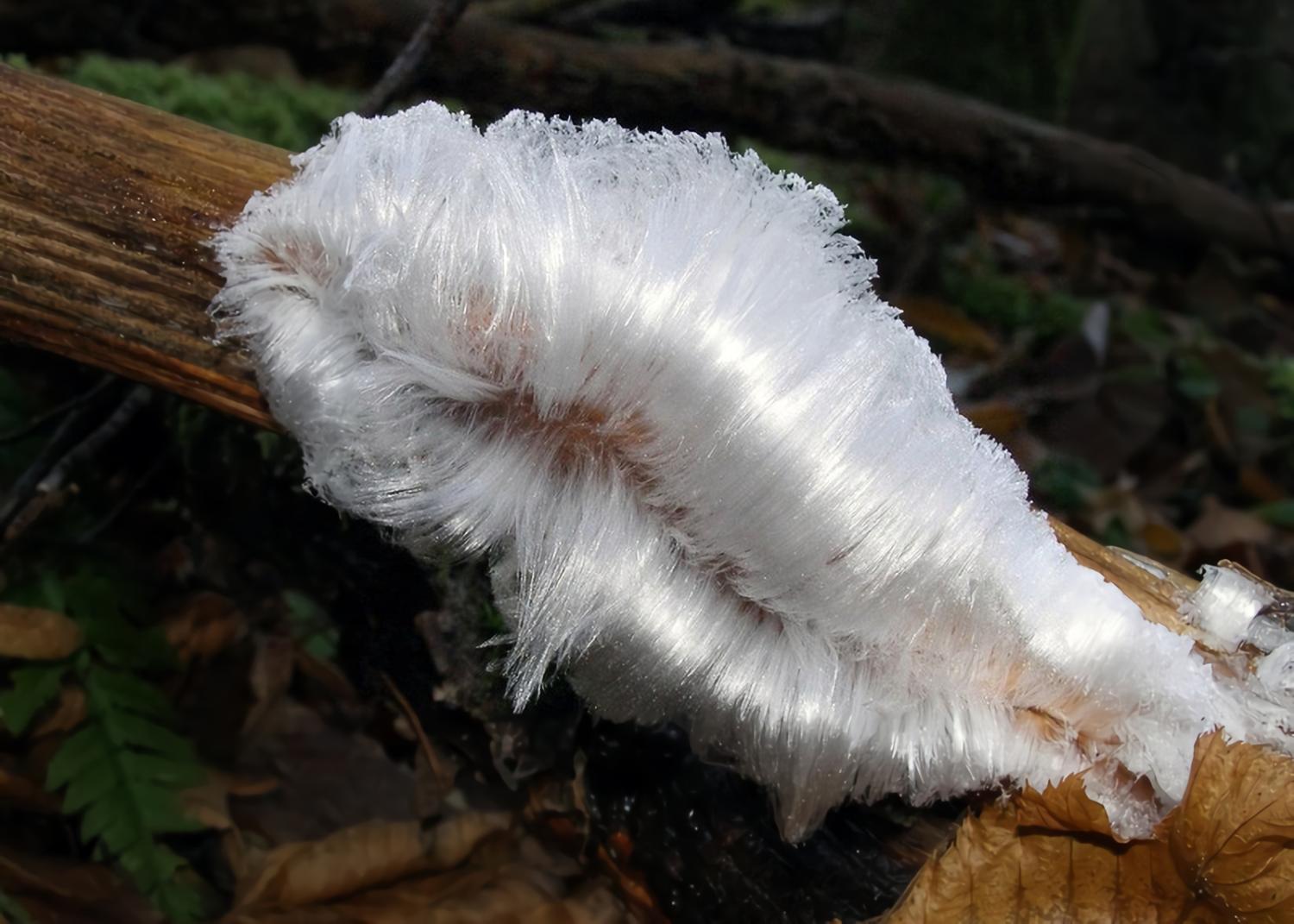
The latter form is particularly remarkable. This is because, particularly at temperatures close to the melting point, ice crystals that are only partially separated prefer to freeze together. Bringing two surfaces together has the effect of lowering their surface energies. Although the phenomenon has been known for a long time and has been researched more thoroughly scientifically, particularly in recent decades, the reason why hair ice is different remains a mystery. Organic compounds likely play a part in this by providing a “shield.”
When you examine the wood closely, you’ll see that each hair ice emerges from its own little hole. It seems like a liquid is pumped through nozzles and then quickly hardens when exposed to air, much like how spaghetti is made. While not fully plausible, this theory is supported by studies suggesting that the holes represent the egress points for so-called wood jets.

The microscopic passages
These hair ice are the microscopic passages that carry water and nutrients from the live tree’s core to its bark, and they flow radially across the conductive tissue. The ice hairs as a whole are the same diameter as the wood rays they emerge from. Furthermore, the ice always seems to grow from the released, barkless pieces of dead wood. It may also emerge from crevices between peeling sections of bark.
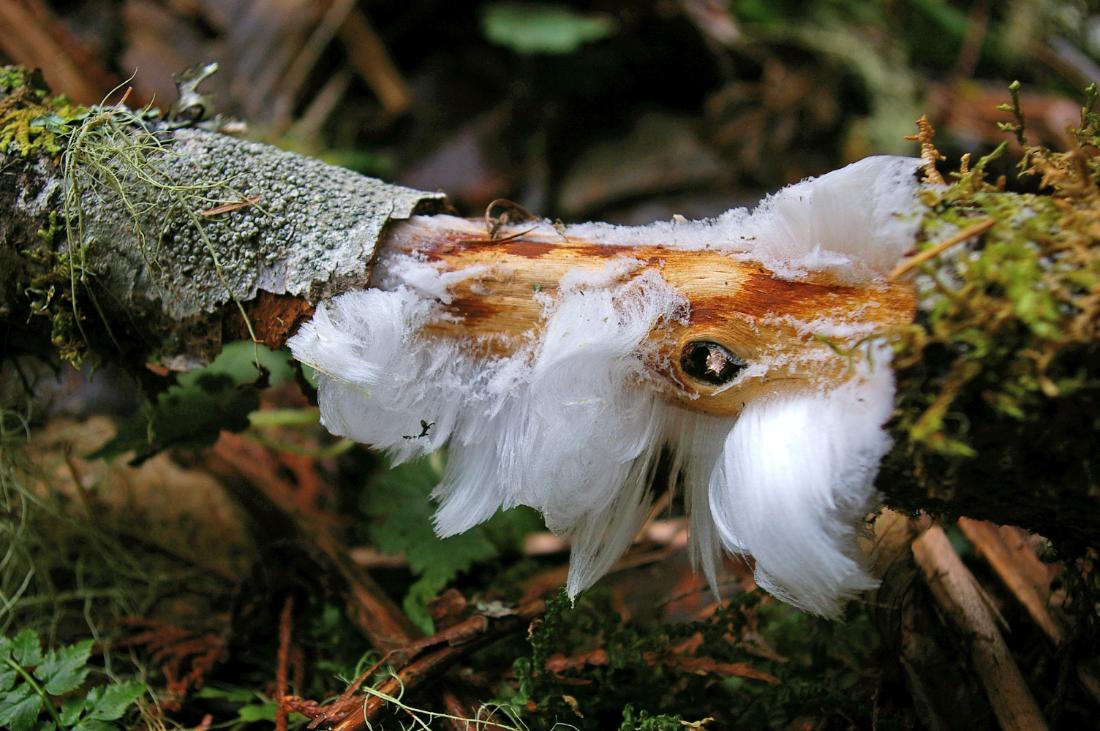
How frozen wood becomes alive again has remained a mystery for a long time. Even in 1918, before his renowned continental drift idea was published, Alfred Wegener (1880–1930) was making significant discoveries. Even he mistook the hair ice for a kind of fungus that thrives on decaying wood. Once he realized it was ice, he proposed that tree fungus really had a significant role in creating this “hair ice.”
The link between hair ice and fungus has recently been proven through scientific studies. In reality, the effect does not occur if the pieces of wood that have been liberated from the ice are handled with heat, alcohol, or fungicides. These bits of wood are capable to re-clothing themselves in the crystalline wool given the right weather circumstances. Moreover, melting hair ice is somewhat brownish in color, which is indicative of organic remnants. The pink jelly fungus (Exidiopsis effusa), common to deciduous trees, had infested all the hairy branches.
Nonetheless, what function does the fungus serve in the process of hair ice being formed? However, resublimation (freezing without first being liquid) of water vapor or the crystallization of supercooled water droplets are also responsible for other winter occurrences, such as the needle-like ice crystals on plants and other objects. Nonetheless, the water molecules in the vapor or liquid form an exterior bond with the nuclei or preexisting crystals.

The ice hairs, on the other hand, emerge through the decaying wood much as real hair does from a human scalp. Therefore, all of the action is happening on the inside. The fungal metabolism is very important in this regard.
The point of separating each hair
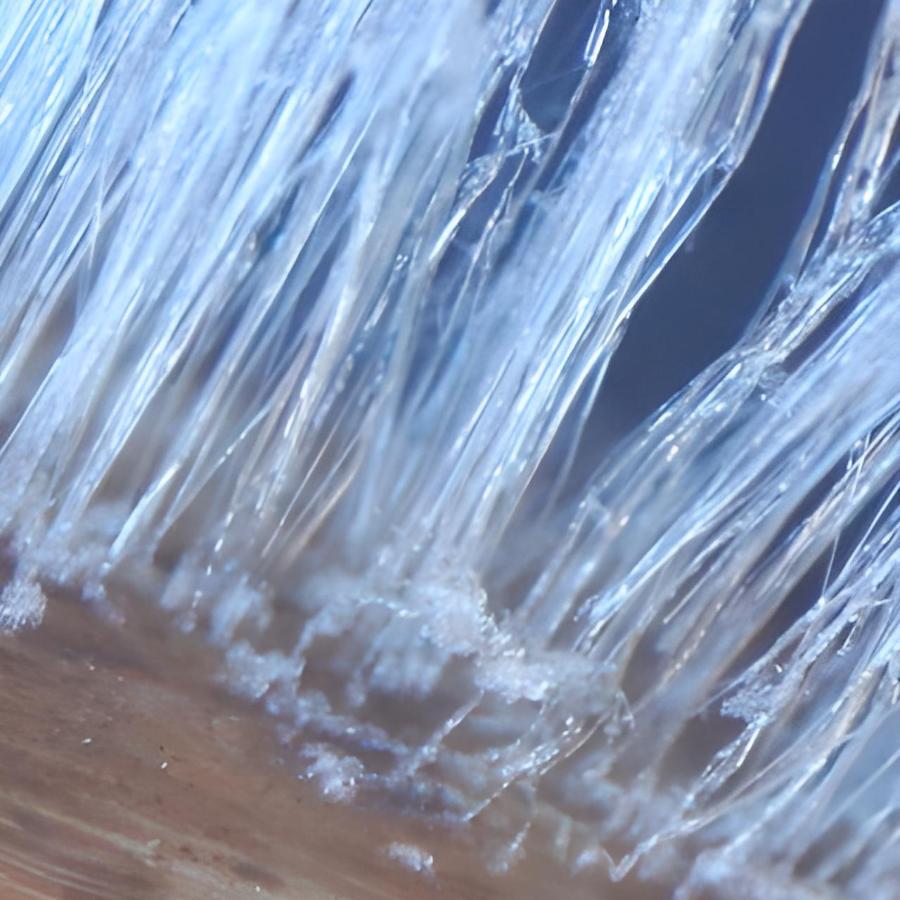
This fungus thrives on the wood rays’ natural organic matter. Water and carbon dioxide gas are both expelled throughout the process. This drives moisture out of the wood via the ray channels. As the fungus emerges into the chilly air, it freezes into thin threads on the molecular remains of its metabolic activities, which serve as crystallization nuclei.
Additionally, a kind of suction action helps ensure that the ejected stream does not diverge at this point. Water is attracted to the ice’s interface, where it neutralizes the interfacial energy by balancing the local charge discrepancies between the wood and crystal surfaces. Because the heat produced by the fungus’s metabolism prevents the branch’s temperature from dropping below freezing, the occurrence of hair ice can only take place when there is a light frost. The hair ice disappears when the temperature drops too far below freezing because the moisture in the wood freezes.
In crests and whirls, the ice threads slant to one side or the other like a person’s primary hair. The fundamental reason for this is that every hair ice grows at a little different pace. Due to imperfections at the ray mouth margins, the growth of hair ice varies. This bizarre activity, which is unprecedented among ice phenomena, gives a sense of life to the observer.