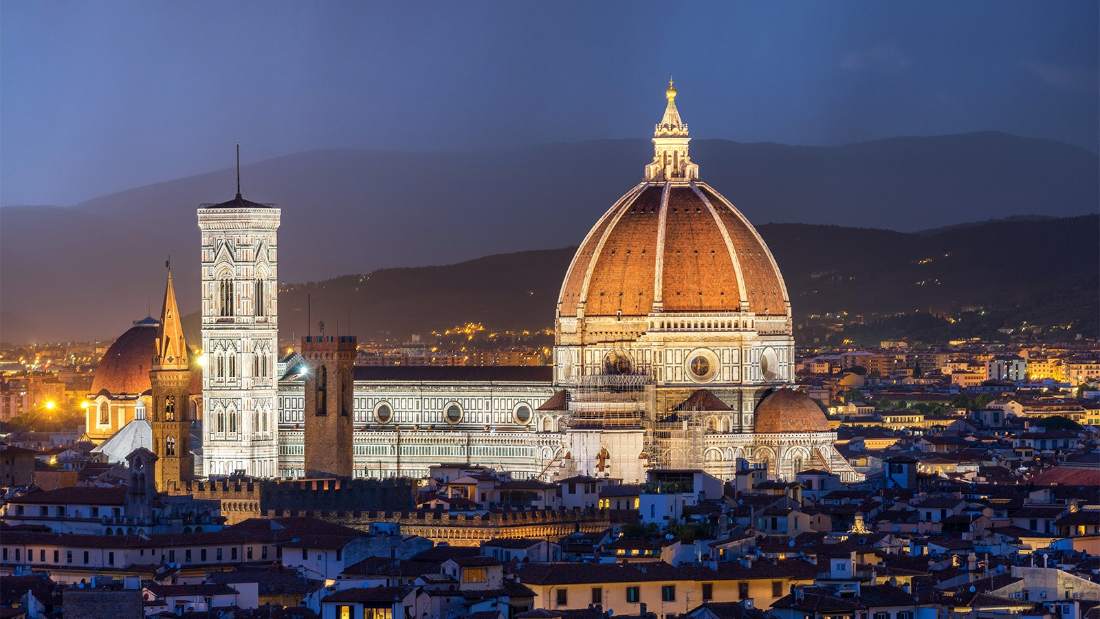
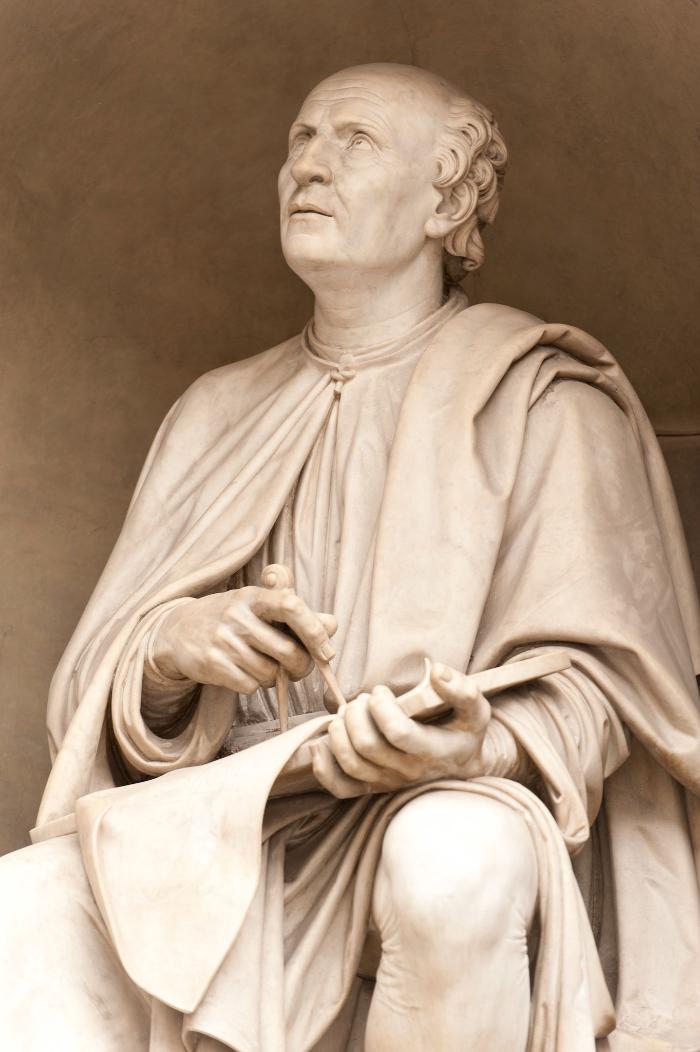
Even though Brunelleschi lacked architectural training, he was awarded the commission to construct Florence’s famous dome. He did that against a familiar foe’s plotting. The dome of Florence Cathedral, known as the Brunelleschi Dome (also known as Cúpula de Santa María de las Flores), is perhaps the most recognizable symbol of Florence, just as every city has its own unique monument. The uniqueness of this building lies in the fact that Filippo Brunelleschi (1377–1466), a goldsmith, rather than an architect, designed and oversaw its construction.
More than 500 years after it was built, Brunelleschi Dome is still the biggest brick dome that has ever been built.
A massive artwork known as a fresco is painted on the interior of Brunelleschi’s Dome. The painting on the dome was created by Giorgio Vasari and his pupil, Frederico Zuccari, about 1579. The Last Judgment is shown in the fresco. The pictures of heaven are painted on one side of the dome, while the representations of hell, including a demon, are painted on the other.
Origin of the cathedral
However, the cathedral’s origins may be traced back decades before Brunelleschi was even born. The Florentine Republic had its capital in Florence in the 13th century. Not unlike the other republics in northern and central Italy, it was eager to impress its peers with displays of pomp and circumstance.
Most importantly, Florence wanted to show rivals like Venice and Pisa that it could keep up with their own impressive developments. This led to the 1296 decision to construct a cathedral. Arnolfo di Cambio was commissioned as the architect, and construction began with the laying of a foundation stone at the site of the bishop’s church of Santa Reparata. There, he would join the ranks of other great architects.

The cathedral was not complete until the early 15th century because of disruptions caused by conflicts with neighboring republics and the plague, which killed as much as 20% of the population in 1347. Santa Maria del Fiore was chosen as the original name for this beautiful Florence Cathedral.
The dome, however, was still absent. A gaping 147-foot-wide (45-meter) crater stood above the church until 1418. There was no blueprint for how such a large dome would be built.
There is no blueprint for the cathedral dome
The traditional way of building would have needed too much wood to support the arches using a wooden scaffold. The manner of construction also necessitated that the scaffolding be left up for a minimum of 16 months. But after so much time, the wood is likely to be rotten. In addition, not even the building itself seemed to be a sufficient safety precaution. The weight of such a dome would have been too great for the walls to bear. The whole structure may have been toppled by the dome.
An alternative strategy was required. The Opera, the institution responsible for building the cathedral, declared a contest. They aimed to find an approachable design for the dome’s construction. The prize money was a hefty 200 florins (30,000 to 200,000 USD) as well.
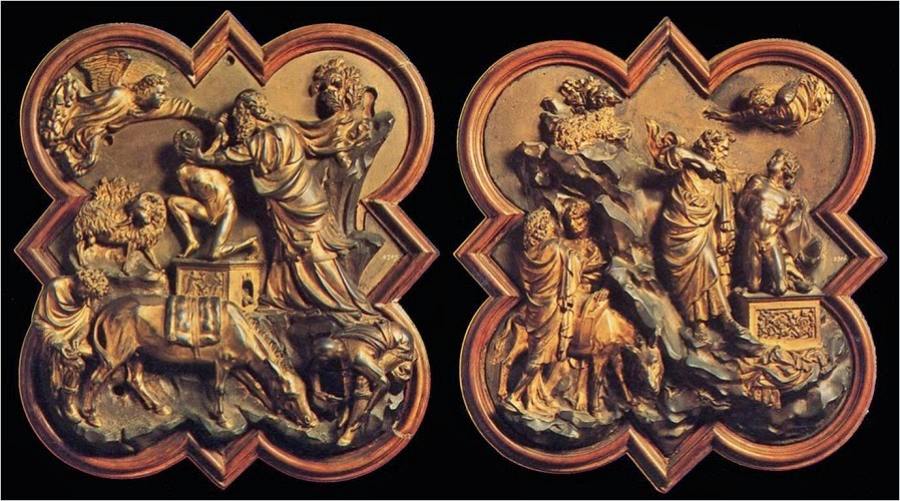
Time for Filippo Brunelleschi had come. He was a professional goldsmith, therefore he was no stranger to contests. Earlier, in 1401, Brunelleschi had competed against goldsmith Lorenzo Ghiberti (1378–1455) and lost to him. This was 17 years ago. For that time being, the doors of the Baptistery were at issue, which was their profession of interest. However, this time, a really groundbreaking feat of architecture was required.
Some of the mysteries of its construction, which Brunelleschi pioneered, remain a mystery even now despite his leaving neither blueprints or drawings behind.
For the preceding decade, Brunelleschi had been traveling extensively, spending most of his time in Rome. There, he examined old structures, or what remained of them, in the spirit of the emerging Renaissance.
There was no need for a timber structure for constructing the dome
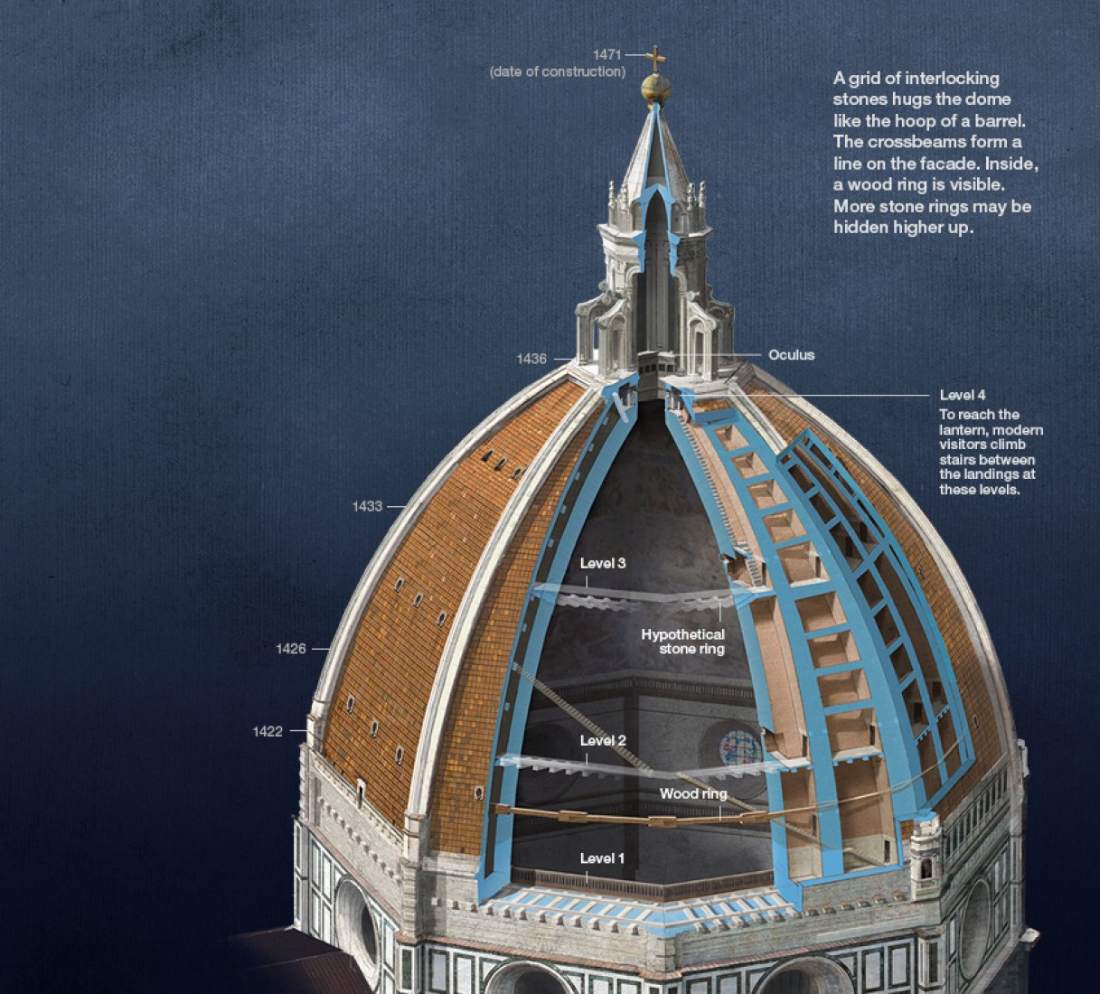
It was time for Brunelleschi to put in his bid, and he did so with Tuscany’s top architects. Specifically, he was interested in constructing a “double shell,” or two separate domes. Anchors and chains of iron and wood, like those used to hold a barrel, were planned to be used to keep the walls in place and prevent them from collapsing. Most importantly, his design wouldn’t require the use of a wooden scaffold, which was how most builders traditionally supported a dome during construction.
Two shells were created by Brunelleschi for the internal framework. A lighter inner shell and a heavier outer shell built of wind-resistant materials. Brunelleschi avoided the weight issue during construction by building two domes, allowing workmen to perch atop the inner dome while constructing the outer dome.
However, Brunelleschi’s involvement in the competition raised eyebrows due to his unusually low profile about the specifics. Brunelleschi’s paranoia about intellectual property theft was not wholly unfounded. The Opera eventually settled on a middle ground, adopting most of Brunelleschi’s design but assigning him a second construction manager, who was Brunelleschi’s opponent from 1401, Lorenzo Ghiberti.
It was estimated that it would take 16 years to finish building the dome. A considerable amount of time, during which Ghiberti made many attempts to replace Brunelleschi. One possible explanation is that he saw that Brunelleschi was the more talented and creative master builder. As an instance, he built a herd of oxen with a “gearbox” that allowed them to go backwards. Because of the height of the dome, Brunelleschi knew that the standard horse-drawn vehicles of the time—a form of impeller with gears—were not enough for lowering loads. But the gears on Brunelleschi’s ox team allowed this to be done without reharnessing the animals.
The dome’s construction also ended up being an architectural wonder. Using the so-called opus spicatum technique, the bricks for the inner dome were arranged in a herringbone pattern. Having done so, the dome’s stability was greatly improved, and collapse was avoided.
Brunelleschi had no professional training in architecture. Experts are still unable to completely comprehend his ingenious construction techniques for the dome.
The challenger to Brunelleschi’s dominance was eliminated
Reportedly, Brunelleschi used a ploy to get rid of Ghiberti and his disruptive influence. One day he claimed to be sick so he could force Ghiberti to bring in the crucial wooden beams, knowing full well that his opponent was unable to do so. Suddenly feeling better, Brunelleschi showed up at the building site to publicly criticize Ghiberti’s work, leading to the architect’s dismissal. Brunelleschi was finally able to build the dome without interference. The cathedral was dedicated on March 25, 1436, exactly 140 years after the first stone was put.
The lantern structure that was to make the city’s highest building even taller (374 feet or 114 meters) was put off for another decade. However, on April 15, 1446, not long after the building project had begun, Brunelleschi passed away. He was so well-respected at the time that he was laid to rest in the cathedral’s crypt. This distinction was reserved for the city’s most notable citizens, and in this instance, it went to a jeweler and a self-taught architect.
Brunelleschi became well-known because of the dome he designed. Most importantly, modern scholars recognize him as a pioneering Renaissance architect, despite the dome technically not being a Renaissance-style building. In contrast to the Roman Pantheon’s dome, which Brunelleschi may have used as inspiration, Santa Maria del Fiore’s dome is made up of four arches and separate components.
Brunelleschi’s whimsical interweaving of multiple disciplines and utilization of historical structures as inspiration, however, have led many to label him the archetypal Renaissance man. The next two centuries of history were supposed to be molded by the ideas of the Renaissance, not only in the Florence area, but all across the heart of Europe.