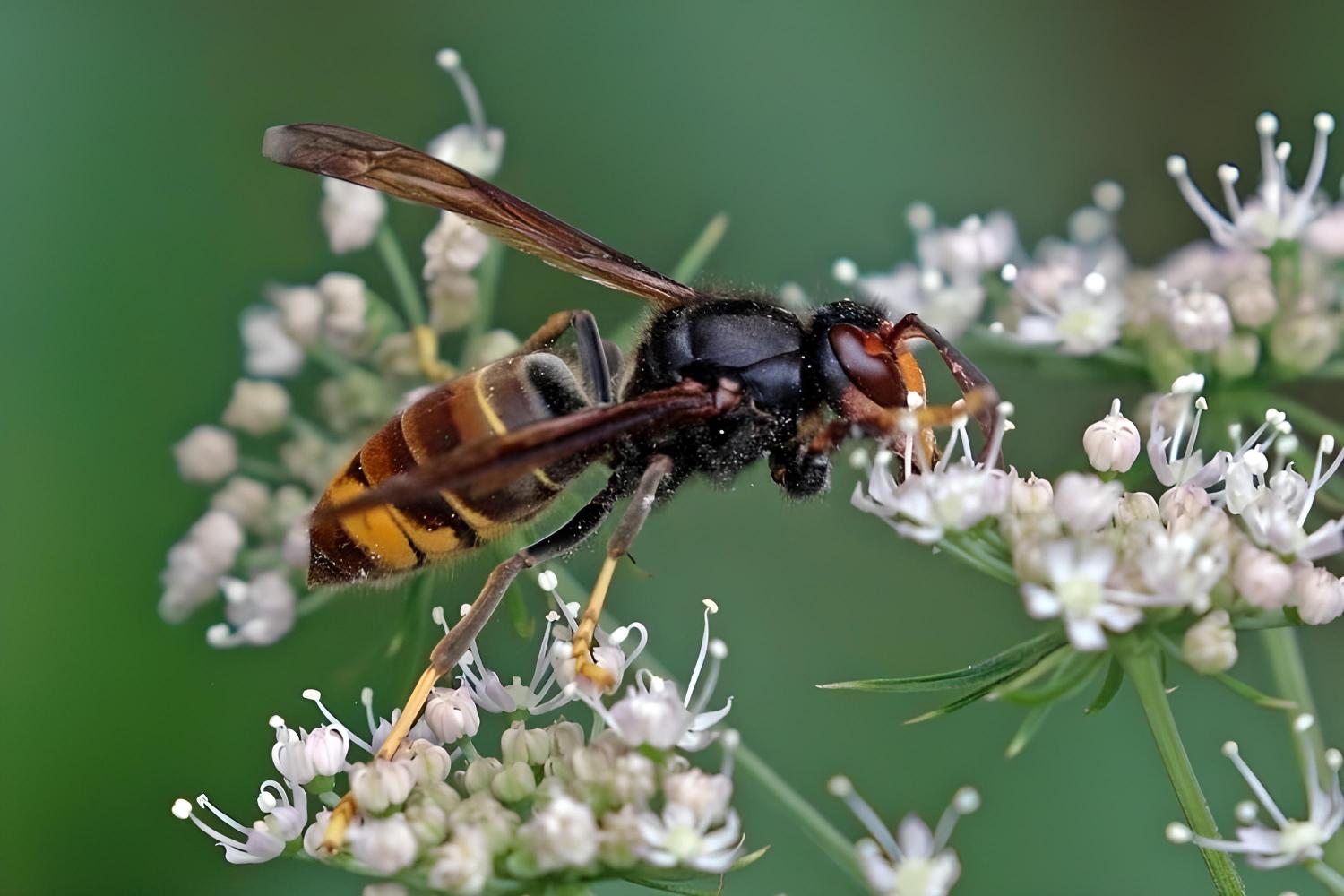
The invading Asian hornet is rapidly colonizing most of Europe. Now, thanks to genetic study, we know for sure how this insect got to North America. The results suggest that in 2004, one fertilized queen hornet was accidentally brought into France. These findings may be useful in putting an end to these creatures.
It is thought that the Asian hornet (Vespa velutina) first arrived in Europe in 2004 from China. The invasive species has successfully established itself on the mainland with several million individuals. However, natural insects like honeybees, hoverflies, and wasps are in danger from the predatory hornets, which may grow to a length of around 1.6 inches (4 cm). They are a major danger to beekeeping, biodiversity, and plant pollination.
A single fertilized female might potentially lead to an influx of millions of unwanted invaders.
DNA Fingerprinting
The first Asian hornet landed in Ireland in April of 2021. Dublin residents discovered the creature “alive but dying” in a home. However, where did it originate? Had it arrived on the Emerald Isle as a descendent of European settlers who had made the journey from the continent? Alternatively, was it the first of another invading wave coming all the way from Southeast Asia?
Researchers led by Eileen Dillane of Ireland’s University College Cork examined mitochondrial DNA from the discovered hornet and compared it to samples from other countries. These countries included Portugal, Spain, France, and Germany. Three genes were the main focus of the study.

Previous study using examinations of a single gene had showed that all Asian hornets in Europe seemed to have the same genetic background. The team took it a step further and investigated two other genes, both of which are better at picking up subtle differences within the invading population.
A Common Ancestor
The mitochondrial DNA of the Irish sample matched that of the other European samples. Therefore, Europe was the Asian hornet’s point of origin rather than Southeast Asia. Based on the striking genetic similarity, researchers concluded that Asian hornets in Europe have a common ancestor and descend from a small group of individuals.
Based on their findings, it is likely that all Vespa velutina in Europe are descendants of a single mated queen that was brought over from China some 15–20 years ago. This demonstrates that a little introduction rate, or even a single newcomer, may set off a devastating invasion.
New War Tactics
Implications for hornet management arise from this newfound understanding of the insects’ ancestry. The animals may recover quite fast even if all invasive hornets in a region were eliminated, for example, by destroying their nests, according to the study’s authors. Nonetheless, the high degree of genetic similarity amongst these invaders may prove to be their downfall and aid in their management.

Examples of such biological control strategies include the development of specific viruses that may be used to target and eradicate just the invasive Asian hornet’s genome sequence-carrying insects. However, the researchers suggest that a large influx was not originally anticipated in Ireland. The Asian hornet cannot survive in the cold, desolate environment.