You could get a headache just by looking at them: All day long, woodpeckers hammer on trees with their beaks without seeming to be hurt. The frequent vibrations and punches are readily tolerated by their brains. Those noisy little birds might make any boxer envious. Do woodpeckers possess a superpower of any sort? Let’s have a look at the reason why woodpeckers don’t get brain damage.
The woodpeckers carve holes into tree trunks with their sturdy beaks. On the one hand, they act as the woodpecker’s houses or food reserves. However, cavities have a role in attracting prospective partners. The male woodpecker draws them in with his beak by thumping lovely tunes on the tree’s bark. The woodpecker also uses its beak to snag insects that are hiding beneath the bark for food.
They Have A Bull’s Neck
Due to its unique structure, the woodpecker can only do all of this labor with its head. Most birds typically have one rear toe and three front toes. However, in woodpeckers, two toes point backward and two forward. They can climb with improved grip thanks to this form.
The woodpeckers have a skill at constructing a nest hole or digging for edible beetle grubs by hammering into wood and discarding the fragments. Even though the woodpecker’s head is striking with at least 1,000 times the force of gravity (35 oz or 1,000 g), the bird seems unharmed.
Comparatively, a human being who sustained a 3,5 oz or 100 g hit would very certainly die. If woodpeckers’ constant tapping shouldn’t cause brain damage or at least frequent headaches, what’s the explanation?
The woodpecker’s cervical spine is strengthened, and its neck muscles are especially noticeable. The tensing of these muscles absorbs the impacts that arise from hammering.
It’s About Biomechanical Law
The brain and skull anatomy of the woodpecker are very well adapted to this daily stress. The brains of woodpeckers are quite tiny, weighing just 2 grams or 0.07 ounces. Because of this modest mass, there is a lower chance of brain damage during jerky hammering because the brain gets less kinetic energy.
A brain that repeatedly decelerates would result in a concussion in humans. But the tiny size and light weight of the woodpecker’s brain protect it from such damage. The brain size of a woodpecker is 700 times smaller than that of an adult human.
Thus, even the most severe hits are not anticipated to result in concussions or even a headache for the woodpecker. Biomechanical laws state that smaller animals can absorb greater decelerations.

And unlike the human brain, which sloshes back and forth during hammer strikes, the brain of the woodpecker occupies practically the whole skull. The brain may move about freely in a lot of cerebrospinal fluid and can therefore swiftly bounce against the skull wall.
The Position of the Beak
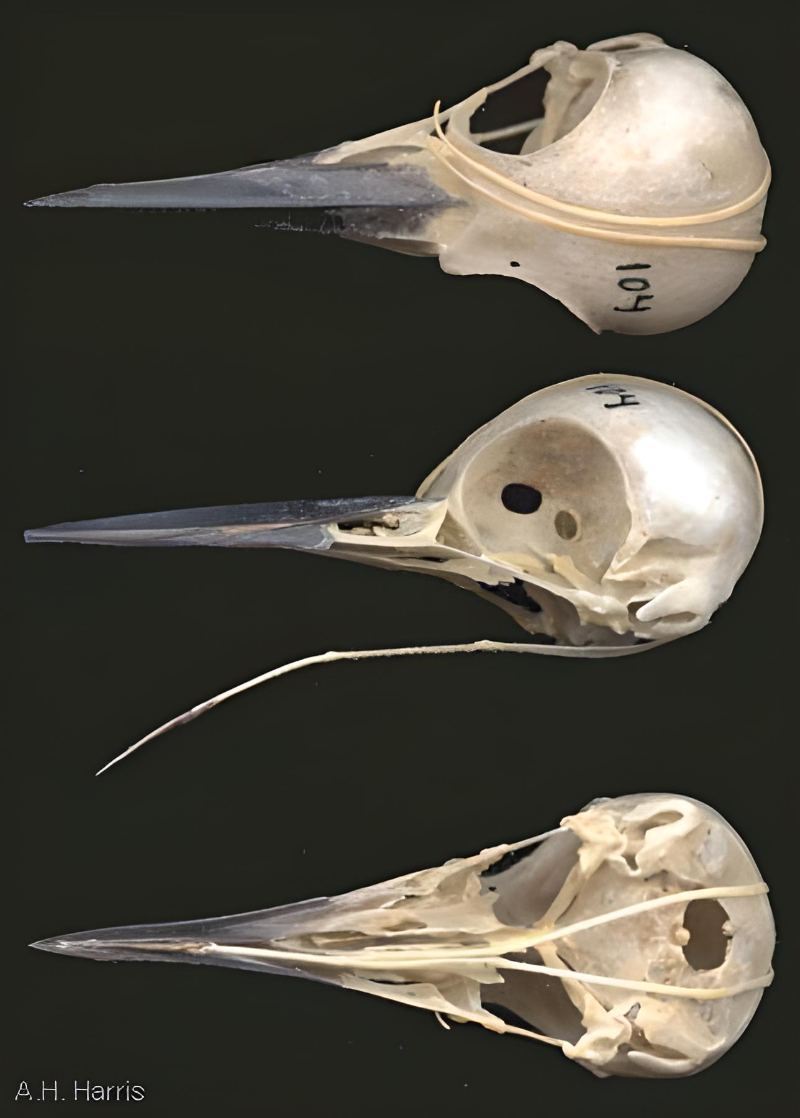
In addition, the beak is perfectly positioned, resting just below the brain. This indicates that the impact force is absorbed by the bones rather than immediately striking the brain. The large skull bones of the woodpecker act as a shock absorber, transferring the force of a collision to the stable bone tissue at the base and rear of the skull.
Because of a sophisticated beak shape that allows separate mobility of the top and lower beaks, woodpecker beaks often get caught in the wood but nearly always break free. The woodpecker also shuts its eyes just before its beak makes contact with the tree bark. By doing this, the impact force won’t be strong enough to drive the eyeballs out of their sockets. Plus, they protect their eyes from splinters.
It’s Hammer Time, All the Time
The woodpecker’s exceptional traits, which it has acquired through the course of its evolution, enable it to do astounding feats on a daily basis, such as hammering a tree’s bark 12,000 times on average each day at speeds of up to 16 miles (25 kilometers) per hour. But because of the way a woodpecker’s body anatomy is built, only 0.3% of the impact energy is sent to the brain. The other 99.7% is absorbed by the body.
Even the way football helmets are made, which are meant to protect players from head injuries, was influenced by the way woodpeckers are built.
Sources:
- McRae, M. (2022, July 14). Why Don’t Woodpeckers Get Brain Damage? Research Presents an Intriguing New Hypothesis. ScienceAlert.
- Jung, J. Y., & McKittrick, J. (2020, January 31). How do woodpeckers avoid brain injury? The Conversation.