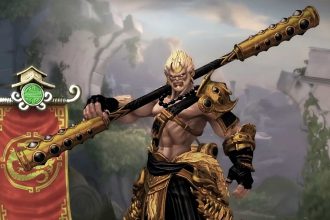
The bo staff (Japanese 棒, bō for “staff”), also known as “long stick”, is a striking cold weapon from Okinawa, Japan. It is locally referred to as Kun (Japanese 棍 Kon) in the Okinawa regions of Ryūkyū. The Bō is used in various martial arts disciplines such as Bujinkan, Kobudō, different schools of Koryū, and certain styles of Karate. Bojutsu is the name for the martial art that specifically makes use of the bo staff. The term “con staff” refers to the same style of weapon in Vietnamese martial arts.
Origin of the Bo Staff
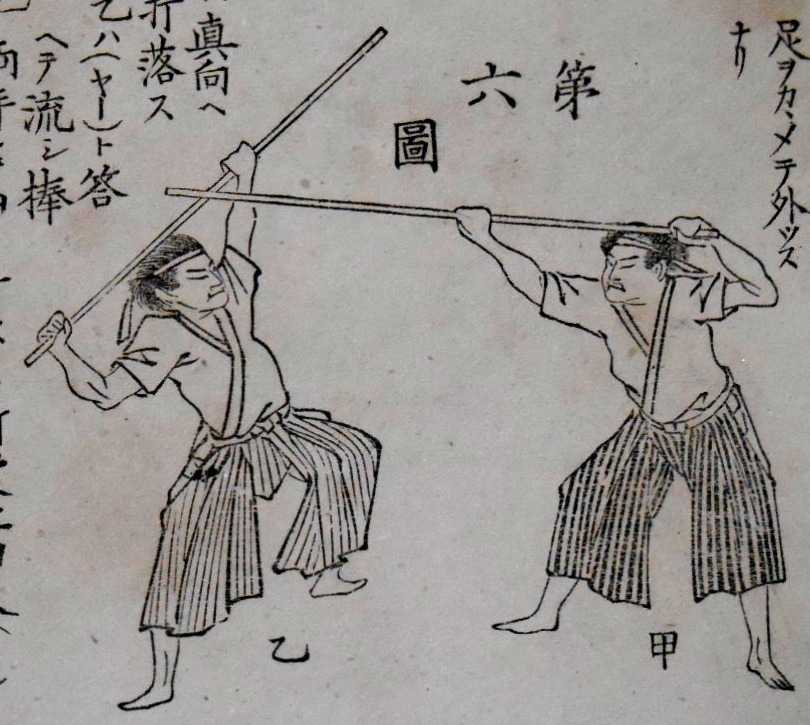
The Shaolin monks brought the Gùn (Chinese: 棍), a staff used in their style of stick combat, to Japan. In that region, the gùn underwent various changes before becoming known as the bō.
During this period, weapons were strictly prohibited for anyone who was not a member of the samurai warrior nobility. Since most samurai were often ambushed, they had to perfect a stealthy weapon that could nevertheless do the job. Thus, the bo staff became a traveling walking staff that doubled as a weapon if danger arose.
The Bo Staff’s Design
The bo staff is often crafted of red or white oak (and rarely of plastic or metal) and is 6 feet (182 cm) in length, with a diameter of 1 to 1.2 in (2.5 to 3 cm). However, modern training necessitates that the size be tailored to the participant. According to that, the bo staff should be longer by two hand widths than the student.
The Ryukyu Kobudo schools typically utilize a bo staff with a diameter of 1.4 in (3.5 cm), although in Yamanni-ryu, the bo is narrower at the edges. Rattan bo is utilized in kung fu dojos (schools) because it is long-lasting, affordable, and simple to carry.
The bo is often crafted from rattan (a type of palm) in Kung Fu dojos (schools). This is because it is more durable, inexpensive, and easier to carry around. Rattan is solid rather than hollow, unlike bamboo.
Because of its flexibility, a bo staff is very difficult to break without special equipment or considerable force.
Fighting Styles and Techniques
When training with the bo staff, beginners start with basic punching and thrusting moves. Basic techniques of the bo in Kung Fu include spinning the stick by rapidly switching your grip. You spin the bo to generate force, which you then use to strike your opponent in the face, neck, arm, hand, hip, knee, or leg with the bo’s end.
At full speed, the bo staff can spin at speeds of up to 55 miles (90 km) per hour. The bo can also be used for levering techniques and thrusts.
Combat drills (kumibo, similar to karate’s kumite) are the first thing you undertake when you reach the upper levels of training with this martial art weapon. At this point, you and your companion will be able to fight more freely.
In the past, some soldiers utilized the bo staff because it was cheap to produce and effective in combat. It was remarkable to see seasoned combatants dispatch opponents from farther than 80 inches (2 m) away.
The primary benefit of the extended range was an improvement in effectiveness over shorter melee weapons like swords and other smaller edged weapons.
Variants of the Bo Staff
The standard length for a bo staff is 6 feet (182 cm), and this specific length of the bo goes by the name “Rokushaku-Bo” (六尺棒). The name means “six shaku long stick” in Japanese, where one shaku is equal to around one foot (30 cm).
Another variant is the Yonshaku-Bō (four shaku long stick – 四尺棒) and it is similar in length to the Jo staff. This 4-foot (120 cm)-long variant wasn’t only for stabbing; it could also be used for levering, crushing, or throwing the target.
The Kushaku-Bo, which was 9 feet or 270 cm (nine shaku – 九尺棒) in length, was formerly widely used in Okinawa but has since fallen out of favor. The large length necessitated frequent hand switching, which meant the staff needed to slip easily between the hands; hence, it was often shaped spherically like most varieties.
Since this variant was capable of producing such strong centrifugal forces, it was ideal for techniques that included spinning the staff. The red oak used in its construction made the Kushaku-Bo sturdy enough to resist cracking or splitting. However, the length posed a challenge in terms of its legality for ownership, as it was challenging to categorize it solely as a walking staff, especially when samurai wielded it as a covert weapon.
The Sanshaku-Bo – 三尺棒, is three shaku in length, or around 3 feet (92 cm), making it the equivalent of a Hanbo, one of the shortest martial art staffs. But this short length allows for rapid execution of close combat techniques. This variant of the bo staff was often carried in pairs and frequently had a string attached to the wrist in case it was knocked out of the hand by a heavier weapon.
The Tanbo (短棒) comes in at an even shorter 2 feet (60 cm). It was quite similar to the hanbo, and it, too, had a wristlet attachment. In order to create a weapon like a nunchaku, two tanbo were often joined together using a chain or other similar device.
Last but not least, the Shoshaku-Bo should be highlighted. This weapon ranged in length from 1 to 1.5 feet (30 to 44 cm), was only used for melee combat, and needed extensive training to be used successfully against longer weapons.
The Bajobo or “horse stick,” is the longest known kind of bo staff at 13 shaku (about 13 ft; 390 cm).
There are more variants of the Bo staff that can be identified by their cross-sectional geometry:
- Round: Maru-bo – まる棒
- Square: Kaku-bo – 角棒
- Hexagonal: Rokkaku-bo – 六角棒
- Octagonal: Hakkaku-bo – 八角棒
The bo is constructed from several different materials. For safety and reliability reasons, the variant called Take-bo (竹棒) is only made from recently chopped bamboo since bamboo that hasn’t been freshly cut splinters over time.
Iron or lightweight and sturdy rattan can also be used in some other variants.
In Okinawa, there was also a special type of Bō that was often incorporated into children’s daily play, serving as both a sword and, for example, a horse for riding. In this way, the handling of this weapon was practiced from an early age.