The Parma Shield at a Glance
What is the Parma shield?
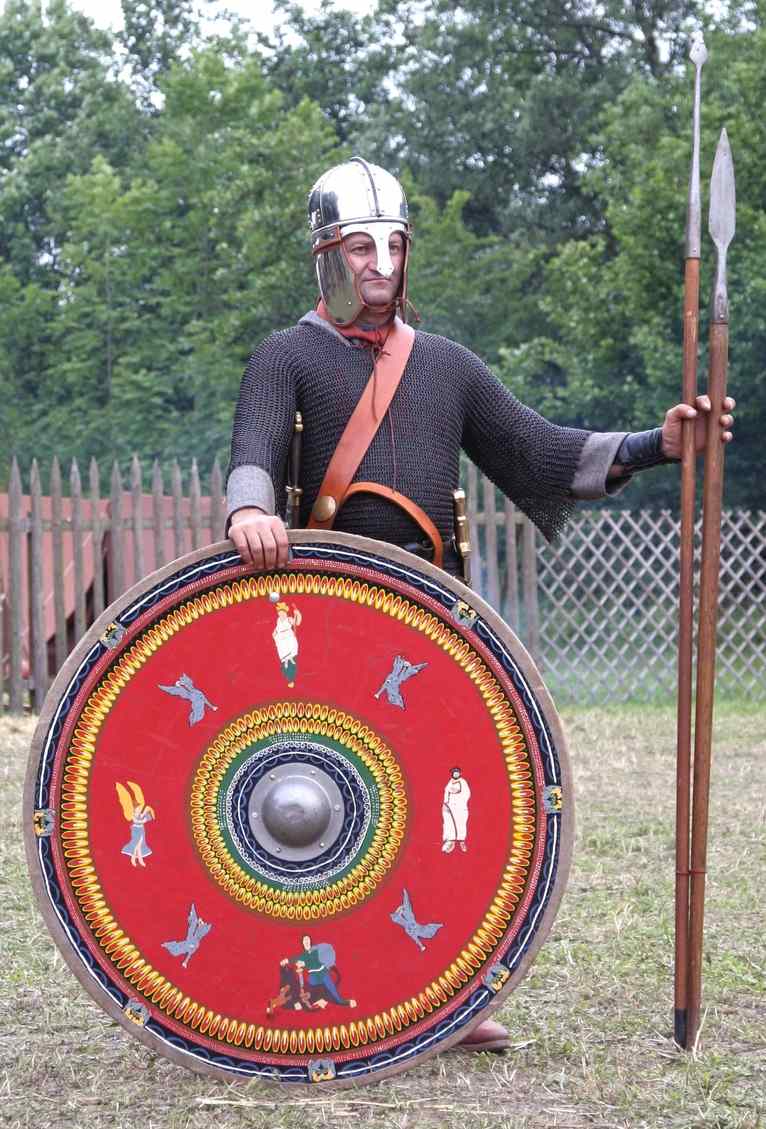
The Parma shield was a round Roman shield that was widely used by Roman soldiers from the 1st to the 8th century AD. It resembled the Greek aspis and played a significant role in Roman military tactics.
What were the dimensions and weight of the Parma shield?
The Parma shield had an elliptical shape with a diameter of approximately 35 to 36 inches (90u002du002d91 cm). It weighed around 5.7 lb (2.6 kg), making it a relatively lightweight shield.
Who used the Parma shield in the Roman Army?
Both infantry and cavalry units in the Roman Army used the shield. Certain signiferi (standard bearers) and centurions also used it. Gladiators, particularly the Thraex gladiators, also used a smaller version of the shield.
What was the significance of the Christogram emblem on the shield?
The most prevalent pattern found on this shield during the late Roman and early Byzantine eras was the Christogram emblem Chi-Rho (☧), representing the Greek word ΧΡΙΣΤΟΣ (u0022chrismonu0022). This emblem held religious significance and was associated with Emperor Constantine I. It was commonly seen on military flags and shields during that period.
The Parma shield was a round Roman shield used by Roman soldiers from the 1st to the 8th century AD. During the twilight of the Roman Empire, particularly from the 3rd century onward, this disk-shaped, wooden parma shield gained considerable prominence and widespread usage among other cold weapons. The shield resembled the Greek aspis and it held a rich historical legacy in the realm of Roman military tactics.
- The Parma Shield at a Glance
- What is the Parma shield?
- What were the dimensions and weight of the Parma shield?
- Who used the Parma shield in the Roman Army?
- What was the significance of the Christogram emblem on the shield?
- Origins of the Parma Shield
- A Plain But Smart Design
- History of the Parma Shield
- The Pattern on the Shield
| Parma | |
|---|---|
| Type: | Shield |
| Origin: | Ancient Rome |
| Utilization | Infantry, Cavalry |
| Diameter: | 35 to 36″ (90–91 cm). |
| Weight: | 5.7 lb (2.6 kg) |
Origins of the Parma Shield
In the Woodwardian Museum, there was a votive parma (above) that was etched and gold-plated. On it, there is a possible depiction of Brennus’s 387 BC siege of Rome and Marco F. Camilo’s recapture of it, as well as a hump with a monstrous face with ram’s horns, greenery, and a twisted beard. It was most likely created during Claudius’ (r. 41–54) or Nero’s (r. 54–68) reign.
The Romans developed the parma shield for use by their cavalry and the auxilia (non-citizen troops) in the 1st century AD. Like many other things borrowed from ancient Greece, this shield was eventually a Roman version of the Greek aspis.
Roman infantrymen frequently used the Parma shield because of its effectiveness in deflecting arrows.
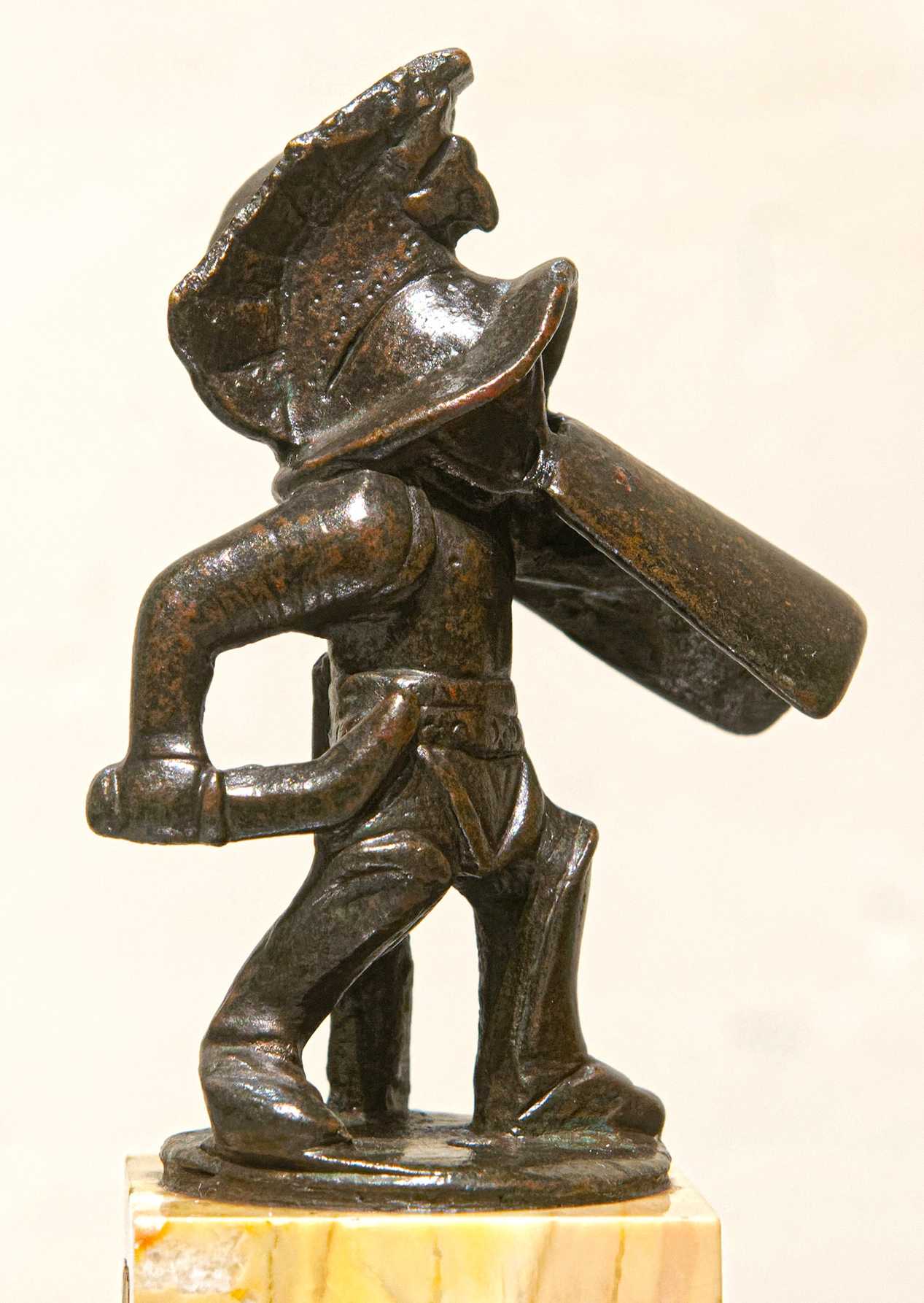
Certain signiferi (standard bearers) and even some centurions used it in the legions of the Roman Army. Some signiferi and gladiators used a smaller, spherical shield with the same name. The Thraex gladiators also utilized a shield called a parma or parmula.
Virgil’s Aeneid (a Latin epic poem) mentions the parma as a distinctive weapon employed by the Teucrians in their defense against the Greeks during the Battle of Troy (Trojan War), and subsequently against the Rutulians (an ancient people in Italy).
He associates the shield with the clypeus (another shield) of the Palladium (a wooden statue of Minerva or Athena) because, being small, the statue was also in proportion.
A Plain But Smart Design
While the legions commonly adorned their parma shields in a vibrant shade of red, the auxiliaries favored a blue-colored version of the same shield. This defensive equipment usually had an elliptical shape with a diameter of around 35 to 36 inches (90–91 cm).
The shield’s iron framework made it a formidable device. In addition to its usefulness in deflecting blows from the center of the shield, the umbo (the bulging shield base, or “shield boss”) served as a mounting point for the shield’s handle.
While it was mostly described as a round shield, there were bigger, oval variants, and they were named “clipeus“. Even though the clipeus shield was first used in Roman warfare after the 3rd century, both names are often used interchangeably in history, causing a bit of confusion.
History of the Parma Shield
In the early republican era of Rome (509 BC–27 BC), the parma was used by legionnaires, namely the lowest class division of the army, the infantry velites. A parma, javelin, sword, and helmet (made of wolf skin for display of valor) were their standard issue gear.
The velites were stationed up front in part for strategic reasons and in part so that they might earn personal glory in one-on-one battles. The Velites were the legion’s youngest and least well-off troops.
“These are not given to a soldier if in the formed array… but to those who in the skirmishing or in similar circumstances in which there is no need to engage in single combat, have voluntarily and by choice placed themselves in danger.”
Polybius
The full-length scutum shield eventually took the place of the parma after Gaius Marius eliminated velites during the Marian reforms (107 BC).
Lighter and better suited for the cavalry and signiferi, the parma shield was only issued to the auxilia for them to use in case of mutiny.
However, with the scutum shield and improved gear, legionnaires would have a higher chance of winning a mutiny. Legions used the parma shield again after the scutum left the army in the 3rd century.
Parma was used in the Eastern Roman (Byzantine) Empire until around the 8th century, when scutum shields took their place once again.
The shield was raised above the head and hit with a sword to make a resounding ring in the Pyrrhic dance, originally an ancient Greek warrior dance.
The Pattern on the Shield
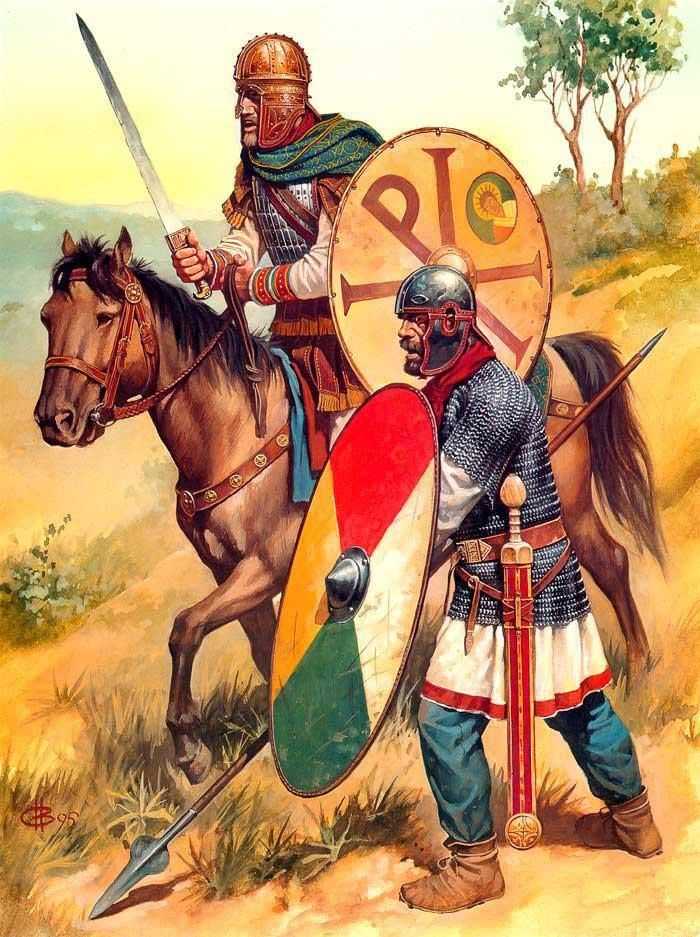
The Christogram emblem Chi-Rho (☧, from the initials of the Greek word ΧΡΙΣΤΟΣ, “chrismon”) was the most prevalent pattern on the shield in the late Roman and early Byzantine eras.
Roman Emperor Constantine I (r. 306–337 AD) used the Chi-Rho sign on a vexillum, or military flag.
The Byzantine army’s attacking force consisted of infantry mounted on horses and foot soldiers armed with circular shields (σκουτάτοι, skutatoi).
They were heavy infantrymen from the Eastern Roman Empire, equipped with spathae and spears. The Latin word scutum is where the term “skutatoi” (“the shied bearers”) originates.
References
- Rome and the Sword: How Warriors and Weapons Shaped Roman History by James, Simon, (2011) 1st Edition – Abebooks
- Ancient Roman War and Weapons (People in the Past: Rome) by Brian Williams, (2002) – Amazon Books
- A History of the Art of War Among the Carthaginians and Romans Down to the Battle of Pydna, 168 BC – by Theodore Ayrault Dodge – Google Books