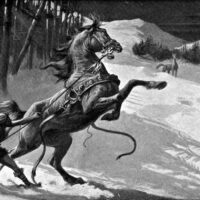
The story involves a giant named Hrungnir who challenges the gods, particularly Thor, to a duel. Thor agrees, and the two set up a meeting at the border of Midgard (the realm of humans) and Jotunheim (the realm of giants). The giant rides the mighty horse, Gullfaxi, to the meeting. Before the duel begins, Thor’s son, Magni, requests the giant’s horse, Gullfaxi, as a gift. Hrungnir, unaware of the horse’s loyalty to Thor, agrees, thinking it’s a small price to pay for such a powerful ally.
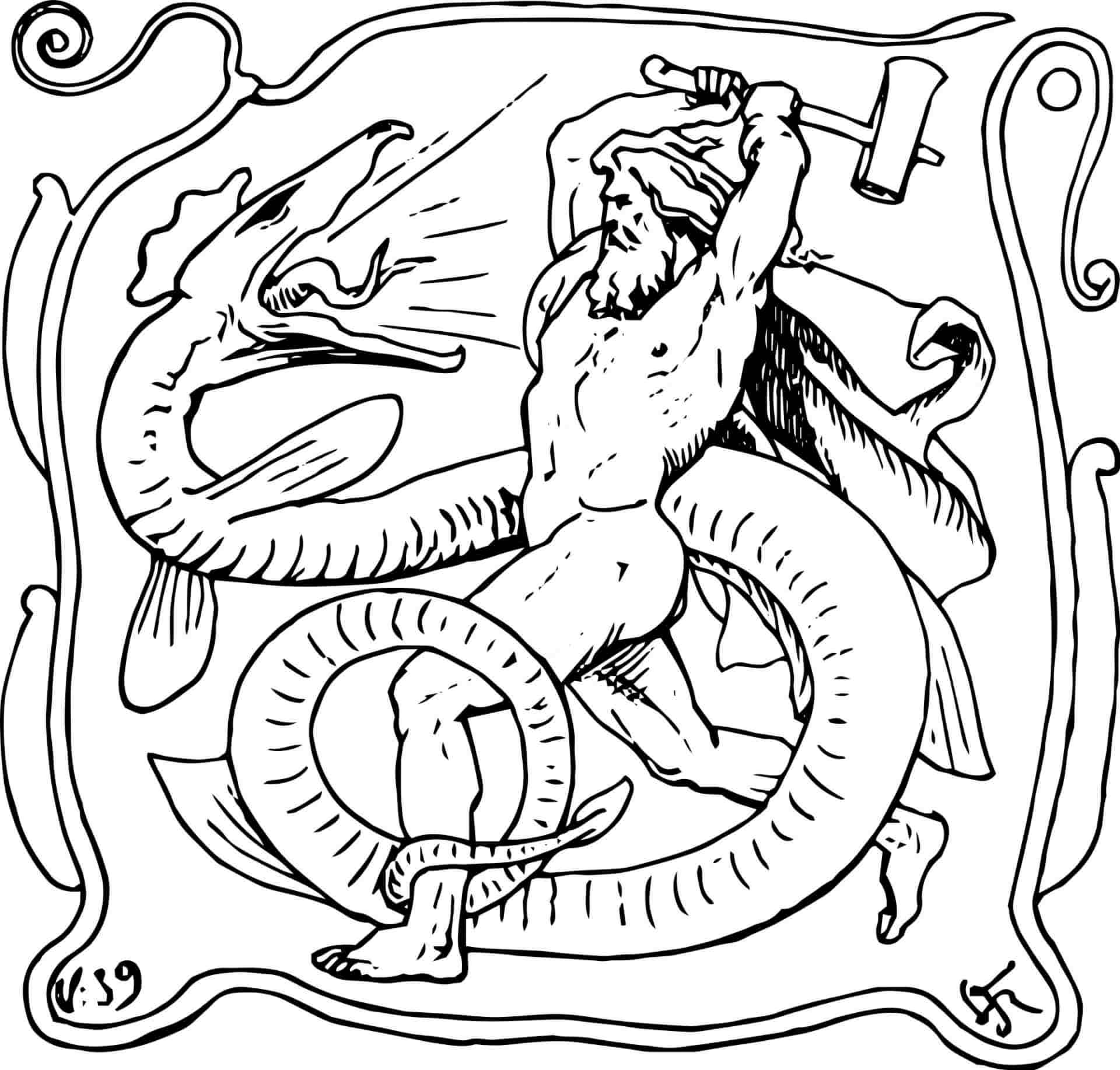
As the duel unfolds, Thor defeats Hrungnir with his mighty hammer, Mjolnir. However, during the battle, Hrungnir falls in such a way that his leg pins Thor to the ground. Thor’s son Magni, only three nights old but already strong, arrives and lifts the giant’s leg off his father, saving him. In gratitude, Thor grants the horse Gullfaxi to Magni as a reward for his assistance. Gullfaxi, known for its golden mane, becomes the steed of Magni, showcasing the bond between the gods and their loyal companions in Norse mythology.
Horses in Norse mythology are often symbols of strength, speed, and other virtues. They are important companions to several gods, aiding them in their quests and journeys.
The Clash of Thor and Hrungnir
The encounter between Thor and Hrungnir, the first owner of Gullfaxi, appears to have been a popular subject among scalds, with frequent references, but the comprehensive written record of this episode is found in Snorri’s Edda (Prose Edda).
According to Skáldskaparmál (17), Odin rides Sleipnir across the realm of Jötunheimr until he reaches Hrungnir, the jötunn. Seeing the god, Hrungnir wonders “what kind of person he might be” to wear a golden helmet, “ride the sky and water,” and comments to this stranger about his “wondrous horse.” Odin appreciates the compliment and bets his head that no horse as good could be found in all of Jötunheimr. Hrungnir admits that it is indeed a beautiful horse but claims ownership of a much faster animal named Gullfaxi. Enraged, the giant mounts Gullfaxi and challenges Odin to a race.
Odin has Sleipnir gallop on his eight legs as fast as possible before Hrungnir, who pursues with giant fury but fails to catch up, unaware that he is leaving his own realm. He finds himself rushed with his mount Gullfaxi to the gates of Ásgard, where Odin invites him to drink and introduces him to the Aesir while Thor is absent. In doing so, the giant begins to get drunk and insults the gods, claiming he could easily carry Valhalla until it sinks Ásgard into the sea and slays all the gods except Freyja and Sif, whom he would abduct and keep for himself.
The gods call on Thor for help. He challenges the giant, but Hrungnir is unarmed and demands the right to fetch his weapons and engage in a fair duel, which he does (probably riding Gullfaxi, though the text does not specify). The battle between Hrungnir and Thor is fierce. The god eventually manages to kill the giant. However, he receives a shard of a whetstone in his skull and collapses. The Aesir realize that Thor is trapped under one leg of the giant; they attempt to free him but without success. Only his son Magni (three days or three years old, according to Snorri Sturluson) manages to free him, stating that if he had faced the giant himself, a single punch would have sufficed to defeat him.
The animal initially held by Hrungnir is given to Magni by Thor as a reward for assisting him after his battle with the giant. However, Odin is disappointed because he apparently wanted this horse:
“And I will give you,” he said, “the ‘golden mane’ that Hrungnir possessed.Then Odin spoke and told me that Thor had made a mistake by giving the good horse to the son of a giantess, and not to his father.”
Skáldskaparmál(17).
The Nafnaþulur, which are a form of mnemonic enumeration in Snorri Sturluson’s Prose Edda, provide a considerable number of horse names, including that of Gullfaxi.
Symbolism and Attributes
In myths and legends, horses often serve as companions to gods and heroic figures, with their attributes and symbolism being highly variable. The ancient Scandinavian peoples constituted a civilization that was both equestrian and mystical, thus naturally attributing numerous powers to the horse—an animal of utmost importance in their culture.
Attributes and Powers of Gullfaxi
Gullfaxi is a giant’s mount that possesses, much like Sleipnir, the ability to fly overseas, move with speed and agility through the atmosphere, and, according to its legend, seems as swift on land and in the air as it is on water, nearly rivaling Sleipnir in speed and endurance. It can be assumed that Gullfaxi then remains the exclusive mount of Magni.
According to a Swedish study, Gullfaxi could be likened to a rainbow.
The golden mane of Gullfaxi does not appear to be a unique feature in myths and legends, as the horses of Indra, mentioned in the Rigveda of Hindu mythology, also possess the same attribute. In the Iliad of Greek mythology, some mounts associated with Zeus or Poseidon also have a golden mane.
Similarly, Sleipnir is also endowed with the ability to traverse the sky and water, much like Hófvarpnir, the mount of Gná in Norse mythology. Fabulous horses possessing these abilities are found in Celtic mythology through Enbarr, the mount of Manannán mac Lir and his daughter Niamh, and in Breton legend with Morvarc’h.