Coiled silently at the freezing, lightless bottom of the world’s oceans in Norse mythology lies a leviathan of such unimaginable length that its scaly body wraps completely around the circumference of planet Earth, allowing its jaws to clamp down onto the tip of its own tail. Known in Old Norse as Jörmungandr (“Huge Monster” or “Vast Wandering Staff”) or the Midgard Serpent (Miðgarðsormr), this venomous offspring of the trickster god Loki serves simultaneously as the physical belt holding the mortal oceans together and the sworn eternal nemesis of the thunder god, Thor.
Born in Jotunheim and Cast Into the Sea by Odin
According to Snorri Sturluson’s Gylfaginning in the thirteenth-century Prose Edda, Jörmungandr was the middle child of a terrifying trio of monsters born in Jotunheim from the union of the trickster god Loki and the fierce giantess Angrboda (“She Who Brings Grief”). Jörmungandr’s older brother was the monstrous wolf Fenrir, and his younger sister was Hel, the half-living, half-corpse ruler of the underworld.
When the gods of Asgard learned through prophecies that these three siblings were being raised in the giant-realm and were destined to bring ruin upon the cosmos, the Allfather Odin sent the gods to seize the three children and bring them before his throne:
- Odin cast Hel down into Niflheim to rule over those who died of sickness and old age, and bound Fenrir with the magical ribbon Gleipnir.
- Looking at the young serpent Jörmungandr, Odin picked the snake up and hurled it down into the deep ocean that encircles all the lands of humanity (Midgard).
- Instead of drowning or staying small, however, the serpent grew to such titanic proportions on the ocean floor that its body encircled the entire landmass of the Earth and bit its own tail—becoming the Norse archetype of the Ouroboros (the world-encircling tail-biting serpent).
Three Encounters With His Arch-Enemy, Thor
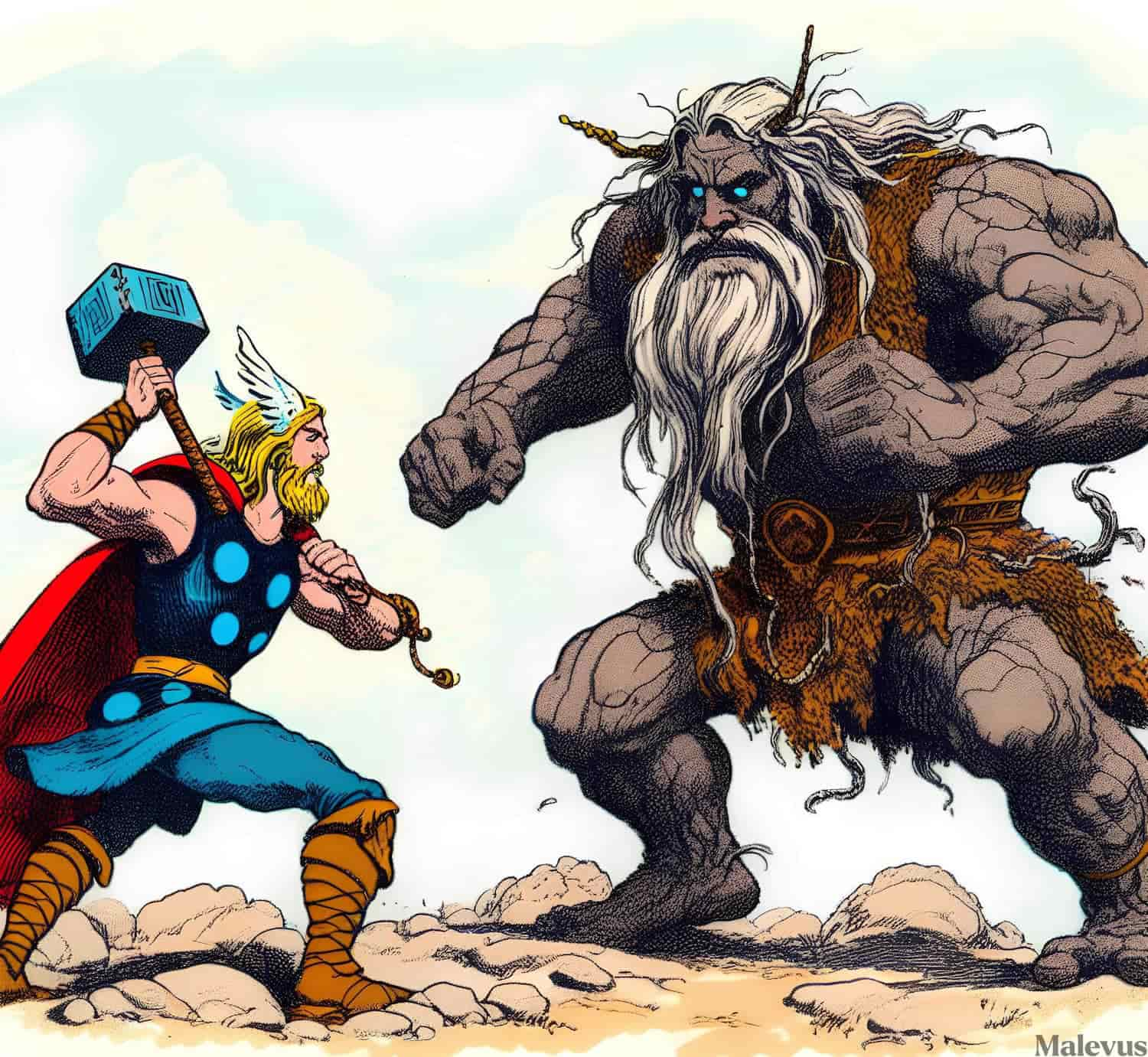
In the Norse pantheon, no rivalry was as personal or explosive as the blood-feud between Jörmungandr and Thor, the red-bearded protector of Midgard and Asgard. Prior to the end of the world, the god of thunder and the great serpent came face-to-face twice in unforgettable comic and heroic adventures:
- Lifting the “Cat” in the Hall of Útgarða-Loki: When Thor and Loki visited the giant fortress of Útgarða-Loki, the giant king mocked Thor’s strength by challenging him to simply lift his pet grey housecat off the stone floor. Straining with every ounce of divine muscle he possessed, Thor only managed to lift a single paw of the cat off the ground! The next morning, Útgarða-Loki confessed the terrified truth: he had used optical magic (sjónhverfing) to disguise the Midgard Serpent as a cat—and when Thor stretched the “cat’s” back up to the ceiling and lifted one paw off the floor, the giants had nearly fainted in terror seeing the world-serpent pulled out of the ocean toward the sky.
- Hymir’s Fishing Trip (Hymiskviða): Determined to settle the score, Thor disguised himself as a young boy and rowed far out past the normal fishing grounds in a small boat with the giant Hymir. Tearing the head off Hymir’s largest black prize bull (named Himinhrjótr, “Heaven-Bellower”) and impaling the whole ox-head onto a massive iron fishing hook attached to a thick anchor line, Thor dropped the bait to the bottom of the abyss. When Jörmungandr swallowed the ox-head and the iron hook pierced the roof of its mouth, the serpent thrashed with such violence that Thor’s fists slammed against the gunwale and **Thor’s both feet punched clean through the wooden bottom of the boat**, bracing himself directly on the granite seabed as he hauled the venom-spitting head of the monster above the waves! Just as Thor raised his hammer Mjolnir to smash the serpent’s skull once and for all, the terrified giant Hymir panicked at the sight of the sinking boat, pulled out his bait-knife, and sliced Thor’s fishing line in half—letting the wounded serpent sink back into the deep.
Nine Fatal Paces at Ragnarok
The final chapter of their rivalry is foretold in the Völuspá. When the cosmic winter arrives and Ragnarok begins, Jörmungandr will finally release its tail from its jaws and thrash in giant fury (jörmungandr snýst í jötunmóð)—causing the world’s oceans to surge over the continents in a planetary tsunami that shakes loose the ship of the dead, Naglfar, while the serpent crawls ashore onto the plain of Vigrid blowing clouds of black poison across sky and sea.
Meeting his ancient foe one last time, Thor will battle the Midgard Serpent in a titanic duel and finally succeed in crushing the monster’s skull with Mjolnir. Yet in the moment of his greatest victory, Thor will stagger backward just nine paces from the serpent’s corpse before falling dead to the earth—drowned and consumed by the torrents of lethal venom that the dying Jörmungandr spat upon him.