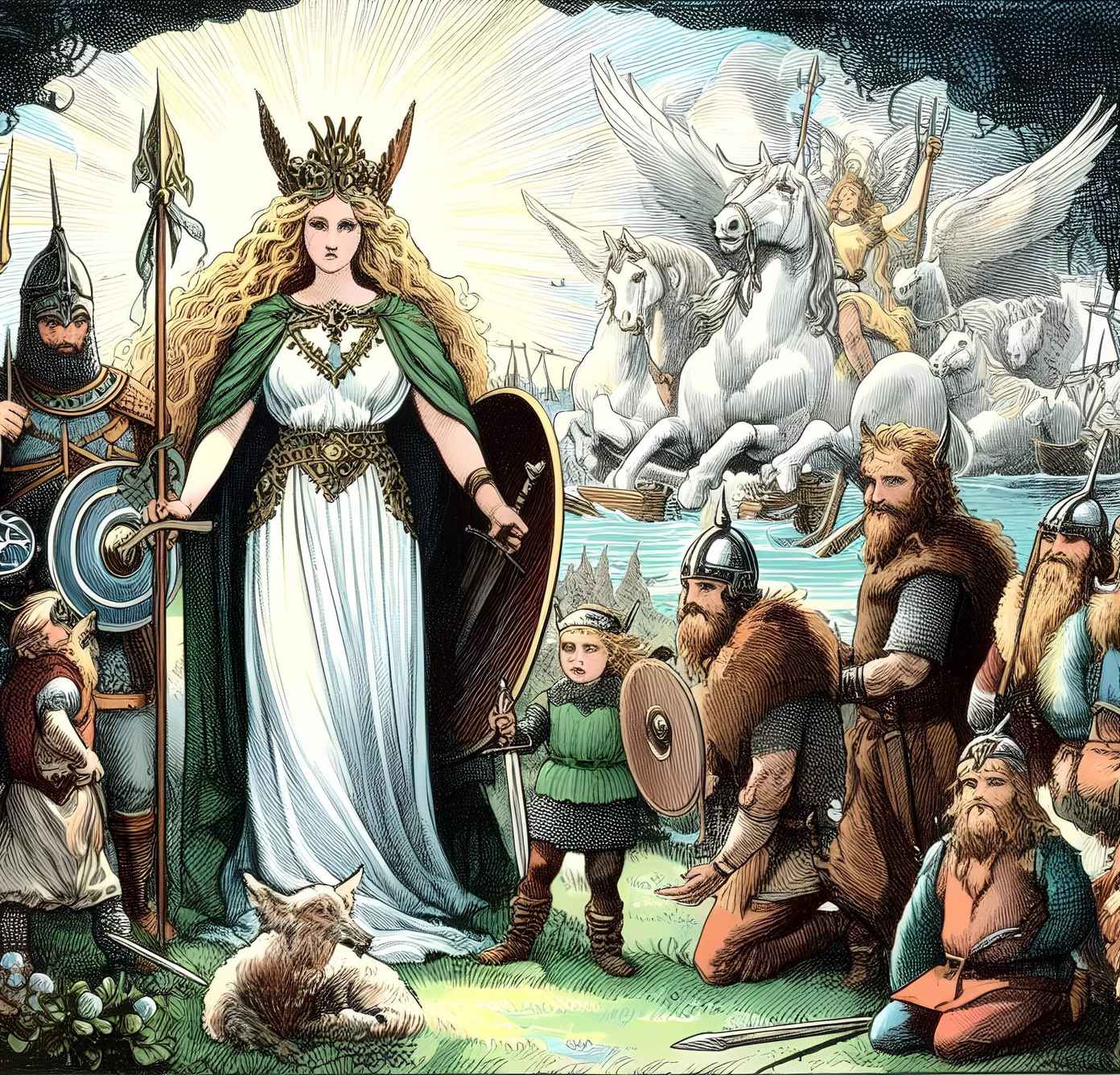
While modern pop culture treats Thor’s hammer Mjolnir as the most famous weapon of the Norse pantheon, to the actual Viking Age warriors of Scandinavia, the supreme emblem of divine kingship, battlefield fate, and blood-sacrifice belonged to the Allfather Odin: his magical spear, Gungnir. Forged deep beneath the earth by dwarven master smiths and inscribed with mysterious runes right upon its steel point, Gungnir possessed a terrifying battlefield enchantment—once hurled, the spear never missed its mark and could never be halted in mid-flight.
Etymology of “The Swaying One” and the Dwarven Forge
In Old Norse, the name Gungnir derives from the verb gungna, meaning “to sway, tremble, or vibrate violently”—an evocative martial term describing the flexing vibration of a long ash-wood spear shaft quivering with kinetic energy just before it is launched, or the trembling shockwave when its heavy iron point punches through an enemy shield-wall.
According to the thirteenth-century Skáldskaparmál in Snorri Sturluson’s Prose Edda, Gungnir was the very first of the six great treasures of Asgard created during Loki’s famous wager in Svartalfheim:
- When Loki traveled underground to commission the dwarven Sons of Ivaldi to forge replacement golden hair for Thor’s wife Sif, the dwarves also crafted the folding ship Skidbladnir for Freyr and the spear Gungnir for Odin.
- In the older Poetic Edda poem Sigrdrífumál, the valkyrie Brynhildr reveals that sacred runes of wisdom and victory were carved directly onto the tip (oddr) of Gungnir, imbuing the weapon with its unerring accuracy and its power to bind unbreakable oaths.
Hurling the Spear Over the Enemy Host: “Odin Owns You All!”
In Norse mythology, Gungnir was not merely a weapon Odin used to stab opponents; it was the ceremonial instrument that initiated war itself and dedicated fallen armies to Valhalla. During the primordial war between the two tribes of gods—the Aesir-Vanir War, recounted in the poem Völuspá—the very first act of warfare in the history of the universe occurred when Odin stepped forward and hurled his spear high over the heads of the assembled Vanir host.
Historical sagas, such as the Eyrbyggja Saga and Styrbjarnar þáttr Svíakappa, record that real-life Viking kings and chieftains copied Odin’s exact ritual before major battles:
- Before the two shield-walls clashed, the Viking commander stepped in front of his ranks and threw a spear in a high arc clean over the heads of the enemy army.
- As the spear sailed over the opposing ranks, the chieftain shouted the ancient sacrificial formula: “Óðinn á yðr alla!” (“Odin owns you all!”)—symbolically turning every enemy soldier killed in the coming battle into a human sacrifice offered to the Lord of the Slain.
Breaking Volsung’s Sword and the Final Charge at Ragnarok
Throughout the legendary sagas, Odin periodically walked the earth in his blue cloak and wide-brimmed hat carrying Gungnir to decide the fate of mortal heroes. In the Volsunga Saga, Odin first gifted the hero Sigmund with the legendary sword Gram (which Odin drove deep into the trunk of the Barnstock oak tree at a wedding feast). Decades later, when an aged Sigmund’s fated hour of death finally arrived on the battlefield, Odin stepped personally into the fray holding Gungnir upright like a staff; when Sigmund swung his unbeaten sword with all his strength, the blade struck the shaft of Gungnir and shattered into two pieces on contact, allowing Sigmund’s enemies to cut him down and send him home to Valhalla.
Finally, when the end of the cosmos arrives at Ragnarok, both the Völuspá and the Gylfaginning describe Odin riding out at the absolute front of the Einherjar warriors wearing his golden helmet and gleaming mail shirt, gripping Gungnir in his hand as he charges straight at the monstrous wolf Fenrir—wielding the unerring spear of the gods until the very last heartbeat of the old world.