Veðrfölnir, also known as Vedrfolnir, is a hawk that resides at the top of the world tree Yggdrasil in Norse mythology. He perches between the eyes of a giant eagle and observes everything in the world with his sharp gaze. Yggdrasil represents the old Norse cosmic perspective, which included all nine realms of life.
The heavenly and terrestrial realms, as well as the human and divine realms, are all included in this enormous ash tree, with Muspelheim, the home of cosmic flames, and Niflheim, the cold world of the dead, at either end.
| Fact | Description |
|---|---|
| Other Names | Vedrfolnir, Vedurfolnir, or Vetrfolnir |
| Origin | Norse mythology |
| Meaning of Name | “Storm pale,” “wind bleached”, or “wind-witherer |
| Role | A hawk sitting between the eyes of an eagle that is perched on top of the world tree Yggdrasil. |
| Associated Characters | The unnamed eagle and the squirrel Ratatoskr. |
| Significance | The hawk is associated with the wisdom of the eagle. It is also theorized that it flies off, acquiring and bringing back knowledge. |
Veðrfölnir in Literature
This hawk is only mentioned in Snorri Sturluson’s Old Norse textbook, “Prose Edda” (Younger Edda), among the Eddic literature from the 13th century. King Gylfi, calling himself Gangleri, inquires of the enthroned High about any further noteworthy details about Yggdrasil, and he answers:
“There sits an eagle on the limbs of the ash, and he is very knowledgeable,
Chapter 16 of Prose Edda, “Gylfaginning”, by Snorri Sturluson.
and between his eyes sits a hawk named Veðrfölnir.
A squirrel named Ratatoskr runs up and down the ash,
carrying words of envy between the eagle and Níðhöggr,
and four stags run across the limbs of the ash and bite the leaves.”
In the poems, the hawk is represented by Veðrfölnir, who is a Norse mythological figure.
That is to say, this moniker may be used by poets to depict a hawk rather than Veðrfölnir itself. For instance, in the Nafnaþulur (a subsection of the Prose Edda), Vedrfölnir is a heiti (“term”) for a hawk.
In Norse mythology, the description of this portion is quite obscure. Another tale has a rooster called Vidofnir taking the place of the holy hawk. Some people also think that Veðrfölnir is the same as Hraesvelgr, a northern eagle whose wings beat chilly winds. The story also says that this hunting hawk has “the wisdom to understand many things,” which makes it seem like Huginn and Muninn, the two ravens from whom Odin learned all there is to know about the universe.

Odin, who is believed to be Grimnir in the Poetic Edda poem Grímnismál, states a similar story:
Ratatosk is the squirrel who there shall run
Henry Adams Bellows translation
On the ash-tree Yggdrasil;
From above the words of the eagle he bears,
And tells them to Nithhogg beneath.
The Meaning of the Veðrfölnir
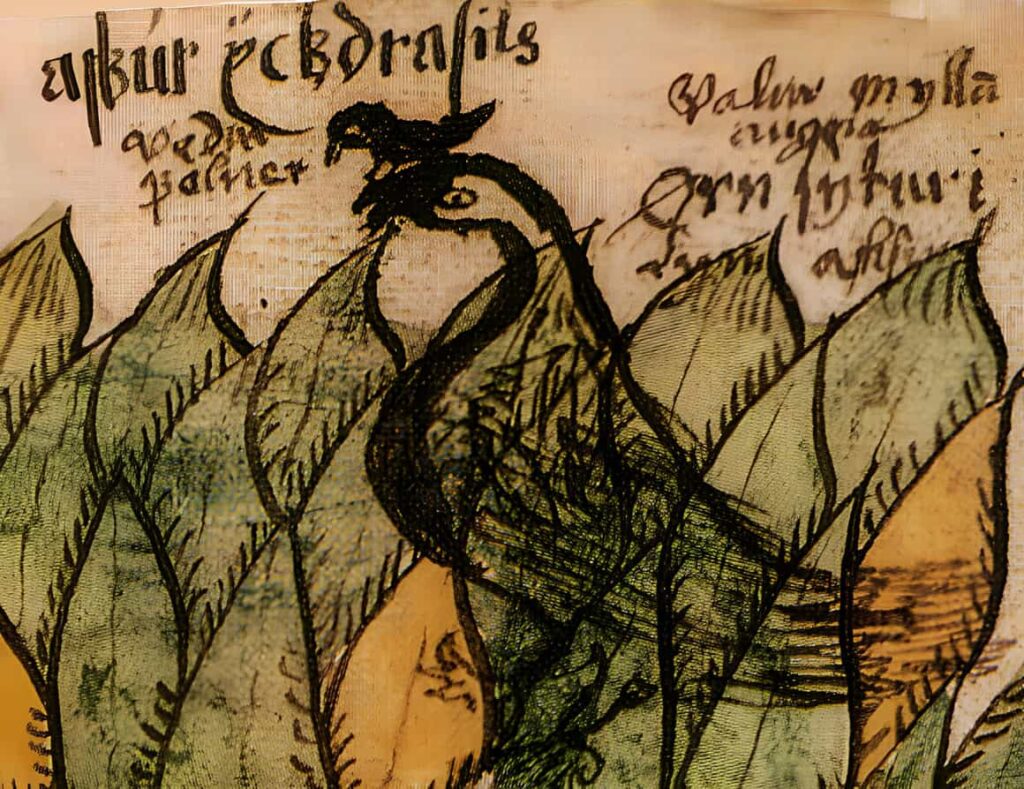
The two parts that make up the Old Norse term Veðrfölnir are veðr, which means “wind,” “fierce wind,” or “weather,” and fölr, meaning “pale,” “white,” or “lacking color,” or fölna, meaning “to wither,” “to become white,” or “to lose color.” Thus, Veðrfölnir might equally mean “wind pale,” “weather pale,” or “become white from wind and weather.
“
Other potential explanations of this name are “Weather Maker” or the one “tousled in or by the storm,” but they are linguistically less evident.
Why the Hawk?
There is a unique relationship between Norse aristocrats and hawks. For hawking, they would domesticate hawks. The hawk was raised in prestige because of the noble hunter’s emotional connection with the hunting bird. The Eddas make many references to this occurrence (Guðrúnarkviða in fyrsta 18; Guðrúnarkviða in önnur 40; Sigurðarkviða Fafnisbana önnur 31). The hawk’s esteem reached a point where it was venerated as a sign of regal might (Skáldskaparmál 62). It is not for nothing that he was associated with the father of the gods, Odin, in Norse mythology, as can be seen from the phrase “like the greedy hawks of Odin.” (Helgakviða Hjörvarðssonar 42).

Veðrfölnir’s relation to the eagle is reminiscent of Víðópnir‘s (a rooster who sits atop the Mimameidr tree) relation to the cosmic eagle Hraesvelgr.
The Hawk-Eagle Relationship
The fact that Veðrfölnir is situated between the holy eagle’s eyes suggests a link between its whereabouts and the eagle’s wisdom. Some think that Veðrfölnir travels into the world to return information to Odin, similar to Odin’s ravens. Hawk’s intellect, on the other hand, may be different from or even greater than that of the holy eagle.
According to the German linguist Jacob Grimm, the term “haukr í horni”—meaning “the hawk in the corner”—is used in Old Norse to describe a secret adviser. He concludes that Veðrfölnir is more than simply the divine eagle’s companion since, after all, the eagle knows a lot more than its counselor.