Hvergelmir is one of the most important sources in Norse mythology. It is located in Niflheim, the realm of cold and darkness, and it is the origin of all the frozen rivers that flow through the nine worlds. Hvergelmir is also the home of many snakes and the dragon Níðhöggr (Nidhöggr), who gnaws at the roots of the world tree Yggdrasil.
Hvergelmir is associated with the cosmic creation myth in Norse mythology. It is one of the wells mentioned in the creation narrative, and the rivers flowing from it contribute to the formation of the worlds.
The Meaning of Hvergelmir
The name Hvergelmir comes from Old Norse hverr, meaning “bubbling boiling spring” and gelmir, meaning “sword” or “the loud one”. Therefore, Hvergelmir can be translated as “the boiling cauldron” or “the roaring kettle”. This name reflects the nature of the source as a place of intense heat and noise, contrasting with the cold and silent Niflheim. Hvergelmir is also called “the cauldron of evil” by some scholars, who derive gelmir from Old Norse galli, meaning “evil, vice, harm”. This interpretation suggests that Hvergelmir is a source of corruption and destruction, as it harbors the serpent Nidhöggr and other venomous creatures.
The Role of Hvergelmir
Hvergelmir plays a crucial role in the Norse creation myth and the fate of the world. According to Snorri Sturluson’s Prose Edda, Hvergelmir was already present in primordial times, before the gods created the world. It was the source of the eleven rivers called Élivágar, which flowed into the abyss of Ginnungagap, where they froze into ice and rime. When the sparks and the heat from the fire realm of Muspelheim met the ice and the rime, the first living being emerged: the giant Ymir, the ancestor of all the giants. Thus, Hvergelmir was the origin of life in Norse cosmology.
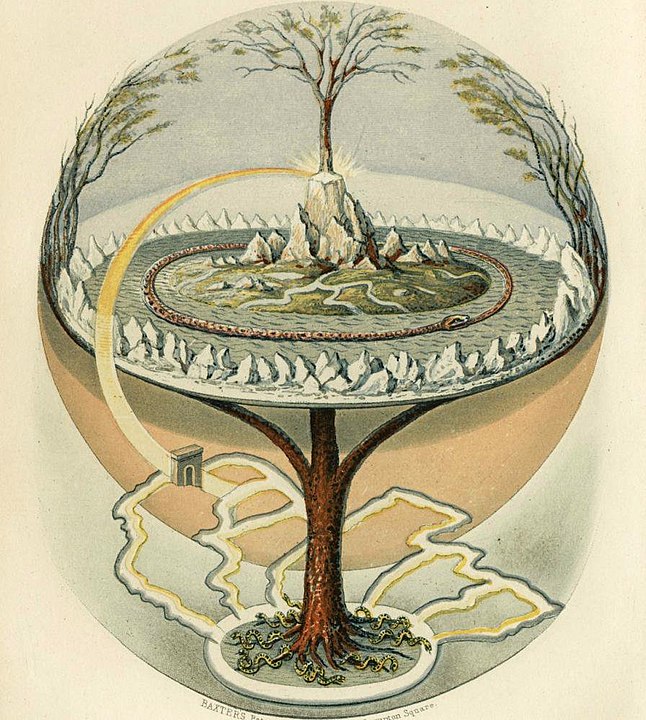
After the world tree Yggdrasil grew out of Ymir’s corpse, one of its three roots extended over Niflheim and Hvergelmir. Hvergelmir became the mother of all the rivers in the world, as the drops from the antlers of the stag Eikþyrnir (Eikthyrnir), who grazed on the branches of the tree Lärad (a variant of Yggdrasil), fell into the source and filled it with water. Hvergelmir was also the dwelling of the dragon Níðhöggr and countless snakes, who gnawed at the root of Yggdrasil and caused it to rot. In the final battle of Ragnarök, Níðhöggr will torment the corpses of the dead in Hvergelmir.
Ginnungagap is the primordial void in Norse cosmology.
Hvergelmir, as a well, is often associated with the cosmic waters that existed within Ginnungagap before the creation of the worlds.
The Symbolism of Hvergelmir
Hvergelmir can be seen as a symbol of the dynamic and chaotic forces of nature, which are both creative and destructive. Hvergelmir is the source of life, but also the source of evil. It is the place where the opposites of fire and ice, heat and cold, light and darkness, meet and interact, generating new forms of existence.
Hvergelmir is also a symbol of the underworld, where the dead and monsters dwell. It is the realm of decay and corruption, where the world tree is constantly attacked and weakened. Hvergelmir represents the threat of entropy and annihilation, which the gods and humans have to face and overcome.
There are other wells in Norse mythology, such as Mímisbrunnr and Urðarbrunnr, each with its unique significance. These wells collectively contribute to the intricate cosmogony of Norse mythology.
Attestations
Poetic Edda
Eikthyrnir the hart is called,
that stands o'er Odin's hall,
and bites from Lærad's branches;
from his horns fall drops into Hvergelmir,
whence all waters rise
Poetic Edda.
Prose Edda
Just-as-High explains that the spring Hvergelmir is located in the foggy realm of Niflheim
Then said Jafnharr: “It was many ages before the earth was shaped that the Mist-World was made; and midmost within it lies the well that is called Hvergelmir, from which spring the rivers called Svol, Gunnthra, Fjorm, Fimbulthul, Slidr and Hrid, Sylgr and Ylgr, Vid, Leiptr; GjoU is hard by Hel-gates.”
Source The Prose Edda (archive.org)
Later in Gylfaginning, Just-as-High describes the central tree Yggdrasil.
Then said Gangleri : “Where is the chief abode or holy place of the gods?” Harr answered: “That is at the Ash of Yggdrasill; there the gods must give judgment every day.” Then Gangleri asked : “What is to be said concerning that place?” Then said Jafnharr: “The Ash is greatest of all trees and best : its limbs spread out over all the world and stand above heaven. Three roots of the tree uphold it and stand exceeding broad: one is among the Aesir; another among the Rime-Giants, in that place where aforetime was the Yawning Void; the third stands over Niflheim, and under that root is Hvergelmir, and Nidhoggr gnaws the root from below.”
Source: The Prose Edda (archive.org)
Hvergelmir contains not only Níðhöggr but also so many snakes that “no tongue can tell them.”
Moreover, so many serpents are in Hvergelmir with Nidhoggr, that no tongue can tell them, as is here said:
Source: The Prose Edda (archive.org)
Ash Yggdrasill suffers anguish.
More than men know of:
The stag bites above; on the side it rotteth,
And Nidhoggr gnaws from below.
And it is further said:
More serpents lie under Yggdrasill’s stock
Than every unwise ape can think:
Goinn and Moinn (they’re Grafvitnir’s sons),
Grabakr and Grafvolludr;
Ofnir and Svafnir I think shall aye
Tear the trunk’s twigs
The spring is mentioned a third time in Gylfaginning where High (Hárr) recounts its source:
Then spake High (Hárr): “Even more worthy of note is the hart Eikthyrni, which stands in Valhall and bites from the limbs of the tree; and from his horns distils such abundant exudation that it comes down into Hvergelmir,and from thence fall those rivers called thus : Síd, Víd, Søkin, Eikin, Svöl, Gunnthrá, Fjörm, Fimbulthul, Gípul, Göpul, Gömul, Geirvimul. Those fall about the abodes of the Aesir; these also are recorded: Thyn, Vín, Thöll, Höll, Grád, Gunnthráin, Nyt, Nöt, Nönn, Hrönn, Vína, Vegsvinn, Thjódnuma.”
Source: The Prose Edda (archive.org)