Throughout the Arab world, many people celebrate Christmas, whether religiously or not. While Muslims celebrate Eid al-Fitr and Eid al-Adha more than any other Arab feast, Christians make up a sizeable minority in many Arab nations, including Egypt, Lebanon, and Morocco. It was predicted that there are 10–15 million Arab Christians residing in the Middle East. Depending on local culture and traditions, these countries celebrate Christmas in different ways. Some non-Christian Arabs, particularly those residing in the US, celebrate Christmas in a secular manner as a result of Western cultural influences and the atmosphere.
-> See also: Most Unexpected Countries That Celebrate Christmas
Arab Countries Where Christmas is a Public Holiday
- Lebanon (45% Christian)
- Jordan (6% Christian)
- United Arab Emirates (UAE) (13% Christian)
- Iraq (2.5% Christian)
- Palestinian territories (1% Christian)
- Syria (5% Christian)
The Significance of Christmas in the Arab World
Since Christianity originated in the Arab world, they still celebrate this holiday despite its Christian origins, with each country bringing its own customs. For instance, Christians make up around 45% of Lebanon’s population, and Muslims and Christians adorn their homes, streets, and stores. Three distinct Christian traditions observe Christmas at various periods in Palestine, with each centering on Bethlehem as the location of the celebration.
Despite the years of fighting, the Syrian capital of Damascus still has a Christmas carnival with thousands of people attending music, dancing, and the nation’s tallest Christmas tree (98 feet) in Abbasid Square. Christmas has been a public holiday in Iraq since 2008 and Christian households congregate in the backyard to light garden fires and recite psalms on Christmas Eve. Christmas is still significant for Arabs due to their cultural variety.
-> See also: Do Muslims Celebrate Christmas?
Traditional Christmas Celebrations of Arabs
- Lebanon: Houses, streets, malls, and businesses in Lebanon deck up their holiday trees with lights and decorations as Christians and Muslims join the holiday side by side.
- Egypt: Egyptian Copts observe a 40-day fast from meat, poultry, and dairy items before Christmas (January 7). Guests bring kahk, a traditional shortbread, to share with their hosts on Christmas Day as a token of their appreciation for the host’s hospitality.
- Jordan: A sticky Christmas cake with nuts and dried fruits spiked with alcohol is a traditional Jordanian holiday dessert.
- Morocco: As a result of the influence of the French and Spanish empires, Moroccan Christmas includes aspects of French culture. The French Christmas dessert, Buche de Noel, is very popular.
- Palestine: All Christian denominations are represented in Palestine. Protestants and Catholics celebrate Christmas Eve on December 24th, while Greek Orthodox commemorate it on January 6th and Armenian Orthodox on January 17th. A Palestinian Christmas feast includes roast lamb or turkey, nougat and sesame seed desserts, and semolina pancakes filled with almonds.
- Damascus: On Christmas Eve, Damascus, Syria’s capital city, hosts a carnival where people sing carols and dance. Churches and residences can display nativity scenes, while streets, homes, and public areas feature typical garlands and lights, sometimes resembling a European city.
- Iraq: There are 150,000 to 300,000 Catholics living in Iraq. As a distinctive Iraqi custom, the burning of dried thorns is a significant part of Christmas rituals. The thorns are burned as a symbol of Christ’s light and the world’s hope.
-> See also: 48 Countries That Celebrate Christmas Widely
Why Most Arabs Are Not Celebrating Christmas
Since it is not a holiday in Islam, most Arabs, especially Muslims, do not celebrate Christmas.
- Religion: Muslims embrace Jesus more as a prophet than the son of God.
- Culture: Christmas is generally not a public holiday in nations with a Muslim majority for this reason.
- Respect: Muslims do not commemorate the holiday but according to their beliefs, Muhammad once let a Christian group do their ceremonies in his mosque. So, they must recognize a certain freedom for Christians to celebrate Christmas.
- Muslims in Non-Muslim Nations: Muslims residing in non-Muslim nations are known to ask their children not to participate in school Christmas parties.
Arabs’ View of Santa Claus
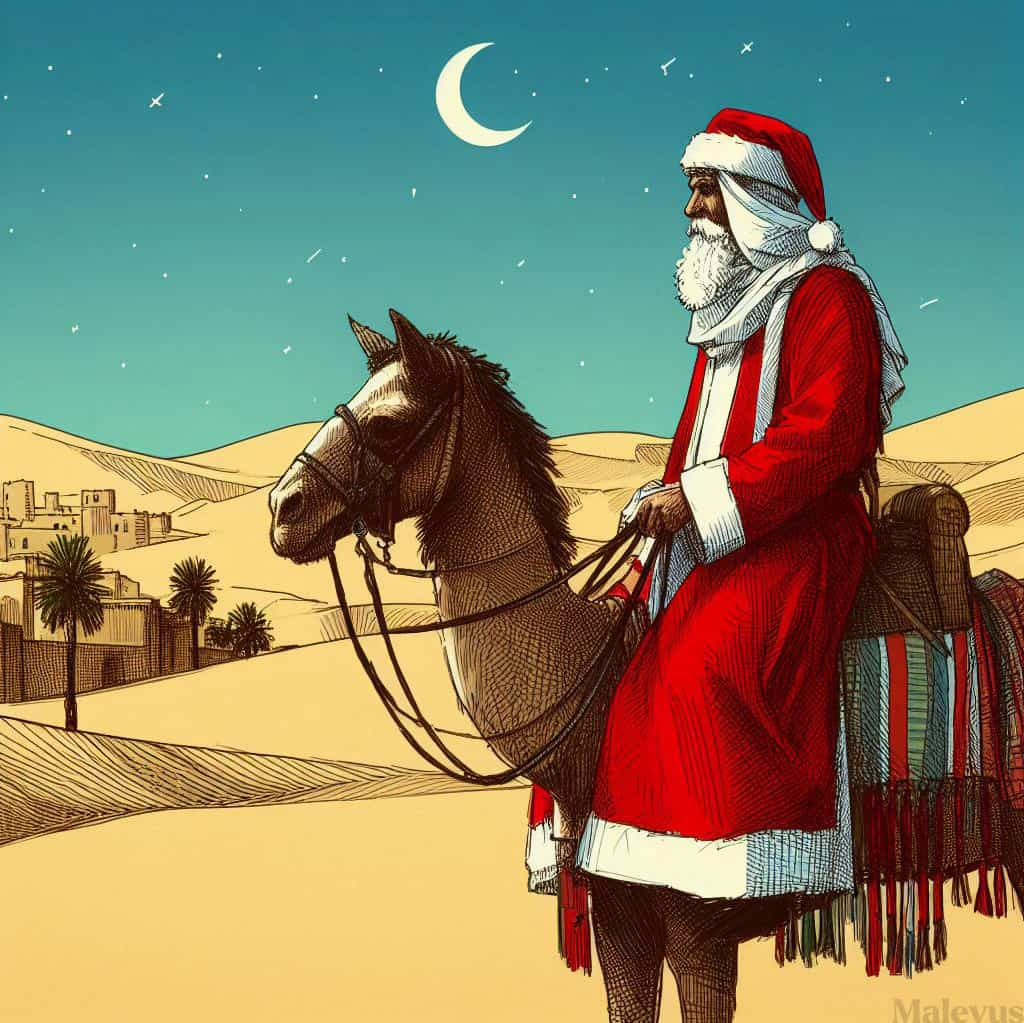
The practice of gift-giving is important in both Christianity and Islam, but Santa Claus is not a traditional figure in Islamic culture. To emphasize the importance of gift-giving around Christmas, children in certain Arab countries, like Syria, are informed that the youngest camel, who took the three wise men to see Jesus, brings them their gifts. Instead of Santa Claus and his reindeer, there is a Christmas camel. On the other hand, publicly celebrating Christmas is forbidden in Saudi Arabia but the immigrant workers celebrate it covertly.
However, Santa Claus is still making appearances in Marrakech, Morocco, to pose for photos with tourists. On the day of Ashura, a festival honoring generosity, giving, and aiding the poor, the Moroccan version of Santa Claus is called Baba Achour. Santa Claus is called Baba Noël in Lebanon, and he is part of a few Catholic customs, like attending a midnight mass service. The Arab World does not have a strong Santa Claus tradition, but the custom of exchanging gifts is there.
The Christmas Meals in Arabs
Christmas dinners can differ from one Arab nation to another.
Jordan: Jordanian dishes such as mansaf (a beef and rice dish prepared with jameed cheese) and wara’ dawali (stuffed vine leaves) are served at the Christmas feast. A classic Christmas turkey sits among Middle Eastern salads such as tabbouleh and fattoush, as well as mezze dishes such as baba ghannouj and hummus. Kunafa and Arabic sweet treats like maamoul and basbousa are among the desserts.
Palestine: Their Christmas feasts aren’t complete without qedreh, a stew made of rice, chickpeas, and lamb cooked in a wood-fired oven. Mezze platters and mihshe malfouf, a stuffing of cabbage leaves with rice and minced meat are also popular. Kunafa nabulsiya, maamoul, and ghraybeh, a typical buttery biscuit, are the dessert options.
Egypt: The traditional Egyptian Christmas meal, fattah, is a combination of rice, bread, boiled lamb or beef, and a vinegar and garlic dressing. It is a popular dish for the holiday. Traditional pastries and molokhiyah (a soup made with leafy greens) are among the other dishes. Maamoul and zalabiya, a beloved Christmas delicacy, are the dessert options.