While everyone knows the famous mid-December Roman festival of Saturnalia—when social roles inverted and Rome erupted in a week of gift-giving and carnival—fewer people realize that as the Roman Empire transitioned from classical antiquity into the medieval Byzantine Empire centered in Constantinople, an equally vibrant, month-long winter solstice festival took over the late November and December calendar: the Brumalia. Named after the shortest day of the year and celebrated across twenty-four consecutive nights mapped to the twenty-four letters of the Greek alphabet, the Brumalia blended ancient agricultural tributes to the wine god Dionysus and the grain goddess Demeter with imperial banquets, torchlit street masquerades, and fortune-telling for the coming winter.
Etymology of “Bruma” (The Shortest Day) and Romulus’s Legend
In classical Latin, the noun bruma was a contraction of the superlative phrase brevissima (dies)—meaning literally “the shortest day of the year” (the Winter Solstice), and by extension the frosty heart of midwinter. According to the sixth-century AD Byzantine antiquarian John Lydus (in his treatise De Mensibus, “On the Months”), the festival traced its mythical origins back to Rome’s founder, Romulus, who supposedly instituted midwinter feasts to entertain the Senate and army when snow and freezing mud halted military campaigns and farm work.
In the agrarian calendar of the Roman and Greek East, late November and December marked the critical threshold of the agricultural year:
- Farmers had just finished plowing and burying their winter wheat seeds inside the cold, dark soil, praying to Kronos (Saturn) and Demeter (Ceres) that the seeds would survive the frost underground.
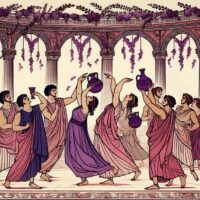
- Simultaneously, winegrowers were tapping the first fermented barrels of the autumn grape harvest, pouring libations of new wine (gleukos) and sacrificing pigs and goats to Dionysus (Bacchus) so the warmth of wine would carry humanity through the dark winter nights.
The 24-Night Alphabetical Banquet Marathon (November 24 – December 17)
By the fifth, sixth, and seventh centuries AD in the Eastern Roman (Byzantine) capital of Constantinople, the Brumalia had evolved into a beloved twenty-four-day festival running from November twenty-fourth straight through to December seventeenth (where it handed the baton directly to the start of Saturnalia and the buildup to Christmas).
What made the Byzantine Brumalia one of the cleverest social traditions in history was how those twenty-four days were organized around the twenty-four letters of the Greek alphabet, from Alpha ($\text{A}$) to Omega ($\Omega$):
- Your Initial Night to Host: Each of the twenty-four days of the festival was assigned one letter of the Greek alphabet in order: Day 1 (November 24) was Alpha, Day 2 (November 25) was Beta, Day 3 was Gamma, all the way to Day 24 (December 17), Omega.
- Feasting by First Name: On the specific calendar day matching the first letter of your first name—for example, if your name was Alexios or Anna, your day was November twenty-fourth (Alpha); if your name was Konstantinos, your day was December third (Kappa)—it was your turn to be celebrated! Friends sent you gifts and poems wishing you “living through a happy winter,” and that evening you threw open your doors (or the Emperor himself hosted senators inside the Great Palace of Constantinople on the night of the Emperor’s initial!) to host a lavish midnight banquet of roasted pork, spiced wine, and music for all your friends.
- Predicting the Winter Weather: Furthermore, farmers treated the twenty-four days of the Brumalia as a meteorological crystal ball, believing that the weather on each day predicted the weather of the corresponding month and weeks of the coming year.
The 692 Council in Trullo Ban—and How the Emperors Ignored It!
Because citizens during the Brumalia also dressed up in comic masks inside the streets, swapped male and female clothes, danced in torchlit processions, and swore oaths by the pagan wine-god Dionysus while treading grapes, hardline Christian bishops in Constantinople grew furious that a festival with pagan roots was thriving right inside the capital of Christendom.
In 692 AD, the Quinisext Council (the Council in Trullo) passed Canon 62, officially banning the Brumalia, the Kalends, and the wearing of comic or satyr masks on pain of excommunication for laypeople and deposition for clergy. Remarkably, the citizens—and even the deeply pious Byzantine Emperors themselves!—loved the alphabetical name-day dinner parties so much that they simply stripped out the explicit prayers to Dionysus and kept celebrating the Brumalia inside the Imperial Palace for another three hundred years, with the tenth-century scholar-emperor Constantine VII Porphyrogenitus recording in detail how he and the royal court still celebrated the candlelit banquets of the Brumalia in the 950s AD.