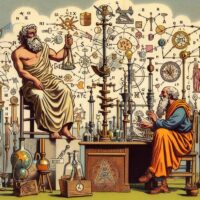
In the Hermetic tradition of Western alchemy, the ultimate ambition of the adept was known in Latin as the Magnum Opus, translating literally to the Great Work. Far from being a crude, get-rich-quick scheme by medieval charlatans hoping to counterfeit gold coins, the Magnum Opus was conceived as a sacred physical, philosophical, and spiritual enterprise spanning years of disciplined work inside the laboratory and the soul. By mimicking and accelerating the natural gestational processes of the cosmos inside a sealed glass flask called the Hermetic Vase or Philosophical Egg, the alchemist sought to guide base matter through four distinct color stages to give birth to the Lapis Philosophorum—the Philosopher’s Stone—capable of healing all bodily corruption and illuminating the human spirit.
Origin of the Four Color Stages in Hellenistic Alexandria
The foundational blueprint of the Magnum Opus was established as early as the first through third centuries AD in Greco-Roman Egypt, preserved in the writings of Pseudo-Democritus and Zosimos of Panopolis. Observing how artisans dyed royal purple wool, tinted metals, and fired colored glass, early Alexandrian alchemists noticed that heated metallic compounds consistently passed through a predictable sequence of chromatic shifts inside the furnace.
They codified this progression into four classical stages named in Greek and later translated into medieval Latin: melanosis or nigredo (blackening), leukosis or albedo (whitening), xanthosis or citrinitas (yellowing), and iosis or rubedo (reddening). Significantly, these four colors—black, white, yellow, and red—corresponded directly to the four classical elements (earth, water, air, and fire) and the four bodily humors of Hippocratic medicine (black bile, phlegm, yellow bile, and blood). After the fifteenth century, many European alchemists compressed the third yellow stage into the transition between white and red, leaving three primary phases symbolized by the black crow, the white swan, and the red phoenix.
Nigredo: The Black Stage of Putrefaction and Death
Every Great Work began with nigredo, the terrifying yet indispensable stage of blackening, dissolution, and putrefaction. Operating under the ancient alchemical axiom that no generation can take place without prior corruption—just as a wheat seed must rot in the dark soil before a green stalk can sprout—the alchemist took the impure starting material (the prima materia) and subjected it to calcination by fire and dissolution in corrosive acids.
Inside the vessel, the metals lost their solid crystalline structure, boiling and decomposing into a uniform, foul-smelling black sludge called the Caput Mortuum (Dead Head) or Corvus Niger (Black Crow). In woodcuts from treatises like the Rosarium Philosophorum, nigredo was illustrated as a king and queen dying inside a tomb, a skeleton standing atop a black sun (Sol Niger), or a dragon devouring a lion. Spiritually and psychologically, nigredo represented the dark night of the soul: the stripping away of worldly ego, pride, and false illusions as the practitioner confronted mortality and chaos.
Albedo: The White Stage of Purification and Lunar Light
Once the matter had been thoroughly broken down into black ash at the bottom of the flask, the alchemist began the patient work of ablution—washing and distilling the blackened residue repeatedly with pure philosophical mercury or dew until the darkness receded. Suddenly, the matter inside the vessel gleamed with a brilliant, pearlescent silver whiteness known as albedo, or the leukosis.
Governed by the feminine, reflective archetype of the Moon (Luna) and associated with silver, the White Queen, the white rose, and the swan, albedo marked the moment when the soul, having been separated from the dead body during nigredo, was washed clean and reunited with the purified matter. At this point in the Magnum Opus, alchemists claimed to have achieved the “Lesser Work” or the White Stone, an elixir capable of transmuting base metals into pure silver and restoring emotional clarity and inner peace to the mind.
Citrinitas: The Yellow Dawn of Solar Awakening
To reach the highest perfection, however, the alchemist could not stop at the cool lunar reflection of albedo. By steadily increasing the dry heat of the furnace (the athanor), the white matter began to blush with a golden-yellow hue known as citrinitas, or xanthosis. Symbolized by the rising of the morning dawn, the peacock’s tail (cauda pavonis)—which flashed a rainbow of iridescent colors just before settling into yellow—and the golden eagle, citrinitas represented the awakening of direct solar consciousness.

Where albedo was the passive reflection of light like the moon mirroring the sun, citrinitas was the ignition of an internal, self-generating fire—the dawning of wisdom, masculine sulfur, and active creative power within the vessel.
Rubedo: The Red King and the Philosopher’s Stone
Driving the fire of the furnace to its maximum intensity brought the Magnum Opus to its triumphant conclusion: rubedo, the reddening. Inside the sealed glass egg, the yellow matter coagulated and fixed into a deep crimson or purple crystalline powder or stone—the Philosopher’s Stone, symbolized by the Red King emerging from the flames, the pelican piercing its own breast to feed its young with its blood, and the immortal Phoenix rising from its ashes.
In the language of Hermetic philosophy, rubedo represented the Chymical Wedding (Coniunctio Oppositorum): the complete, permanent reconciliation of all cosmic opposites—spirit and matter, male and female, sun and moon, fire and water, conscious and unconscious—into a unified whole. Whether interpreted by early chemists like Robert Boyle and Isaac Newton as a quest for the fundamental laws of atomic transmutation, or by twentieth-century depth psychologists as the ultimate map of human self-realization, the Magnum Opus remains Western history’s richest metaphor for transformation through fire.