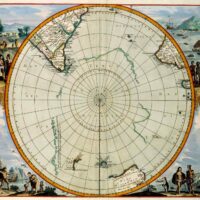
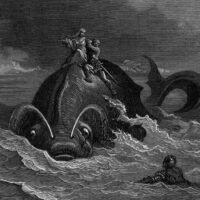
The Latin phrase “hic sunt leones” (literally “here be lions”) or “hic sunt dracones” (literally “here be dragons”) is an expression associated with ancient maps to denote the still unexplored zones of Africa. This phrase recurs in historiography and literature but lacks evidence in medieval cartographic documentation and is rarely found in ancient artifacts.
HC SVNT DRACONES
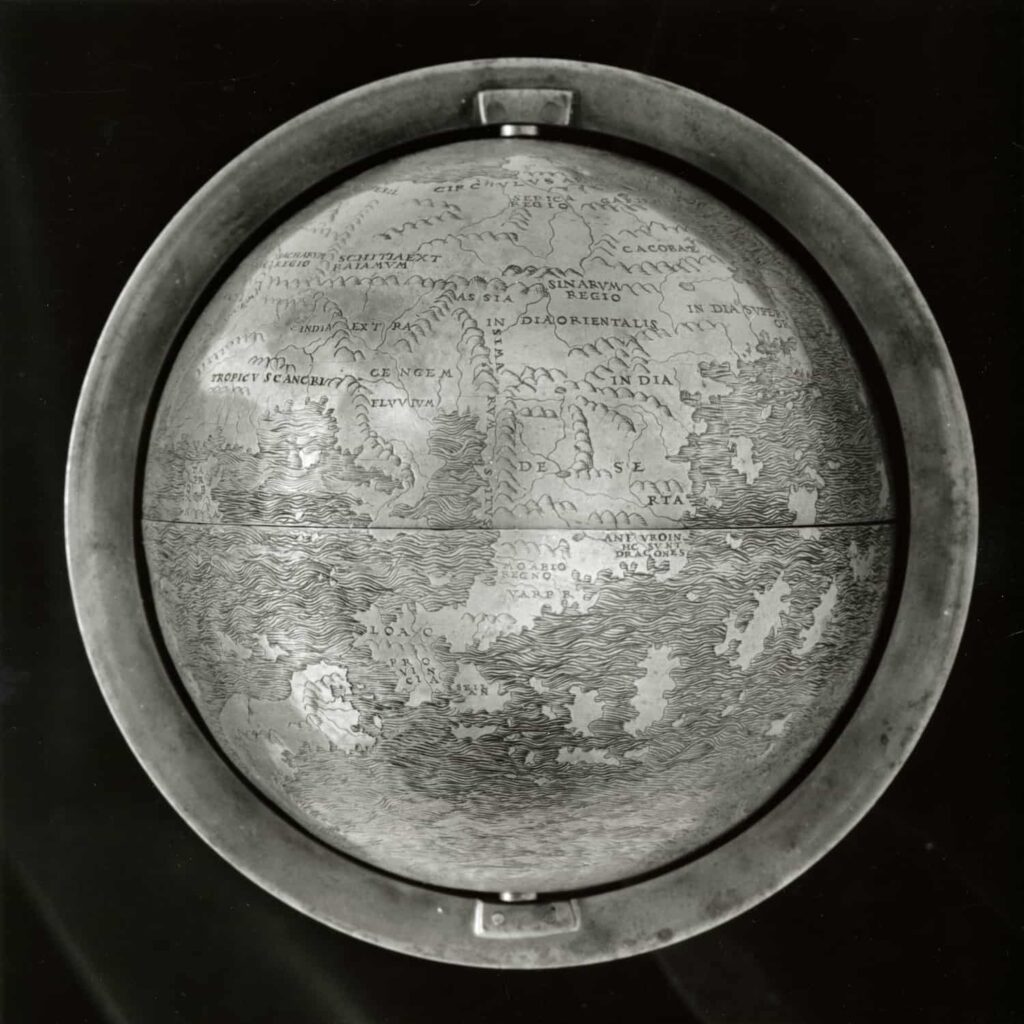
Early world maps often illustrated the space beyond the known world with mythical creatures like sea serpents and sea monsters. On the Hunt-Lenox Globe, one of the oldest surviving globes dating back to the years 1503–1510, the inscription HC SVNT DRACONES is located in the area of eastern Asia below the equator. While this is the only known use of the phrase on a historical map, the expression in Latin, as well as its English translation, “here be dragons,” has gained proverbial significance in the English-speaking world since the 20th century. It serves as a warning about unexplored and perilous territories.

Here Be Dragons and Here Be Lions
Only the Cotton Map (10th century AD) includes the mysterious statement “hic sunt leones” between Gog and Magog and the eastern coast of Asia, accompanied by a drawing of the well-known maned feline. Indeed, in that area, there were tigers, leopards, and also lions (a small population still exists in India today). Some maps instead feature the expression “hic sunt dracones.” Additionally, it is not uncommon to come across the indication “hic nascuntur elephantes,” but the latter seems more like information about ivory resources.
There is no historical evidence that the phrase was ever used by a cartographer for Mediterranean Africa. However, a widely spread explanation suggests that originally, the Latin phrase “hic sunt leones” appeared on geographical maps of ancient Rome and later periods, marking the unexplored regions of Africa and Asia. The phrase signified the uncertainty about what lay in those unknown lands, except for the presence of wild beasts, or it referred to territories that could not be conquered.
Many times, pre-industrial-age cartographers adorned their maps with ornamental drawings, sometimes as per the request of patrons, featuring coats of arms, flags, large portraits of rulers, goods, and more. This was especially true for cartographic schemes intended for scholastic meditation rather than actual travel. Particularly during the late Middle Ages, the coastlines were much more known than the inland territories.
For this reason, even well into the modern era, cartographers placed various illustrations in vast continental areas that could be somewhat curious or interesting, allowing ample space for both imaginary and unreachable places (such as the terrestrial paradise, Gog and Magog, and the realm of Prester John) and various legendary or allegorical beings, including blemmies, cynocephali, elephants, unicorns, rhinoceroses, manticores, and even lions. In reality, uninhabitable areas were defined based on temperature (excessive cold or heat) or the presence of venomous snakes and scorpions (as seen in Leardo), serving as a metaphor for satanic allegories in the Bible.
Today, the phrase is used to indicate a situation or condition requiring particular attention or respect for a certain group of people.
The Phrase in Literature
- Inspired by the reading of medieval maps, Marco Polo asserts that lions were abundant in China, likely alluding to tigers since lions never lived in China (zoological classification would only emerge later).
- The term is also the title of Stephen King’s horror short story, Here There Be Tygers, which is an allusion to the phrase.
- In Umberto Eco’s novel “The Name of the Rose,” the symbolic meaning of this phrase is anachronistically used by one of the protagonists, Jorge da Burgos, in the sentence “There are boundaries beyond which it is not allowed to go. God wanted it written on certain maps: hic sunt leones,” when he and the protagonist, William of Baskerville, were in the secret room of the library called “finis Africae.”
Usage of Here Be Dragons Today
Technology, Science, and Economy
In the source code of applications, the phrase is often inserted as a comment to warn other developers about poorly written code or confusing sections. In the financial world, risk managers use the jargon “T.B.D.” (there be dragons) to indicate risks that are not foreseeable. The Chaos Computer Club had chosen “here be dragons” as the motto for the 26th Chaos Communication Congress. Olle Häggström named a monograph published in 2016 on existential risks and transhumanism after the English translation of the phrase. OpenStreetMap names its servers after fictional dragons.

Pop Culture
Numerous references can also be found in pop culture: In the English original of the series Star Trek: The Next Generation, in Episode 28 “Where Silence Has Lease,” Captain Picard comments on the unknown future with: “Beyond this place there be dragons.” Additionally, in the video game Divinity 2: Ego Draconis, a parchment can be found bearing the inscription “Hic sunt Dracones,” and in the video game Eternal Darkness: Sanity’s Requiem, a document with the words “Hic sunt dracones” is discoverable.
The formulation is also used in the BBC series Sherlock: Mycroft Holmes justifies his statement that Sherlock would be more useful in England than on a potentially deadly intelligence mission in Eastern Europe by saying, “Here be dragons,” to his brother, whom he calls a dragon slayer. In the Syfy series “The Expanse,” taken over by Amazon Prime, the eleventh episode of the second season is titled “Here There be Dragons.” In the video game The Witcher 3: Wild Hunt, the phrase is also used to indicate the outskirts of the open world that the titular character cannot venture into.
In this context, the expression has an ironic meaning within the game, as the Witcher hunts monsters but not dragons. Other monsters are often initially introduced as “dragons,” only to be revealed as false.
Related Expressions
Comparable is the meaning of “Hic sunt leones.” This variant is quoted in Umberto Eco’s The Name of the Rose by William of Baskerville due to its double meaning when he finds the “finis africae” (“End of Africa”).