In Greek mythology, Ceto (Κητώ / Kētō: “large fish,” hence “cetacean”) was a fearsome female aquatic monster, the daughter of Gaia, the Earth, and Pontus, the Sea. Ceto was associated with the perils of the sea and sea monsters, such as whales or sharks. The term “ceto” eventually became a word to refer to any sea monster, and it is still used that way. Her role in mythology is that of the mother of a progeny of aquatic and serpentine monsters, in union with her brother, Phorcys, with whom she had many daughters collectively known as the Phorcydes (although of all her daughters, the Graeae are often directly described as the Phorcydes). In Greek art, she was depicted as a fish with a serpent-like form. Ceto also gave her name to the constellation Cetus, the whale. In the so-called Perseus cycle, the mythological hero defeats Ceto before she devours Andromeda, an event often depicted in works by painters such as Titian, Rubens, or Delacroix. The nature of Ceto is similar to that of other goddesses with whom she is associated, such as Charybdis, Scylla, Lamia, Echidna, and Hecate, goddesses who give birth to monsters and possess a formless and bestial nature. Ceto is the origin of the term “cetacean.” Cetus is also the name of the constellation Whale.
Ceto Myth in Ancient Sources
In the Theogony, Hesiod names her as having “beautiful cheeks” and states that the children of Ceto and Phorcys were, namely: the Graeae (Pephredo and Enyo), “gray-haired from birth,” the two Gorgons (Euryale and Stheno, not including Medusa since she was the only mortal of the three Gorgons), and the enormous serpent that guarded the golden fruits of the Garden of the Hesperides. Echidna is also mentioned as her daughter or descendant, as the poem does not clearly specify her parentage. Following the Hesiodic tradition, Apollodorus tells us that “from Phorcys and Ceto (were born) the Phorcydes and the Gorgons.”
Other versions vary in the genealogy. Higino tells us that a certain Gorgon was the father of the Gorgons, a name that would then be considered a patronymic and not a theonym. The dragon of the Hesperides, later named Ladon by poets, is sometimes imagined as the son of Typhon and Echidna. A scholium on Apollonius of Rhodes cites Phorcys and Ceto as the parents of the Hesperides, but this opinion is only held by this author. In the Homeric poems, Ceto is not described. In the Odyssey, Phorcys was the father of Thoosa, who, in turn, was the mother of Polyphemus by the work of Poseidon, but the mother of Scylla was Cratais. Stesichorus refers to Scylla as the daughter of Phorcys and Lamia (which can be translated as “the shark,” referring to Ceto and not the mythological queen of Libya).
Sea Monster in Greek Legends
Kêtos (later Latinized as Cetus) is a generic term that has designated various sea monsters.
Andromeda and the Sea Monster
Sent by Poseidon, this “sea monster” (θαλάσσιον κῆτος / thalássion kêtos) is tasked with devouring Princess Andromeda, exposed as a sacrifice after her mother Cassiopeia claimed that she is more beautiful than the Nereids, cherished by Poseidon. Perseus kills the monster and saves Andromeda.
Pliny the Elder mentions a cult of the “legendary Ceto” in Joppa — modern-day Jaffa — in a single reference, indicating that the remains of Andromeda’s chains can be found there. S. Safrai and M. Stern propose two hypotheses to explain the mention of a Ceto cult in Joppa by Pliny: this cult was actually devoted to the monster from the Andromeda story, which a resident of Joppa may have established under the name Ceto, and it involved another deity, cetos or Derceto, whose name was distorted.
Laomedon and the Sea Monster
Further in the Library, the story is told (also found in Diodorus Siculus’ Historical Library) of Laomedon, who, after offending Apollo and Poseidon, was forced to sacrifice his daughter to a sea monster (kêtos), which would come to abduct people even in the fields. Referring to this divine vengeance against Laomedon, Ovid identifies Ceto with a flood. Other authors, like Valerius Flaccus, add the noise of an earthquake. Both elements suggest a tsunami.
According to Apollodorus, the monster was eventually killed by Heracles. According to the Incredible Stories by Palaephatus of Samos, the monster Ceto, also called Ceton, was a powerful king who, with his ships, subdued all the coasts of Asia Minor, including the city of Troy, which owed him a tribute called dasmos. At that time, money did not exist — the tribute was paid in kind, with horses, cattle, or young girls. If the tribute was not paid, he would devastate the region. Heracles and his armed men passed through the region as Ceto landed and marched against Troy; Laomedon hired Greek soldiers who, alongside his own, fought and killed Ceto and his men.
Other Mentions and Representations
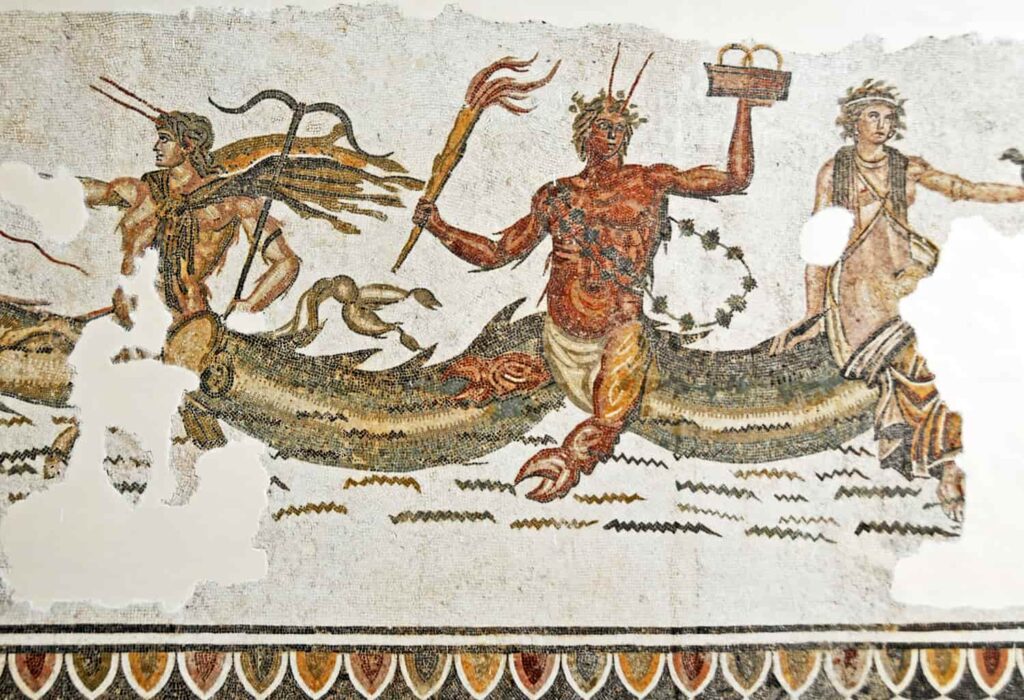
As such, she is described as a horrifying female sea monster that has the appearance of an immense whale combined with the features of a shark, ray, and dragon. She could freely assume the form of any one of these four creatures or all of them at once. She is often depicted as a whale with shark-like characteristics (reminiscent of the killer whale) or as a sea dragon resembling a ray (similar to the manta ray).
In the Odyssey, Homer refers to seals as kêtos. Aristarchus of Samothrace, as reported by Eustathius of Thessalonica, speaks of the myth of a relatively unknown people mentioned by Homer in the Odyssey, the Ceteians, further revealing that they were present in the battles during the Trojan War alongside Eurypylus, a Mysian fighting on the side of the Trojans and coming from a kingdom neighboring Troy.
These Ceteians also fell in the war as they had come to marry Trojan women. This people allegedly have a myth associating the death of great figures with a large fish—which is the basic meaning of the Greek word κῆτος / kêtos, denoting any large aquatic animal, such as whales or cetaceans—in the profound grief that drowns them at their disappearance.
Genealogy
Ceto is the daughter of Pontus and Gaia. Together with her brother Phorcys, Ceto gives birth to numerous sea monsters. Hesiod’s Theogony lists their children as Echidna, the Gorgons (Stheno, Euryale, and Medusa), the Graeae (Enyo and Pemphredo—Dino is not mentioned by Hesiod), as well as Ladon, the “Dragon of the Hesperides” (some authors attribute him as the son of Echidna and Typhon). Additionally, Ceto has given birth to the Hesperides themselves. A scholiast of Apollonius of Rhodes is the only one to name Phorcys and Ceto as the parents of the Hesperides. Homer mentions Thoosa, the mother of Polyphemus, as the daughter of Phorcys, but without specifying if Ceto is her mother.
Consorts and Offspring
- With Phorcys (son of Pontus and Gaea)
- Echidna (doubtfully)
- The Gorgons (or daughters of Gorgon):
- Stheno
- Euryale
- Medusa
- The Graeae (or simply, the Phorcydes):
- Dino
- Enyo
- Pephredo
- The Hesperides nymphs
- Ladon (the dragon of the Hesperides)
- Scylla (as Cratais)
Crateis
Ceto is identified in two aspects, both as the mother of Scylla in Homeric texts. The Homeric texts refer to Scylla as the daughter of a certain Cratais or Crateis (Κραταιις), which may denote “the powerful” or “of the rocks.” Apollodorus, who wrote many centuries after Homer, recounts that “there was Scylla, daughter of Crateis and Trienus or Phorcys, who had the face and chest of a woman; from her sides, six heads of dogs with twelve legs each protruded”; thus, he identifies Scylla as one of the Phorcydes.
There is also a river called Cratais in the territory of the Bruttii, near the Strait of Messina.
Other Oponymous Characters
The sources also speak of the cetos or cetaceans, sea monsters that are difficult to differentiate from the daughter of Pontus. In Greek art, the goddess was represented in anthropomorphic form, but it is very common to confuse her with the monsters that attacked Troy and Ethiopia and with the constellation of Cetus, which derives from “Κητος Τροιας,” the monster sent by Poseidon to destroy Troy.
This cetos appears in two episodes: the chaining of Andromeda (in which Perseus is the hero who faces it) and that of Hesione (whose rival, in this case, was Heracles). In mythological sources, there is also one of the Oceanids named Ceto. She was a naiad from India who, in her union with Helios, bore Astris or Astride, who, in her union with the river god Hidaspes, was in turn the mother of Deriades, the main antagonist in Nonnus of Panopolis’s Dionysiaca.
Sea Monster in Other Legends
Hebrew Bible
The Book of Jonah (2:1) speaks of dag gadol (דג גדול), which can be literally translated as “great fish.” The Septuagint translated this phrase into Greek as μέγα κῆτος / méga kêtos.
Jerome of Stridon, in the Vulgate, later translates these terms into Latin as piscis grandis (“great fish”). However, in the Gospel according to Matthew (12:40), he translates the word kêtos as cetus.
Subsequent Developments
Sciences
Her name has been given to the asteroid (65489) Ceto.
Literature
In Chapter II, III, 3, Explanation of the noise heard by Gilliatt, from the novel Les travailleurs de la mer, Victor Hugo refers to the ocean in these terms: “Navigation confronts a unique monster. The entire sea is the same hydra. The waves cover the sea with a kind of fish skin. Ocean, it is Ceto.”
Cinema
- 1981 and 2010: In the film Clash of the Titans directed by Desmond Davis or its 2010 remake, the monster is called the Kraken, which is a misnomer as it is a creature from Norse mythology.
- 2003: In the animated film Sinbad: Legend of the Seven Seas (2003), a sea monster of the goddess Eris is named Cetus.
Comic Book
2008 to 2012: In the manga Beyblade: Metal Masters, a member of the European team has a spinning top called “White Grand Cetus,” and one of their teammates has a spinning top called “Blue Grand Cetus.”
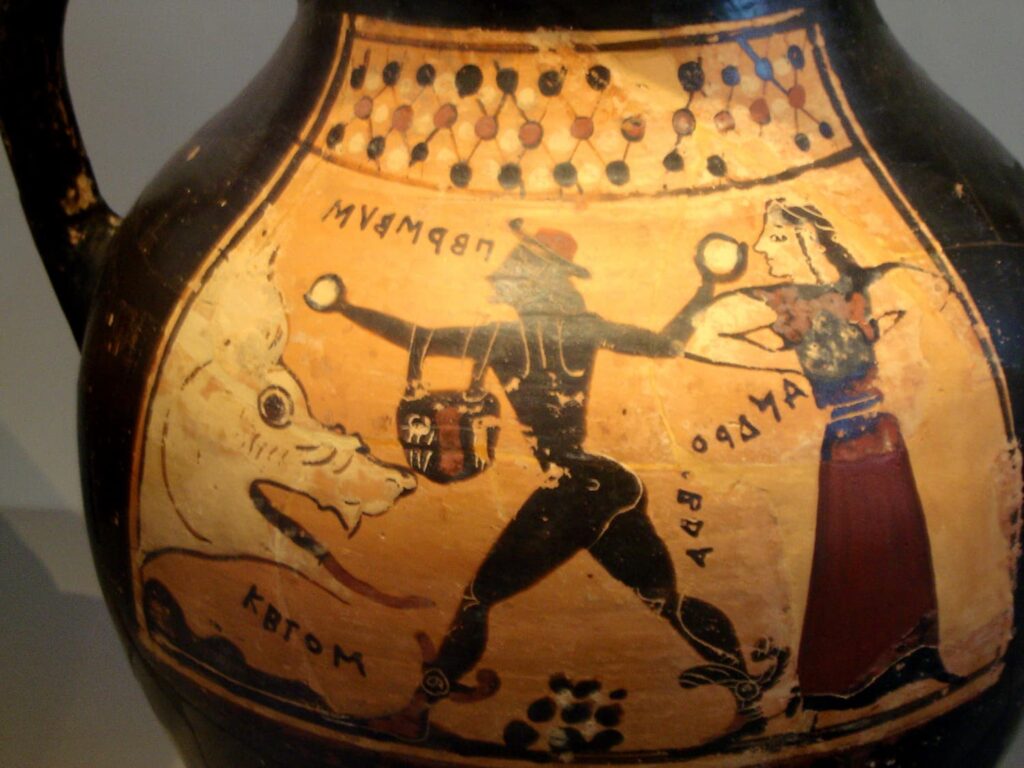
Featured Image: Keto, the sea monster on a loutrophore with Perseus and Andromeda.