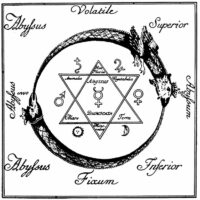
Look at a branching river delta photographed from an orbiting satellite, and it looks startlingly identical to the branching network of veins and capillaries inside a human lung or retina. For more than two thousand five hundred years, philosophers, physicians, and mystics across Greece, China, India, and Renaissance Europe looked at these uncanny structural mirrors between the human body and the vast universe around it and formulated one of the most enduring ideas in intellectual history: the doctrine of the Microcosm and the Macrocosm—the belief that the individual human being is a miniature, living replica (a “little world”) containing every law, element, and harmony of the entire universe.
Etymology: Democritus and the Greek “Mikros Kosmos”
The English word microcosm comes directly from the ancient Greek phrase mikros kosmos (combining mikros, “small,” with kosmos, meaning both “order/harmony” and “the universe”), contrasted with the makros kosmos or megas kosmos (“the Great World” or the Universe at large).
The earliest surviving philosophical fragment using the exact phrase mikros kosmos to describe a human being belongs to the fifth-century BC pre-Socratic Greek atomist philosopher Democritus of Abdera (Fragment 34), while his contemporary Anaximenes and later Plato (in his cosmological dialogue the Timaeus) and Aristotle (in his Physics) expanded the concept into a cornerstone of classical thought. In Plato’s Timaeus, when the divine craftsman (the Demiurge) fashioned the physical universe, he built the cosmos not as a dead clockwork machine, but as a single, giant living organism possessing both a body and a rational World-Soul (Anima Mundi)—and then crafted the human being using the exact same harmonic proportions in miniature, making the spherical human skull a mirror of the spherical vault of the heavens.
Anatomical Correspondences: Rivers as Veins, Bones as Rocks
Across late antiquity, the Islamic Golden Age (most notably in the tenth-century encyclopedias of the Brethren of Purity in Basra), Jewish Kabbalah (Adam Kadmon), and medieval Christian mysticism (such as the twelfth-century visionary paintings of Saint Hildegard of Bingen), scholars mapped out an elaborate system of physical correspondences between the Great World (Macrocosm) and the Little World of Man (Microcosm):

- Earth and Bones/Flesh: Just as solid bedrock and mountain ranges form the structural skeleton holding up the continents, calcified bones support the human frame, while fertile soil corresponds to muscular flesh and grass/trees correspond to human hair.
- Water and the Bloodstream: Just as the great rivers, subterranean springs, and ocean tides circulate moisture across the globe, veins and arteries carry the four humors and blood from the heart across the body.
- Air and Breath (Pneuma): The four winds and atmospheric breezes of the sky mirror the living breath inhaling and exhaling through the human lungs.
- Fire and Vital Heat/Intellect: The blazing heat of the Sun and the celestial stars above mirror the metabolic warmth of the human heart and the spark of rational consciousness inside the mind.
Renaissance Medicine, Da Vinci’s Vitruvian Man, and Paracelsus
The philosophy of the Microcosm reached its artistic and medical zenith during the fifteenth- and sixteenth-century European Renaissance. When Leonardo da Vinci drew his iconic 1490 pen-and-ink masterpiece, the Vitruvian Man—inscribing a naked human figure with outstretched arms and legs simultaneously inside a perfect square (the ancient symbol of the material, four-cornered earthly world) and a perfect circle (the symbol of the eternal, divine heavens)—he was illustrating what he called in his notebooks the “cosmografia del minor mondo” (“the cosmography of the microcosm”).
In Renaissance medicine, this belief was not mere poetry; it was clinical practice:
- Melothesia (“Zodiac Man”): Every medieval and Renaissance physician’s almanac featured a diagram of a human body showing which constellation and planet governed each internal organ—from Aries governing the head and Leo governing the heart down to Pisces governing the feet—dictating when it was safe or dangerous to perform surgery or bloodletting.
- Paracelsus (1493–1541): The Swiss pioneer of medical toxicology and chemistry built his entire medical revolution around the Microcosm. Arguing that because every mineral, salt, metal, and herb in the outside earth has an exact chemical counterpart inside the human microcosm, a physician should not merely read ancient books in a library, but study the chemistry of nature directly to find the specific mineral cure that restores balance inside the human body.
Modern Evolution of the Word
With the rise of the telescope, the microscope, and modern physics in the seventeenth and eighteenth centuries, the literal astrological link between human organs and the planets faded into history. Yet the concept of the microcosm survived intact in modern science and sociology: used by ecologists to describe a self-contained miniature ecosystem (like a sealed terrarium or a tide pool that models the entire biosphere), by sociologists to describe a small town or classroom that reflects the demographics of an entire nation, and by astrophysicists who remind us of Carl Sagan’s famous dictum—that because every iron atom in our blood and every calcium atom in our bones was forged inside the hearts of ancient exploding stars, we are still, in the truest physical sense, the universe made small enough to contemplate itself.