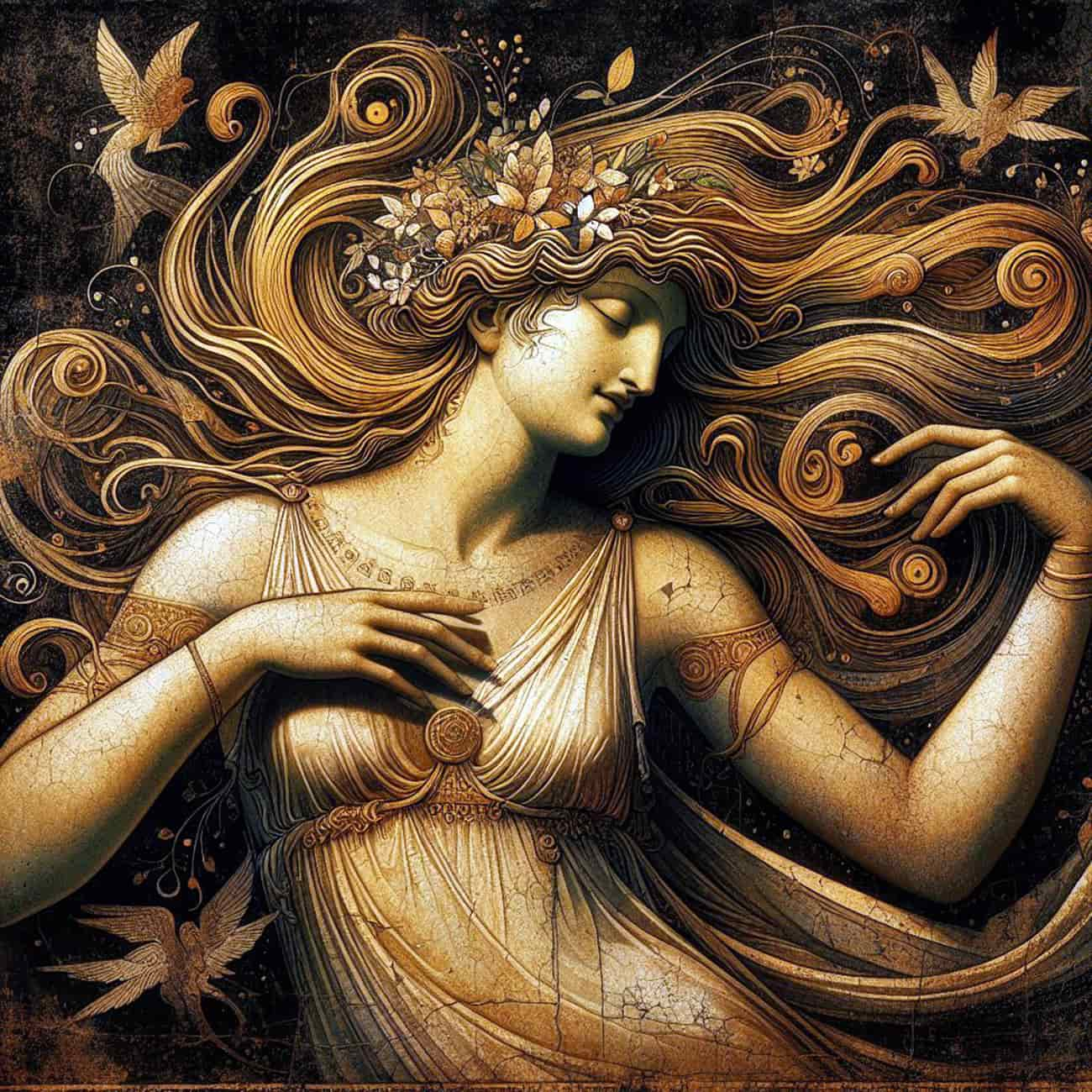
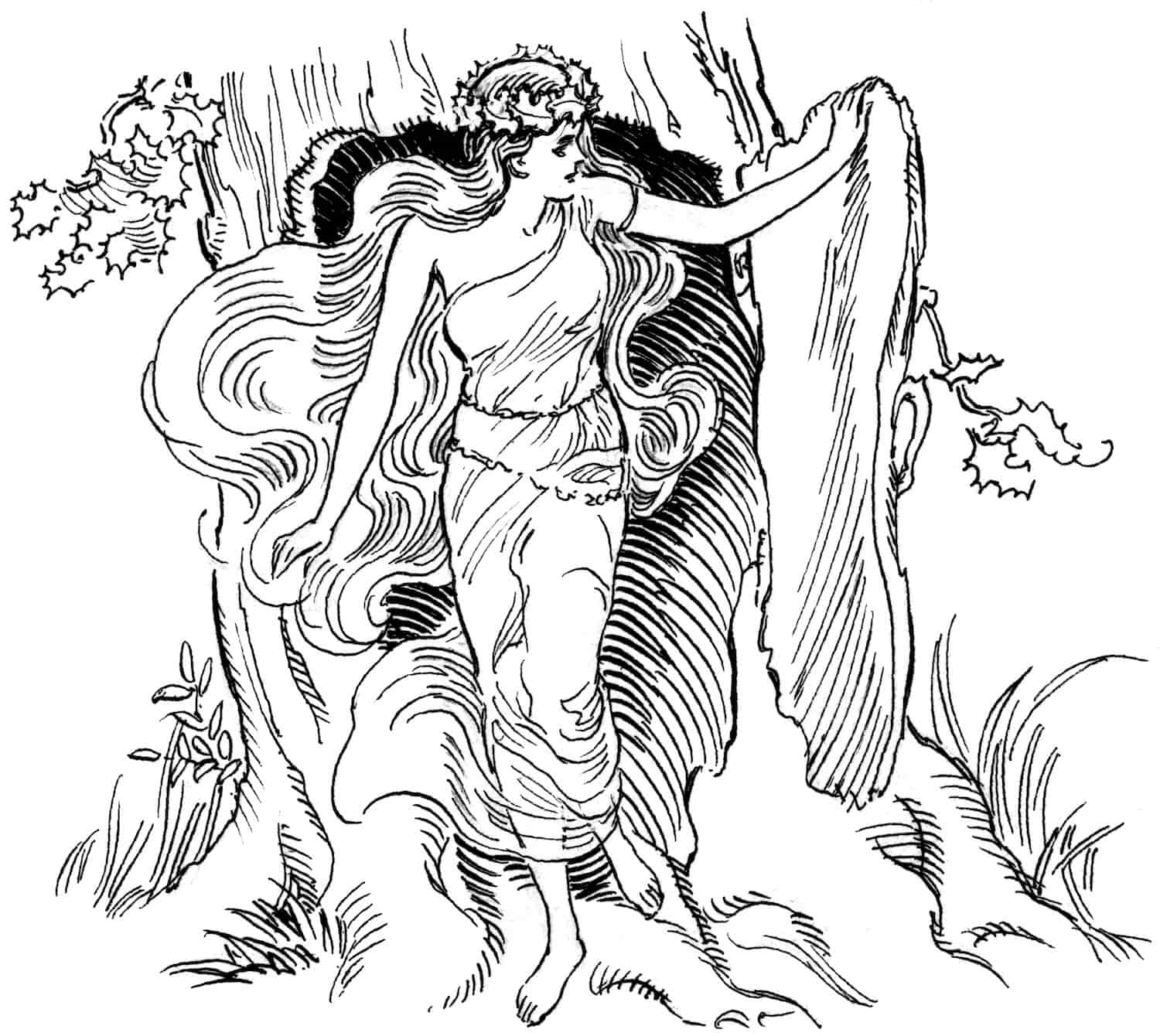
Ate, also known as Ata (ancient Greek Ἄτη, “crime”, “misfortune, calamity, blindness”), in ancient Greek mythology, is the goddess of calamity: by blinding and bewildering the minds and hearts of people, she impels them towards crimes, compels them to commit reckless deeds, the consequences of which result in various disasters; a malevolent spirit of discord and curse, whose sole occupation is inflicting harm.
She personifies error, clouding of the mind, deception, and folly. According to Homer:
“Bane [Ate] is mighty, swift of foot… // She speeds far ahead and… // Torments mortals.”
Ate in Mythology
Ate was the personification of mind damage and reckless actions, as well as the results of those actions. It led both men and gods to deviance and irresponsible acts. Ate was a calamity that struck head-on, blinding the mind and bringing about destruction. After whatever evil and accident Ate had sent, the Litae came to heal them.
Repeatedly mentioned by Homer and Aeschylus. In the “Iliad,” Homer calls Ate the daughter of Zeus (“Daughter of the thunderer, Bane [Ate]…”), without mentioning, however, her mother. Initially, she lived on Olympus among the other gods.
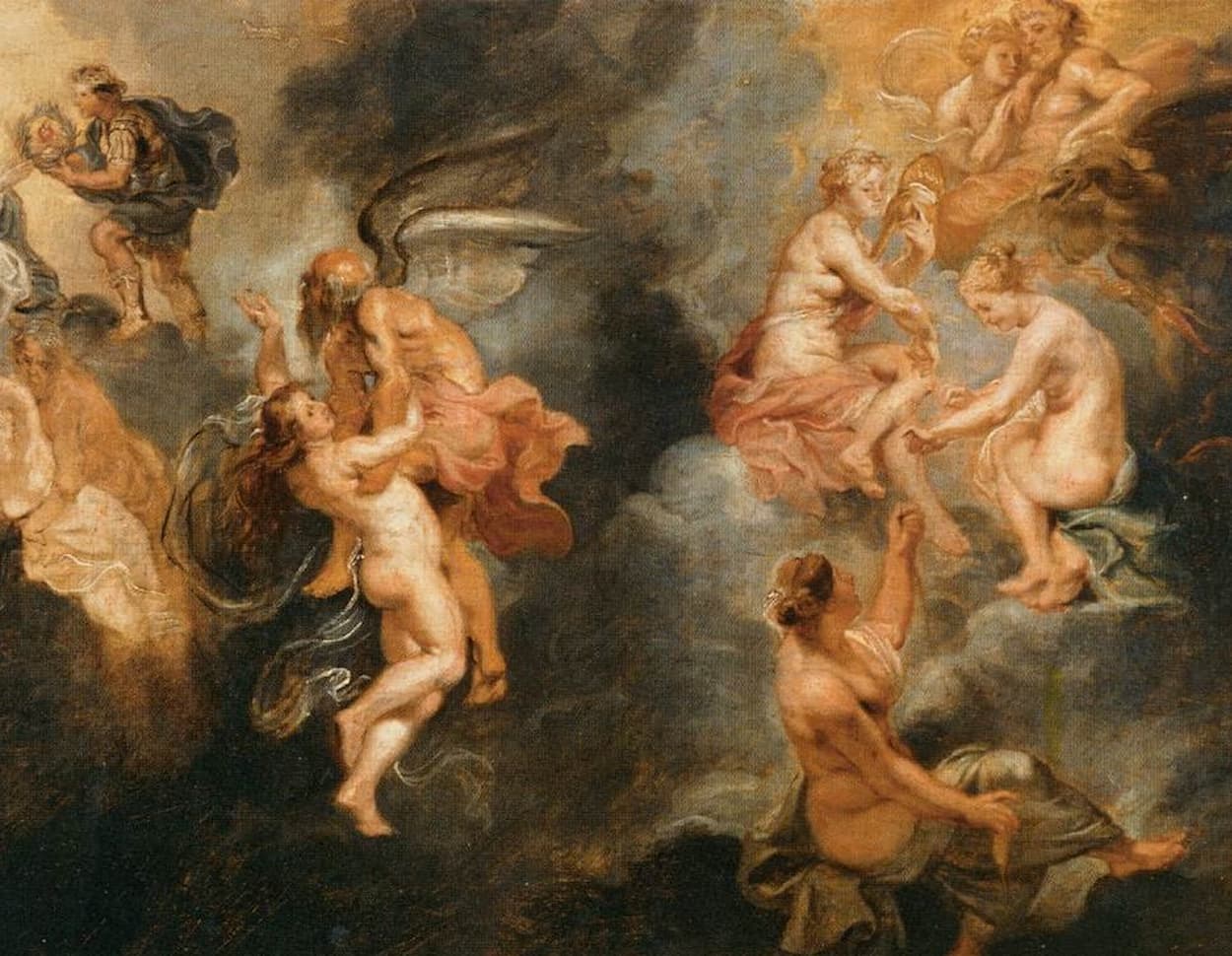
According to legend, once Hera persuaded Ate to cloud (blind) Zeus’s judgment so that he would swear to make the first mortal born his great ruler. Taking advantage of the oath, Hera hastened to ensure that Eurystheus was born before all others, and Heracles, who was born slightly later, fell under his dominion. Learning of this, Zeus in anger cast Ate from Olympus to the earth, forever forbidding her to appear in the abode of the gods.
Since then, Ate “with incredible swiftness” roams the earth. She “…does not touch them [with her feet] // The dust of the earth; she walks upon the heads of humans, // Tormenting mortals; and she easily ensnares another in her net…”, bringing ruin and devastation to mortals, pushing people toward all that is bad.
According to Homer
Homer tells us that behind Ate, always unheeded, always follow the other daughters of Zeus, the Litae, embodying remorse, prayers, and pleas for forgiveness. They attempt to rectify and atone for the sins committed by their sister; in doing so, they are lame, cross-eyed, wrinkled, and very slow. If a person honors them, they heal him from the wounds inflicted by Ate, implore forgiveness for him, but if a person neglects them, they punish him, sending their elder sister upon him again. N. I. Gnedich in his translation of the “Iliad” (1829) named Ate “Obida,” V. V. Veresaev in his translation (1949) – “Osléplenniy.”
According to Apollodorus, Ate, cast down from the heavens, fell on the summit of a mountain in Phrygia, later named after her, and with her fell the Palladium (the miraculous statue of the goddess Pallas). Later, on this mountain, Ilus founded the legendary Ilium (Troy), which is why Troy is called founded on the hill of Ate.
In Hesiod’s Theogony
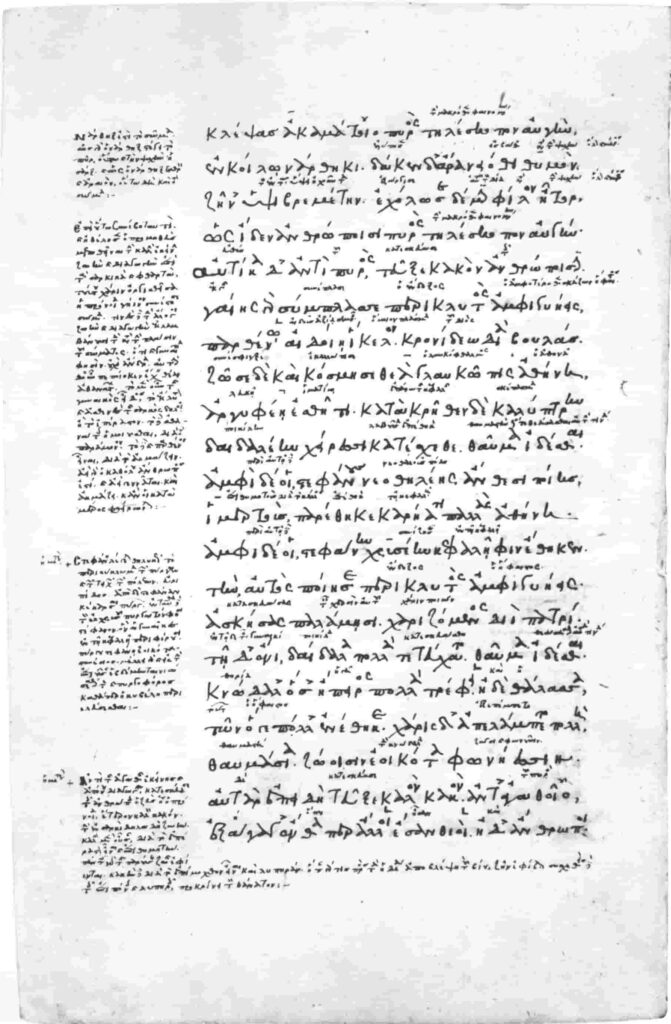
In Hesiod’s “Theogony,” the mother of Ate is named as the goddess of strife, Eris, but the name of the father is not mentioned, which led many to consider Zeus as Ate’s father. Hesiod reports that Ate always walks together with her half-sister Dysnomia, the goddess of lawlessness.
According to another legend, Heracles killed his children and nephews while under the influence of the goddess Ate. To atone for his involuntary guilt, he decided to participate in the expedition of the Argonauts.
The Description of Ate
Archaic epic poetry
According to Hesiod, in the Theogony, Ate was the child of Eris, like Ponos, Lethe, Limos, Alge, Hysmines, Phobos, Machai, Androctasiai, Neike, Pseudologiai, Amphilogiai, Dysnomia, and Orkos. She went hand in hand with her sister, Dysnomia (Anomia). As the goddess of harm and the ruin of humans, she brought disasters upon them.
In Homer‘s narrative in the Iliad, Ate was the daughter of Zeus who brought destruction to all (“the eldest daughter of Zeus, the envoy Ate, who blinds all”), capable of exercising her destructive power even on her own father, the supreme of the gods: “for Zeus at the time was in a temper, to say the least, with even the best and bravest of men.”
Her walk is described as gentle, not on the ground, but on the heads of humans, implying how easily she influences and leads them to destruction. This exact passage is commented on by Agathon in Plato’s Symposium, saying that just as in Homer, as evidence of tenderness and gentleness, Ate’s walk on the soft skulls of humans (instead of walking on hard things), one should also see the issue of the tenderness of Love.
According to the Homeric narrative, Ate contributed to Hera leading Zeus to a terrible oath, which resulted in the woes of Heracles. When Zeus realized this, he seized Ate by her glossy locks and hurled her from Olympus, down to the lands of humans: “Straightaway Zeus caught her up by her headlong, trailing hair, swearing by the headlong water of Styx that never should Ate come to Olympus and the starry sky again, she who brings harm to all.”
Classical tragic poetry
In ancient Greek tragedies, the image of Ate is different, as her action resembles that of Nemesis and the Erinyes. She avenges the heinous deeds and pursues and punishes the perpetrators of these actions, as well as their descendants. The vengeful character of Ate is more prominent in Aeschylus and less so in Euripides, where “Justice” is developed more in terms of righteousness. Thus, in Agamemnon, Clytemnestra invokes Ate and the Erinyes when referring to her husband’s murder as “perfect retribution” for the loss of Iphigenia: “and you hear the terms of my oaths; by the perfect retribution of my child, by Ate and the Erinyes, to whom I myself sacrificed him…”
In Culture and Eponymy
In ancient tragedies, the goddess Ate is portrayed as both the source of evil, falsehood, and sin, and as an avenger, thus being the companion of the goddess of retribution, Nemesis; by plunging the sinner into even greater sin and crime, she leads him to his doom.
William Shakespeare used the image of the goddess Ate in his plays “Love’s Labour’s Lost” (1595), “King John” (1595/1596), “Julius Caesar” (1599), and “Much Ado About Nothing” (1600).
Come, talk not of her. You shall find her the
Much Ado About Nothing, Much Ado About Nothing
infernal Ate in good apparel.
And Caesar’s spirit, raging for revenge,
Marcus Antonius
With Ate by his side come hot from hell,
Shall in these confines with a monarch’s voice
Cry “Havoc!” and let slip the dogs of war,
In honor of Ate, the asteroid of the main belt (111) Ate (Latin Ate) was named, discovered in 1870.
The equivalent of Ate in Roman mythology is Nephus.
Resemblance with Eileithyia
The legend of Ate attempting to interfere, in order to please Hera, with the destiny of Heracles even before his birth, appears as a duplication of the later one presenting Eileithyia, the goddess of childbirth, attempting to prevent Alcmene from giving birth to her son.
In the eleventh song of the Dionysiaca, Ate plays an exactly analogous role as an auxiliary of Hera’s vengeance by bringing about the end of Ampelos, the eromenos satyr of Dionysus, whom Hera treats as an archenemy and persecutes throughout the poem:
“Meanwhile, Ate, the homicidal deity, sees the fearless hunter [Ampelos], wandering through the mountains, far from Bacchus. Immediately, she assumes the graceful appearance of a youth of his age, and, to please the stepmother [Hera] of the divine offspring of Phrygia [Dionysus], addresses him [Ampelos] with a sweet voice, in these treacherous terms […]”
— Nonnus of Panopolis, Dionysiaca, XI
It seems that Hesiod, by diverging from the tradition of the Iliad and making Ate and Eris descendants of Nyx (Night) rather than Zeus, wanted to remove from the lineage of the latter two of his most notoriously harmful and malevolent representatives: Eris, explicitly named as the sister of Ares, also appears as a daughter of Zeus and Hera.