By using this site, you agree to the Privacy Policy.
Accept
MalevuzMalevuz
  • HISTORY
  • SCIENCE
  • BIOGRAPHY
MalevuzMalevuz
Search
  • HISTORY
  • SCIENCE
  • BIOGRAPHY
Follow US
Malevuz > Myth > Eurynomos: A Daemon in Ancient Greek Mythology
Myth

Eurynomos: A Daemon in Ancient Greek Mythology

Hrothsige Frithowulf
ByHrothsige Frithowulf
History Editor
Hrothsige is a history writer at Malevus. He has a bachelor's in history from the University of Exeter. Hrothsige's areas of historical interest encompass the ancient...
- History Editor
6 June 2025
Share
4 Min Read
SHARE

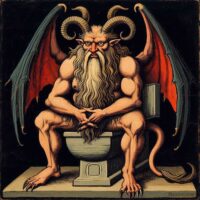
Eurynomos, or Eurynomus (Ancient Greek Εὐρύνομος), is a demon in ancient Greek mythology who dwelled in the underworld and consumed the bodies of the deceased. The artist Polygnotos depicted him in Delphi as a monster, sitting on a spread-out vulture’s skin, with a skin color ranging between dark blue and black, and with bared teeth. He can also be a monster in human form with white skin, yellow eyes, and long black hair.

Contents
  • Eurynomos in antiquity
  • Eurynomos in modern times

Eurynomos in antiquity

Eurynomos, a daimon (spirit) of decomposing corpses, is either a minor figure whose associated literature is lost to time or perhaps an invention of the painter Polygnotos. He is mentioned by Pausanias, who saw his painting in a temple in Delphi, depicting him with a dark complexion, sitting on a vulture’s skin, and showing his large teeth:

“Eurynomos, said by the Delphic guides to be one of the daimons of Hades, who eats all the flesh of the corpses, leaving only their bones. But Homer’s Odyssey, the poem called the Minyad, and the Returns, though they recount Hades and its horrors, know of no daimon named Eurynomos. However, I will describe what he looks like and his demeanor in the painting. He is of a color between blue and black, like that of flesh flies; he shows his teeth and is seated, and beneath him is spread a vulture’s skin.”

We know nothing more about him other than what Pausanias says. It is the representation of death, to which its name alludes “the one who commands widely”. Vulture skin is reminiscent of the well-known role of this animal.

buy soft cialis online http://comdistec.com/gallery/images/gif/soft-cialis.html no prescription pharmacy

Eurynomos, like Ceutonimo or Charon, are beings linked to the chthonic world, and they are never associated with any lineage, only a specific function. Compare this with Demogorgon, another mysterious entity linked to the underworld.
More Read

Bishop Fish
Bishop Fish: A 16th-Century Myth Told for 500 Years
Meliae: Nymphs in Greek Mythology
Between Scylla and Charybdis
Epiales: The Daemon of Nightmares

Eurynomos in modern times

Eurynomos is described in Collin de Plancy’s Infernal Dictionary (1853): he is a superior demon, a prince of death, who takes control of certain individuals and “sends them out” at night to kill. He makes the eyes of his victims green. He has large and long teeth, a frightful body, all filled with wounds, and wears the skin of a fox or a wolf. He is also mentioned by Pau-Païns in his famous “Little Breviary of Monsters and Other Demonic Creatures” (1850).

buy stromectol online http://comdistec.com/gallery/images/gif/stromectol.html no prescription pharmacy

Eurynomos is also mentioned in the chapter “The Infernal Names” of Anton LaVey’s “The Satanic Bible” as one of the devilish names, where it is asserted that this demon is the “Greek prince of death.

buy kamagra oral jelly online http://comdistec.com/gallery/images/gif/kamagra-oral-jelly.html no prescription pharmacy

” However, this thesis is a fantasy of LaVey’s, as according to surviving records, this demon in ancient Greek mythology is simply a minor corpse-eater. Additionally, LaVey made a mistake in the name, writing it as “Euronymous” instead of “Eurynomos.”

Interestingly, the musician Øystein Aarseth (Euronymous) took an erroneous spelling as a creative pseudonym.
Share This Article
Email Copy Link Print
ByHrothsige Frithowulf
History Editor
Hrothsige is a history writer at Malevus. He has a bachelor's in history from the University of Exeter. Hrothsige's areas of historical interest encompass the ancient world and early Europe, along with the history of modern culture.
Previous Article Belphegor Belphegor: A Demon in Jewish and Christian Tradition
Next Article Pasithea Pasithea: One of the Charites in Greek Mythology

Latest News

985px Landing of Lieutenant James Cook at Botany Bay 29 April 1770 painting by E Phillips Fox

Top 10: The Greatest Knights in History

Knights were the medieval equivalent of elite soldiers, and many…

List
3 November 2026
Charles Rolls driving a Peugeot 1896
List

10 of the Craziest Laws in History

For more than 4,000 years, humans have devised new laws…

18 October 2026
Ikinci Meksika Imparatorlugu
History

Why Did the Second Mexican Empire Collapse?

The Second Mexican Empire did not collapse because of a…

14 April 2026
A painting depicting Aboriginal Tasmanians attacking John Allen’s Milton Farm near Great Swanport in 1833.
History

Colonialism in Tasmania

The colonization of Tasmania was not a simple story of…

14 April 2026

You Might Also Like

Tamoanchan
Myth

Tamoanchan: Paradise in the Mesoamerican Cultures

27 October 2026
Vodyanoy
Myth

Vodyanoy: The Water Spirit in Slavic Folklore

7 June 2025
Gullinkambi
Myth

Gullinkambi: The Rooster Who Lives in Valhalla

6 June 2025
Haggis Animal
Myth

Haggis Animal: A Mythical Creature of Scottish Cuisine

6 June 2025
  • Privacy Policy
  • About us
  • Editorial Standards

© Malevuz. All Rights Reserved.

Welcome Back!

Sign in to your account

Username or Email Address
Password

Lost your password?