Nekhbet (Nḫbt) was likely the oldest goddess in Egyptian mythology, initially locally worshipped at Nekheb (the current site of El-Kab located 80 km south of Luxor), the capital of the third Nome, where she was the protective deity and the oldest oracle was also located. Her name means “that of Nekheb.” In Dendera there is an image of Wadjet and Nekhbet, which shows Nekhbet sitting on a papyrus plant (see feature image).
She was the vulture goddess ultimately representing the south (Upper Egypt), and whose symbol, along with the uraeus of the locally worshipped Wadjet, adorned the pharaoh’s forehead after the unification with the north (Lower Egypt). These two goddesses, collectively called the Two Women, also formed the beginning of one of the five names of the pharaoh: the nebty name or the hieroglyphs for “[he/she] of the Both Ruleresses…”.
From at least the Old Kingdom, a close connection with kingship emerged, and Nekhbet was associated as the crown goddess with the White Crown. In the Pyramid Texts, she is depicted as a large white cow as Mother Goddess. The Greeks equated her with Eileithyia.
Name and Epithets
Nekhbet is not actually a name but a reference: “That of Nekhbet”. The mother goddess in question was also called “the Secret”. Furthermore, in a number of papyri, these epithets have been found:
- The White of Nekhen
- The Silver
- Lady of the Great House
- Bow binder (denoting the peoples she unites)
- Great Wild Cow (Pyramid Texts 729a, 911 and 1566a).
Nebet-Shemau (Nbt-Šmˁw) was the title for Lady of Upper Egypt.
Her constellation was Horus, with which she was also equated with Neith. The Greeks equated her with Eileithyia when they found images of her nurturing and protecting the divine pharaoh child. Due to her close association with the Moon, she was also historically equated with Selene.
Image and Attributes
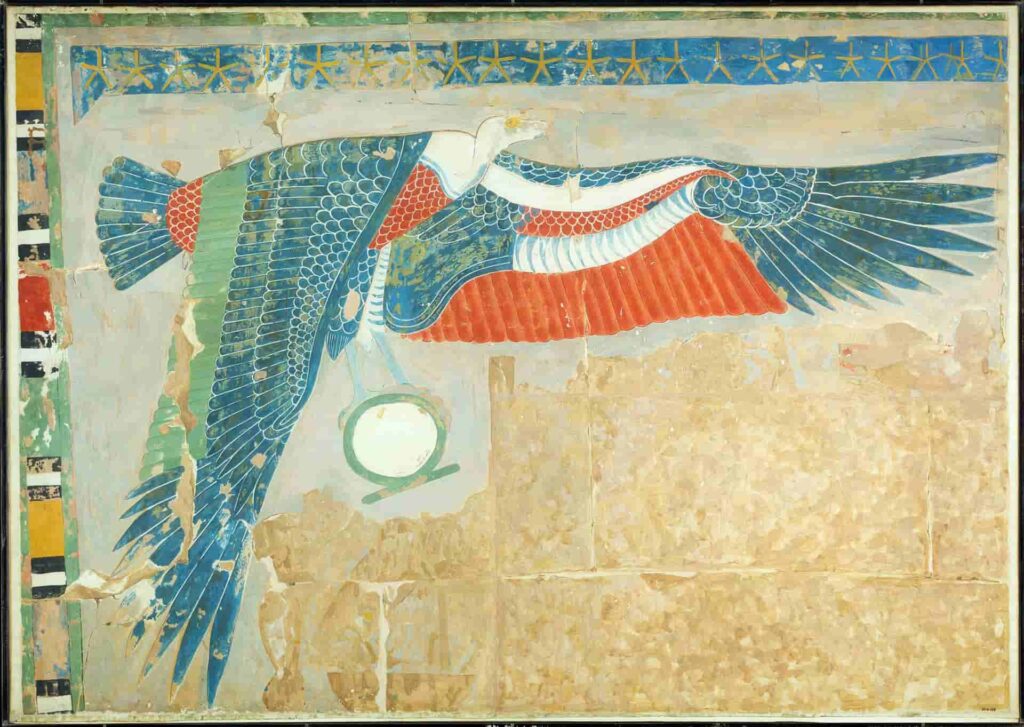
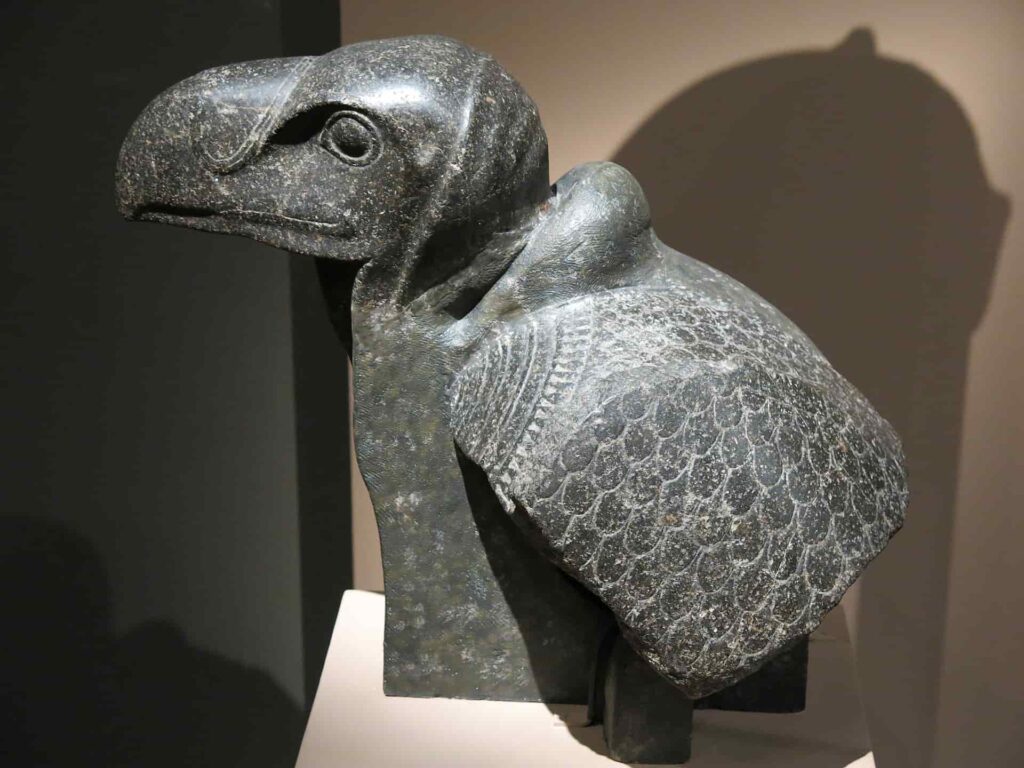
Nekhbet was mainly depicted in the early days of her worship as a vulture, wearing the shen ring, a symbol of eternity later adopted by a number of other gods.
Alan Gardiner identified the vulture used in religious iconography as the Griffion vulture type (suggesting a connection with the later griffin). After being linked with the Cobra goddess, she was also depicted as a serpent, but she then wore the white crown for clarification. With spread wings, she signifies, as a serpent, the protection of kingship. The two serpents on the winged sun symbol are also considered embodiments of Nekhbet and Wadjet.
In anthropomorphic form, the goddess was depicted as a woman with a vulture cap on her head, possibly also the white crown, and wings.
During the New Kingdom, the vulture appeared next to the uraeus on the main adornment worn by deceased pharaohs. Traditionally, this was a reminder of the two national goddesses Wadjet and Nekhbet, but according to Edna R. Russmann, in this newer context, one should rather think of Isis and Nephthys, two goddesses who were meanwhile associated with funeral rites.
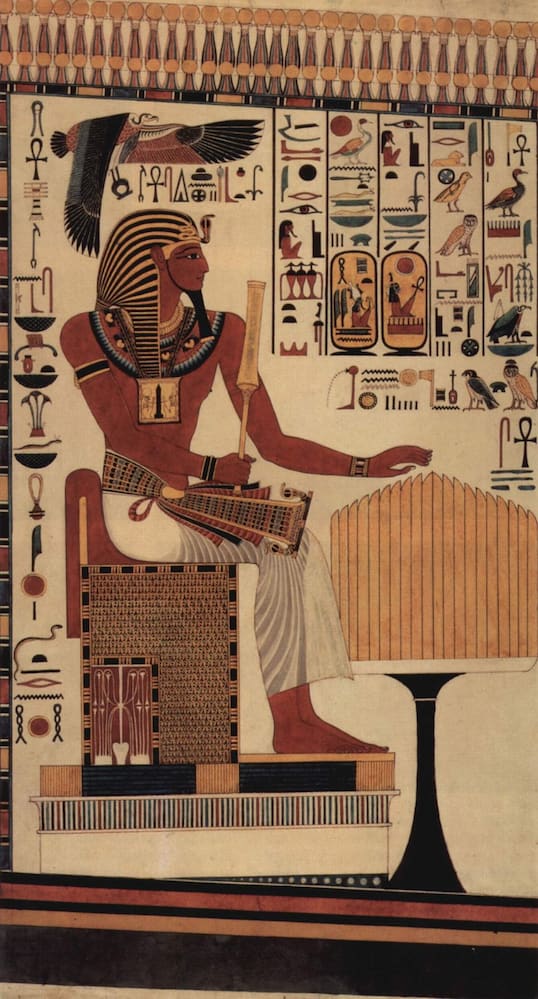
Nekhbet was usually painted as a vulture with spread wings on the ceilings of temples and above the image of the king (or queen), with a shen ring in its claws (symbolizing infinity, “whole,” or “all”). As the protective goddess of the pharaoh, she was also seen as the divine aspect of the ruler. It was in this capacity that she was the Mother of Mothers and was equated with the Great White Cow of Nekhbet.
In certain texts of the Egyptian Book of the Dead, Nekhbet is referred to as the “Father of the Fathers, Mother of the Mothers, who has existed from the beginning and created this world.”.
Cult
In predynastic Egypt, the word for ‘vulture’ was Mut, which has been preserved in the name of the goddess Mut of Thebes. The priestesses of the goddess Nekhbet were called “muu” (mothers) and performed their rituals in robes made of Egyptian vulture feathers.
At Nekheb, originally a necropolis or city of the dead, the oldest oracle of Egypt was located in the sanctuary of Nekhbet, the mother goddess of Nekheb. By the end of the Predynastic Period (ca. 3200–3100 BCE) and probably also the Early Dynastic Period (ca. 3100–2686 BCE), the necropolis served as the counterpart to Nekhen, the religious-political capital of Upper Egypt. The original settlement at the site of Nekhen dates back to Naqada I or the late Badarian culture. At its peak around 3400 BCE, the city had at least 5000 inhabitants, possibly double that number.
As the cult site gained importance with the mother goddess becoming the national goddess of all of Upper Egypt, sanctuaries dedicated to her were established in many other places, and temples were built for her.
According to Wilkinson, the cult center of Nekhbet had a remarkably large temple sanctuary at El Kab, although little remains of it today. Nothing has been found of the sanctuaries that undoubtedly stood there in ancient times, but ruins dating from the later Dynastic period have been discovered. Only traces of the Middle Kingdom and the New Kingdom have survived.
After Nekhbet became the protective goddess of Upper Egypt, it was logical that she, along with her Lower Egyptian counterpart, Wadjet, formed the pair known as the Two Women upon the unification of the two lands.
Originally, Nekhbet was closely related to Mut and Tefnut. The morning god Hapi was assigned to her as a husband, and the water lily, emblematic of Upper Egypt, became her plant.
Appearance
The goddess Nekhbet is depicted as a vulture or sometimes as a woman with a vulture’s hood or vulture’s head. As a constellation, it is called Huret and at the same time equated with Neith. Her nickname is “The Secret”.
In Dendera there is an image of Wadjet and Nekhbet, which shows Nekhbet sitting on a papyrus plant.