Meteorological agencies across the globe have confirmed an alarming milestone in the modern climate record: planet Earth has just experienced its hottest June since instrumental temperature tracking began in the mid nineteenth century, shattering the previous June heat record set only one year earlier. Driven by the relentless accumulation of greenhouse gases in the atmosphere and amplified by oceanic heat waves and shifting Pacific circulation patterns, this consecutive broken record underscores a rapid acceleration in global surface and sea temperatures that has caught even veteran climatologists off guard.
The Global Numbers and the 1.5 Degree Threshold
According to consolidated satellite, weather station, and ocean buoy data analyzed by the European Union’s Copernicus Climate Change Service, NASA’s Goddard Institute for Space Studies, and the National Oceanic and Atmospheric Administration, the global average surface air temperature for June climbed to more than 1.5 degrees Celsius above the pre industrial reference average of 1850 to 1900. Even more striking than the absolute number was the margin by which the record fell: rather than creeping past the previous year’s mark by a hundredth of a degree as typically occurs in long term climate series, this June leaped ahead by a significant margin, extending an unprecedented streak of consecutive record breaking warm months across the planet.
Passing the 1.5 degree Celsius threshold during an individual summer month does not mean the world has permanently breached the long term limit established by the 2015 Paris Climate Agreement, which measures temperatures averaged across twenty or thirty year periods. However, climate scientists warn that crossing this line repeatedly during individual months serves as a preview of the extreme weather instability that awaits if decadal averages reach that same elevation permanently.
Why Are Consecutive Records Falling So Fast?
The back to back shattering of June temperature records is the result of two powerful forces acting in tandem: long term human induced warming and natural interannual climate variability. First and foremost, the baseline temperature of the Earth continues to rise steadily because global emissions of carbon dioxide, methane, and nitrous oxide from fossil fuel combustion and deforestation remain at historic highs, trapping outgoing infrared radiation in the lower troposphere like an thickening thermal blanket.

Layered directly on top of that rising baseline was the lingering thermal signature of a powerful El Nino event in the tropical Pacific Ocean. During an El Nino phase, weakened trade winds allow vast pools of sun warmed water piled up in the western Pacific to slosh eastward toward the coast of South America, releasing colossal amounts of latent heat and moisture from the ocean interior directly into the global atmosphere. Furthermore, atmospheric physicists point to secondary accelerators, including a sharp reduction in sulfur dioxide aerosol pollution from international cargo ships following clean fuel regulations—which reduced reflective cloud cover over shipping lanes—and the lingering stratospheric water vapor injected by the 2022 Hunga Tonga underwater volcanic eruption.
Unprecedented Marine Heat Waves in the North Atlantic
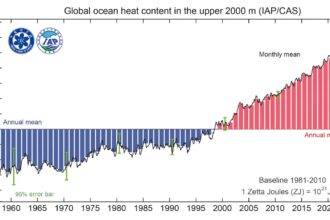
Perhaps the most unsettling contributor to the June record occurred not over land, but across the world’s oceans, which cover seventy percent of the planetary surface and absorb roughly ninety percent of all excess heat trapped by greenhouse gases. Throughout June, global sea surface temperatures between sixty degrees North and sixty degrees South latitude remained at the highest levels ever observed by satellites for the time of year.
In the North Atlantic Ocean, from the coast of West Africa and the Canary Islands up to the waters surrounding Ireland and the United Kingdom, sea surface temperatures soared three to five degrees Celsius above normal seasonal averages, classifying large swaths of the ocean basin under extreme Category 4 and Category 5 marine heat waves. Because calmer than normal trade winds failed to stir up cool deep water and blew less Saharan desert dust across the Atlantic to shade the water’s surface, the ocean absorbed solar radiation unimpeded. These bathwater ocean temperatures threaten cold water fisheries, trigger widespread coral bleaching across the Caribbean, and act as high octane thermal fuel for early season tropical hurricanes.
Continental Heat Domes and Human Impact
Across the Northern Hemisphere landmass, the record June warmth manifested as persistent, stationary high pressure ridges known as heat domes, which trap hot air beneath sinking atmospheric columns for weeks at a time. In North America, prolonged heat domes settled over northern Mexico, Texas, and the American Southwest, pushing daytime temperatures past forty five degrees Celsius and straining regional electrical grids as air conditioning demand peaked. Across southern Europe, North Africa, the Middle East, and northern India, early summer heat waves arrived weeks ahead of historical schedules, triggering severe agricultural drought, drying out Mediterranean forests ahead of the peak wildfire season, and claiming hundreds of lives among outdoor workers and elderly residents.

Simultaneously in the Southern Hemisphere, where June marks the arrival of winter, Antarctic sea ice extent dropped to its lowest June level since satellite monitoring began in 1979, missing a chunk of floating ice larger than the area of Western Europe. As the Earth transitions through the remainder of the year, the shattering of last year’s June record stands as concrete empirical proof that what once counted as an extreme statistical outlier has rapidly become the baseline climate of the twenty first century.