What is the history of geometry? The term “geometry” is derived from the ancient Greek word “geometria,” which means measurement (-metria) of earth or land (geo), but this branch of mathematics covers much more than mapping. Geometry explains the relationship between shape and size, and also the nature of mathematics and numbers. Find out more about the invention and history of geometry, as well as the pioneers of geometry and the groundbreaking discoveries they made that have shaped the field.
- Discovery and Origin of Geometry
- The Turning Point in the History of Geometry
- Timeline of the History of Geometry
- 3000 BC – Practical Geometry
- 300 BC – Spherical Geometry
- 500 BC – Pythagoras
- 4th Century BC – Geometric Tools
- 360 BC – Platonic Solids
- 240 BC – Archimedean Solids
- 9th Century – Islamic Geometry
- 1619 – Kepler’s Polyhedron
- 1637 – Analytical Geometry
- 1858 – Topology
- 1882 – The Discovery of the Klein Bottle
- 20th Century – Fractal Geometry
- Today—Computational Geometry
- Types of Geometry
Discovery and Origin of Geometry
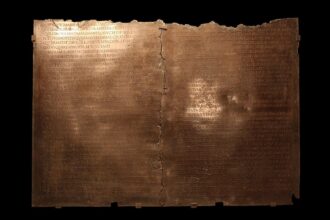
Ancient civilizations in places like the Indus Valley and Babylonia roughly 3000 BC are credited with laying the groundwork for geometry. Geometry first appeared in the ancient world as a set of rules and formulas suitable for planning, constructing, astronomy, and solving mathematical problems. These principles included length, area, angle, and volume. Cubic and spherical Indus weights and measures were crafted from chert, jasper, and agate.
Beginning around the 6th century BC, the Greeks expanded this knowledge and, using it, developed the conceptual field currently recognized as “geometry.” Greek philosophers such as Thales (624-545 BC), Pythagoras (570-490 BC), and Plato (428-347 BC) realized the fundamental relationship between the nature of space and geometry and reinforced geometry as an important field of study belonging to mathematics.
Euclid (325-265 BC), who was probably Plato’s student and worked as a teacher in Alexandria, summed up the early Greek geometry in his magnificent work, “Elements,” written in 300 BC, and created scientific principles for geometric models using a handful of simple rules and axioms. The Elements became a standard geometry textbook for over 2000 years.

Let no one ignorant of geometry enter.
Plato, Greek philosopher, and mathematician
The Turning Point in the History of Geometry
Throughout the Middle Ages, mathematicians and philosophers from different cultures continued to use geometry to create a model of the universe. But the next major milestone came with the work of the French mathematician and philosopher René Descartes (1596-1650), who lived in the 17th century. Descartes developed coordinate systems to define the positions of the points in two-dimensional and three-dimensional space led to the birth of the field of analytical geometry, a new tool of mathematical algebra to solve and define geometry problems.
Descartes’ work also led to the emergence of far more exotic forms of geometry. Mathematicians had long known that there were regions, such as the surface of a sphere, where the axioms of Euclidean geometry did not apply. The discovery of non-Euclidean geometry helped clarify many more fundamental principles that combined numbers and geometry. In 1899, German mathematician David Hilbert (1862-1943) developed new and more generalized axioms. Throughout the 20th and 21st centuries, these axioms were applied to a wide variety of mathematical cases.
Timeline of the History of Geometry
The timeline of geometry begins with the birth of practical geometry and concludes with fractal geometry.
3000 BC – Practical Geometry
The history of geometry first arose in the Indus Valley and Babylonian civilizations from the need to solve problems such as calculating the volume of material required to build a pyramid. The level of sophistication of some of these early concepts is so high that a contemporary mathematician can struggle to deduce them without resorting to calculus.

300 BC – Spherical Geometry
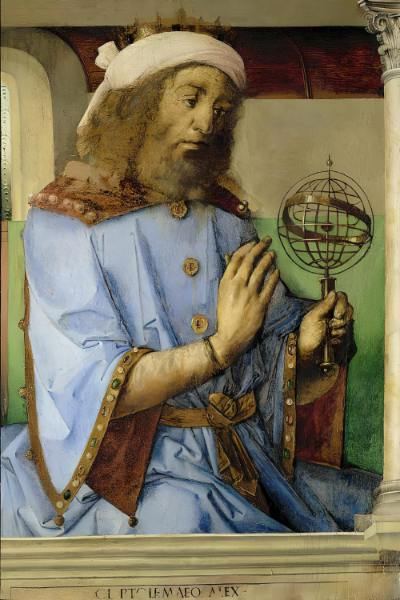
The Greek astronomer Theodosius of Bithynia (169-100 BC) compiled “spherics” in a book that consolidated the earlier work by Euclid (325-265 BC) and Autolycus of Pitane (360-290 BC) on spherical astronomy. In his Elements book, which was regarded as authoritative all the way up to the early 19th century in the history of geometry, Euclid provided the foundation for geometry.
The spherical geometry allowed calculating areas and angles on spherical surfaces, such as star or planet positions in the imaginary sky sphere used by astronomers, or the locations of points on a map. However, this system does not follow Euclidean rules. In spherical geometry, the sum of a triangle’s angles is more than 180 degrees, and lines that run parallel to each other eventually meet. Euclid is considered the “father of geometry.”
500 BC – Pythagoras
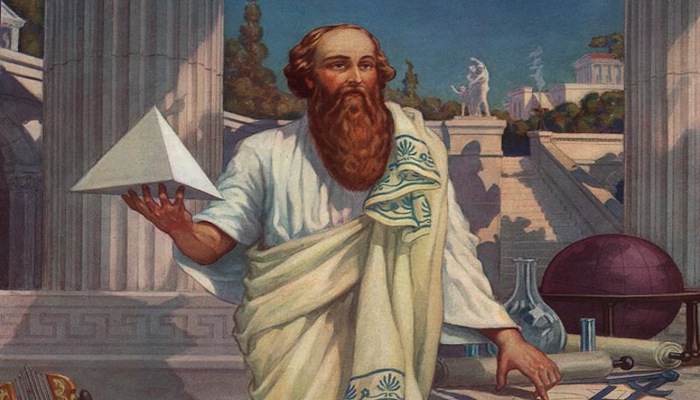
The Greek philosopher named the “Pythagoras theorem”, which calculates the hypotenuse (the longest side) of a right-angled triangle from the lengths of the other edges. The theory that a triangle’s angles would sum to 180 degrees, or two right angles, is attributed to Pythagoras of Samos.
He said that the sum of the squares of the other two sides of a right triangle equals the square of the hypotenuse (the side opposite the right angle). Whenever the ancient engineers knew the lengths of two sides of a right triangle and needed to figure out the third, they used this theorem to do so, just like we do today.
The idea of similar triangles, whereby two triangles are similar if they have the same form but need not have the same size, was also created by Pythagoras (570-490 BC). Pythagoras is remembered as a pivotal figure in the development of geometry.
4th Century BC – Geometric Tools
Since the geometric tools have been around for thousands of years in the history of geometry, their precise historical beginnings are difficult to ascertain. However, the use of geometric instruments to measure, sketch, and build geometric forms and constructions may be traced back to at least the ancient Egyptians and Greeks. The Egyptians employed geometric tools in the building of their pyramids. The Greeks founded the science of geometry and wrote extensively on the use of geometric tools. They have undergone significant changes throughout the time.
The Greek philosopher Plato (428-347 BC) stated that the tools of a true geometer should be limited to a straightedge and a compass, thereby establishing geometry as a science rather than a practical mastery. Euclid (325-265 BC), the “father of geometry,” and subsequent geometers defined the method of creating geometrical forms using certain tools. The ancient Greeks were the first to present building challenges using just a straightedge and compass. Some examples are building a line that is twice as long as another line or a line that divides an angle into two equal halves.
360 BC – Platonic Solids
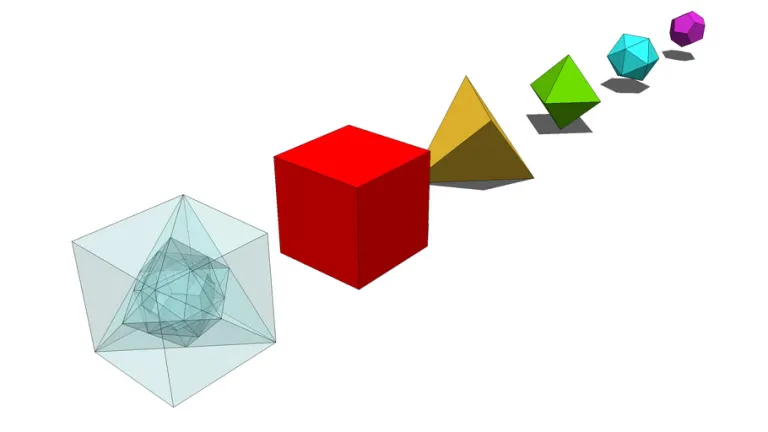
Plato introduced the concept of the Platonic solids first in his dialogue “Timaeus.” The Platonic solids are known as the five regular convex polyhedra (polygonal bodies), but Plato also combined them with his ideas about the structure of matter in 360 BC. The Platonic solids include five shapes that can be formed by joining similar faces along the edges. The tetrahedron has four faces, the cube has six, the octahedron has eight, the dodecahedron has twelve, and the icosahedron has twenty faces.
In this “Timaeus,” Plato equated the five Platonic solids with the classical elements (earth, air, fire, and water) and the fifth element of the universe, which he named the “quintessence.”
In the history of geometry, mathematicians and philosophers have always had a healthy respect for and fascination with the Platonic solids. They have also found applications in the fields of art, design, and architecture, and have served as inspiration for the development of several additional three-dimensional forms. The Platonic solids are still widely studied and admired for their symmetry and elegance, making them an integral element of modern geometry.
240 BC – Archimedean Solids
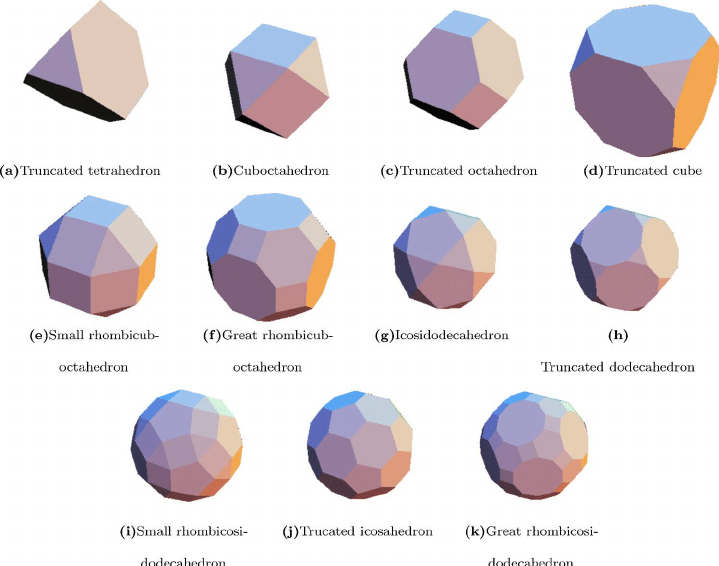
The Greek mathematician Pappus of Alexandria (who flourished in 320 AD) described 13 convex polyhedrons, which are uniform polygons with similar edges and corners. In all, there are 14 Archimedean solids, 13 of which are attributed to Archimedes. In his 240 BC book, “Measurement of a Circle,” he detailed his study on these solids. The value of pi was approximated in this book by the Greek mathematician using the Archimedean solids.
Archimedean solids are a class of polyhedra. To qualify as one of these solids, each of the faces of an object must be a congruent regular polygon, and there must be vertices at which two or more polygons intersect. Archimedean solids differ from Platonic solids in that their vertices do not always have the same number of faces meeting.
9th Century – Islamic Geometry
Mathematicians and astronomers of the Islamic world explored the possibilities of spherical geometry. The geometric models used in Islamic decoration during this period are similar to modern fractal geometry.
Geometric principles and the recurrence of geometric patterns are central to Islamic geometry, which is known for its ornate and aesthetically pleasing forms. Stars, polygons, and both regular and irregular tessellations are common components of these patterns.
During the Islamic Golden Age (about the 8th to 13th centuries), Islamic geometry emerged as its own culture. Structures, tiles, textiles, and other ornamental arts all made use of these patterns and designs.
1619 – Kepler’s Polyhedron
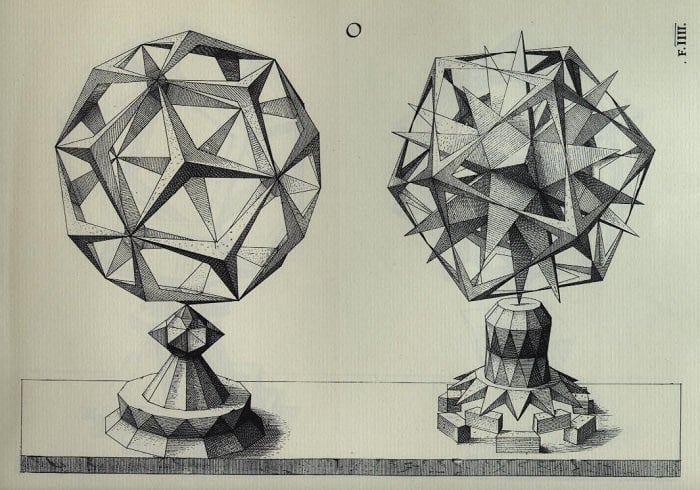
German mathematician Johannes Kepler (1571-1630) discovered a new class of polyhedra, known as the star polyhedron. In his 1619 treatise “Harmonices Mundi,” Kepler described a set of four polyhedra. These “Kepler-Poinsot polyhedra” are the small stellated dodecahedron, the great stellated dodecahedron, the great dodecahedron, and the great icosahedron.
The Platonic and Archimedean solids, which are likewise polyhedra but have regular polygons for faces, are closely linked to Kepler’s polyhedra. Kepler’s polyhedra differ from these solids in that not all of their vertices are shared by the same number of faces. In Kepler’s mind, these geometric patterns reflected the underlying structure of the cosmos and hence had a cosmic meaning.
1637 – Analytical Geometry
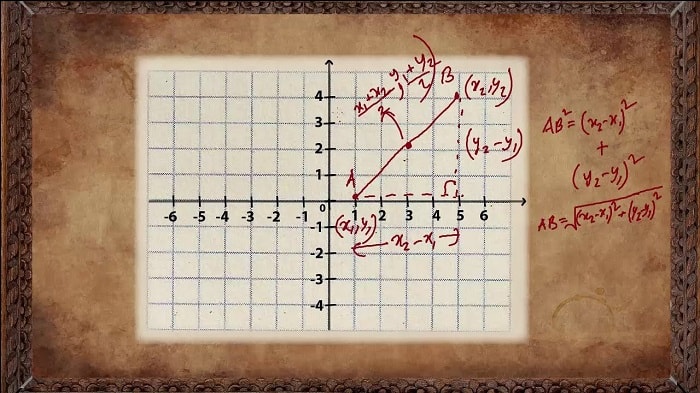
“La Geométrie,” a fascinating book by the French mathematician and philosopher René Descartes, explains how points in space can be measured by coordinate systems and geometric structures can be described by equations. This is called “analytical geometry,” and it is a field of study.
The study of geometric forms and their attributes is the domain of analytical geometry, often referred to as coordinate geometry or Cartesian geometry. Many consider René Descartes to be the “father” of analytical geometry because of his work in this area.
Prior to the advent of analytical geometry, the measurement and qualities of physical objects and forms were at the center of the geometry field. Descartes’ ideas made possible the abstract analysis and description of geometric forms and their attributes using algebraic techniques.
In addition, he proposed the use of equations to define geometric forms and curves, which allowed for a more accurate and rigorous investigation of these objects and their attributes. Today, many disciplines rely on the tools and techniques developed in analytical geometry, making it an indispensable branch of mathematics in the history of geometry.
1858 – Topology
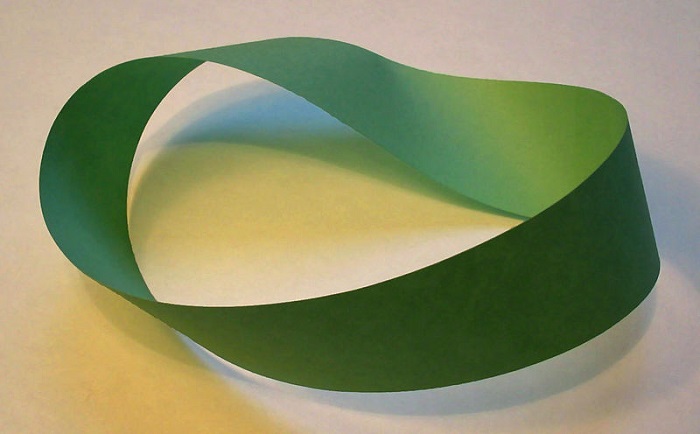
During the 19th century, mathematicians began to be fascinated by topology, or geometric edges and surfaces rather than specific shapes. The visualized Möbius strip above is an object with a single surface and a single continuous edge.
Topology is the mathematical study of the features of geometrical objects and spaces that remain unchanged while they are continuously deformed. It can be deformed by stretching, bending, and twisting, but not by ripping or gluing.
Leonard Euler, a Swiss mathematician who flourished in the 18th century, is considered the father of modern topology. Using what would become known as graph theory, Euler investigated the topology of polyhedra. Graph theory is the study of networks made up of points and lines.
The notion of the Möbius strip, a surface with just one side and one border, was established by August Ferdinand Möbius and Johann Benedict Listing, who contributed to the advancement of topology in the 19th century. To explore various mathematical objects and structures such as manifolds, knots, and topological spaces, topology evolved into a more abstract and generic discipline in the 20th century.
1882 – The Discovery of the Klein Bottle
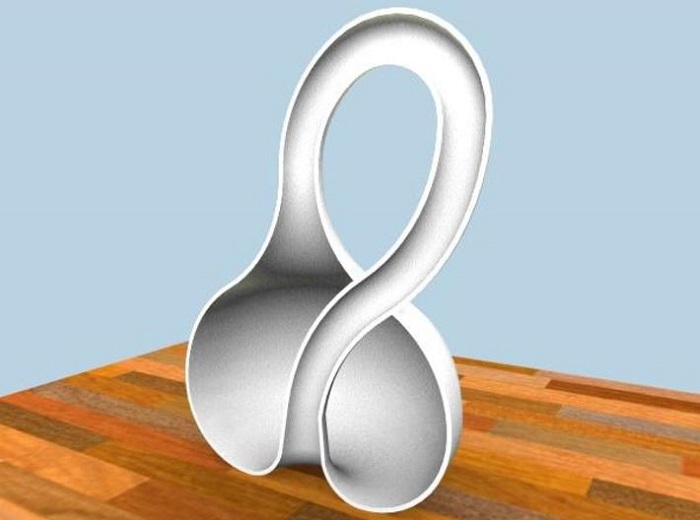
German scientist Felix Klein (1849-1925) discovered a shape that has a one-sided surface without any surface borders, which proves to be a geometry with more than three dimensions. Felix Klein initially characterized it in the 19th century as a tool for investigating the characteristics of non-orientable surfaces.
The Klein bottle is not characterized by its geometric form but rather by its attributes and connections to other things, making it a topological entity. It is a mathematical description of a surface with no obvious boundaries, and it may be thought of as a loop that has been twisted and linked to itself.
One of the fascinating features of the Klein bottle is that it can’t be immersed in three-dimensional space without crossing over into itself. Because of this feature, the Klein bottle is notoriously hard to draw to scale, prompting the creation of a number of computer techniques for studying and understanding its features.
20th Century – Fractal Geometry
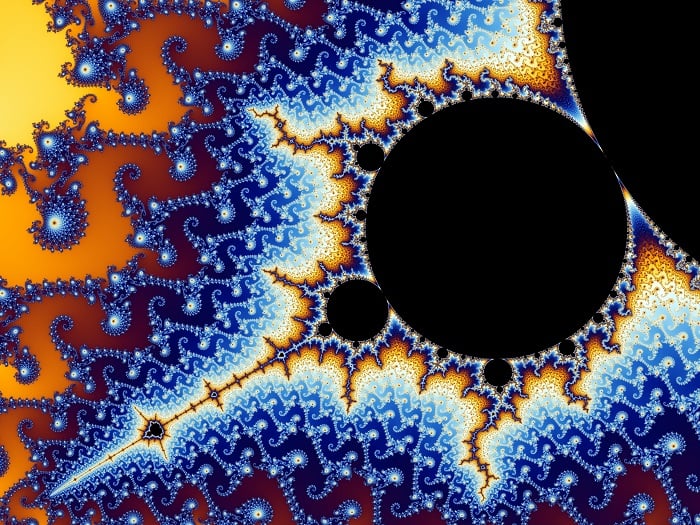
Our ability to use computers has led to the discovery of fractals, which are equations of detailed models that repeat each other at different scales and produce shapes like the well-known Mandelbrot set and display them in a graphical form.
Mathematically speaking, fractal geometry is the study of the characteristics of geometric objects with both self-similarity and a non-integer dimension. Many definitions of fractals focus on the fact that they are geometric forms with “fractional dimension,” or a dimension that is between a whole number and a fraction.
The French mathematician Henri Poincaré used the word “fractal” to characterize things having a “fractional dimension” in the early 20th century. However, the German mathematician Georg Cantor researched the idea of self-similarity, a central aspect of fractals, far earlier, in the 19th century.
Benoit Mandelbrot, a mathematician born in Poland, is widely recognized as the pioneer of fractal geometry. He made significant contributions to the area in the 1970s. Mandelbrot used the term “fractal geometry” to characterize the emerging area of study he established by using computer graphics to show and analyze the characteristics of fractals.
Fractal geometry has relevance in many modern disciplines, such as physics, biology, and computer science. It’s also used in the development of computer graphics as well as the research of chaotic systems.
Today—Computational Geometry

The computer’s power allowed us to solve problems such as the four-color theorem, which distinguishes the various regions within a complex map using nothing but four colors in such a way that no two adjacent regions on the map have the same color.
Francis Guthrie introduced the four-color theorem in 1852, then in 1976, Kenneth Appel and Wolfgang Haken used computer systems to verify it. Extensive computer computations were used to prove the four-color theorem, which states that every map can be colored using just four colors.
Useful in many disciplines, including cartography and computer science, the four-color theorem is worth studying. It’s used to make comprehensible maps, and it’s spawned new computational and mathematical methods for investigating and comprehending the characteristics of maps and other spatial systems.
Types of Geometry
Euclidean Geometry
Euclidean geometry is analyzing shapes in two dimensions and three dimensions according to the rules established by Euclid, an ancient Greek mathematician. One defining feature of Euclidean geometry is that its definitions and theorems are grounded in axioms, or universally accepted facts.
Euclidean geometry, named after the ancient Greek mathematician who developed it, is one of the most widespread kinds of geometry. Axioms, or fundamental principles, form the foundation of Euclidean geometry. For example, it is an axiom that any two straight lines will meet at a single point. This branch of geometry is very applicable since it explains the behavior of solid forms and objects in the physical world.
Non-Euclidean Geometry
This branch of geometry is distinguished from Euclidean geometry by its use of various axioms. Two examples of non-Euclidean geometries are hyperbolic geometry, which uses a different set of axioms for parallel lines, and elliptic geometry, which uses a different set of axioms for the sum of the angles in a triangle.
Some of the assumptions of Euclidean geometry are rejected in non-Euclidean geometry. Hyperbolic geometry, one of the most well-known types of non-Euclidean geometry, is predicated on the premise that two lines can meet in more than one place. This branch of geometry is often used in the investigation of cosmological structure and space-time characteristics.
Projective geometry
The focus here is on geometric shapes and transformations that keep length-to-width ratios (the ratios of distances) the same. Perspective drawings and other forms of graphics can be analyzed using projective geometry.
Projective geometry is the study of the characteristics of figures and forms when they are projected onto a two-dimensional plane, making it the third type of geometry. Creating perspective and the appearance of depth on a two-dimensional surface is made possible using this form of geometry, making it useful in art, architecture, and photography.
Topological Geometry
The fourth type of geometry is topological geometry, which investigates the features of geometric objects that remain the same under continuous deformations like stretching or bending. This geometry is often used in the investigation of sub-atomic structures and cosmological characteristics.
Preserved features of geometric forms during continuous deformations like stretching or bending are the focus of this field of research. Deformable forms have interesting qualities that can be investigated using topology.
Differential Geometry
Differential geometry is a calculus-based research field in geometry. Curves and surfaces in three dimensions can be analyzed with the help of differential geometry. Numerous branches of science and technology rely heavily on the concepts and methods of differential geometry, such as physics, engineering, and computing. It is used in the investigation of spatial phenomena and the properties of dynamic physical systems.
It is a tool used in physics to learn more about the nature of space-time and how particles and fields behave. Manifolds are high-dimensional spaces used to simulate physical processes and investigate their characteristics.
This type of geometry has many applications in engineering, including the study of surface qualities and the design and analysis of complex systems like airplanes and cars. In computer science, it is used to study data structures and algorithms and what makes them work the way they do.
Algebraic Geometry
In algebraic geometry, we apply algebraic concepts and methods to the study of geometry. This field of study focuses on the qualities of shapes whose characteristics can be expressed in terms of equations. This type of geometry studies Algebraic curves, Algebraic surfaces, Algebraic varieties, and also manifolds. These are curves, surfaces, objects, and high-dimensional spaces that can be defined using algebraic equations such as parabolas, planes, ellipsoids, lines, circles or the curvature of space-time.
In general, geometry is a fascinating and intricate mathematical field with several practical applications. Geometry is essential to our knowledge of the world around us, whether we’re trying to figure out how the cosmos formed or conjure up some impressive optical illusions.
Bibliography
- Ray C. Jurgensen, Alfred J. Donnelly, and Mary P. Dolciani. Editorial Advisors Andrew M. Gleason, Albert E. Meder, Jr. Modern School Mathematics: Geometry. Houghton Mifflin Company, ISBN 0-395-13102-2.
- Frits Staal, 1999, “Greek and Vedic Geometry”, Journal of Indian Philosophy, doi:10.1023/A:1004364417713, S2CID 170894641
- Nineteenth Century Geometry – Stanford Encyclopedia of Philosophy
- Rosenfeld, B. A., 1988. A History of Non-Euclidean Geometry: Evolution of the Concept of a Geometric Space, New York: Springer.
- Euclides, Elementa, I. L. Heiberg (ed.), Leipzig: B. G. Teubner, 5 volumes., 1883–88.
- Mathematics Department, University of British Columbia, The Babylonian tabled Plimpton 322.