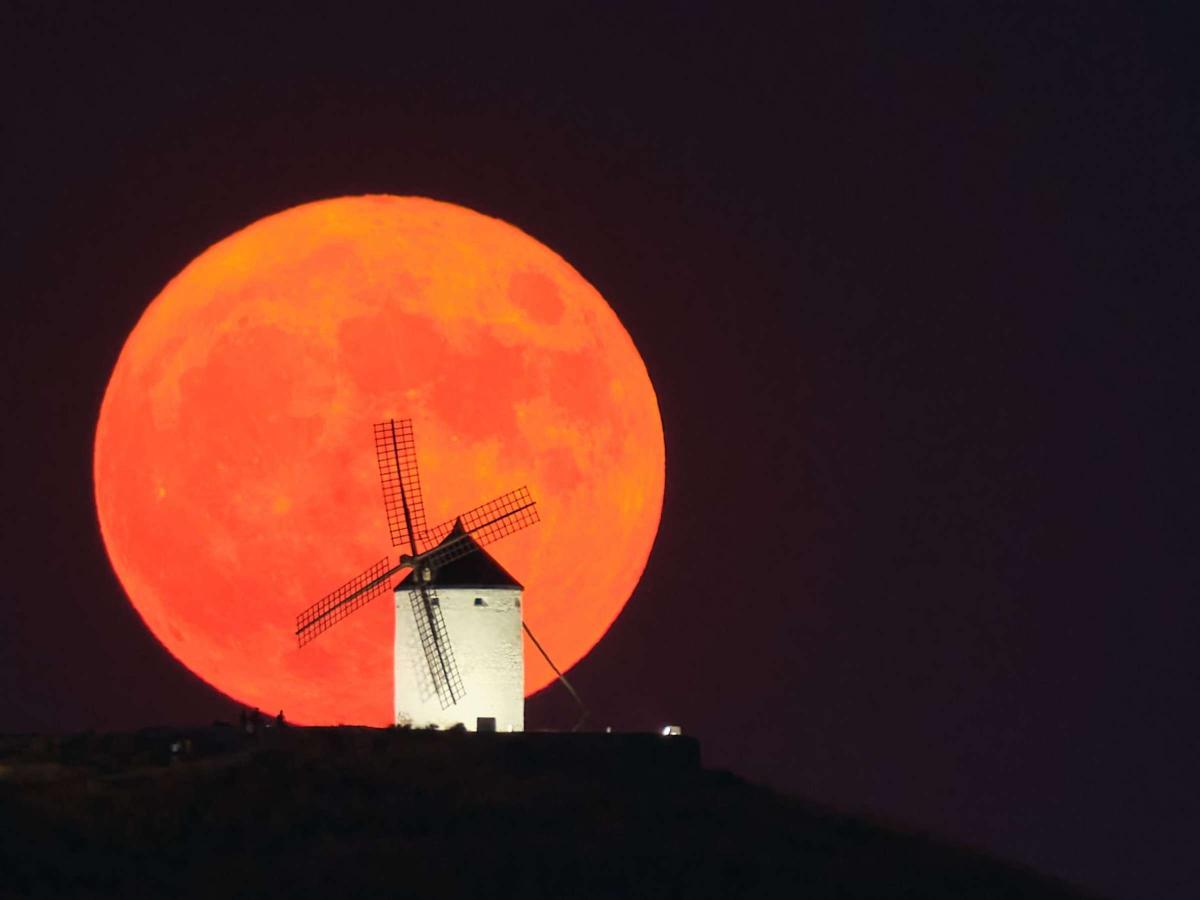
The Earth’s satellite is supposed to appear unusually large in the sky at certain times of the year. And if you go outside – assuming the weather is good – and look at the Moon, you get truly amazed. The full Moon hovers majestically above the horizon. In its orbit around the Earth, the Moon comes particularly close to us several times a year. This promises a particularly large and bright full Moon in the night sky called ‘supermoon‘. But although this effect is hardly visible to the naked eye, the supermoon amazes many observers. In fact, the amazement is rather due to another effect: An optical illusion makes the Moon appear bigger near the horizon.
When the Moon Is Especially Close to Us
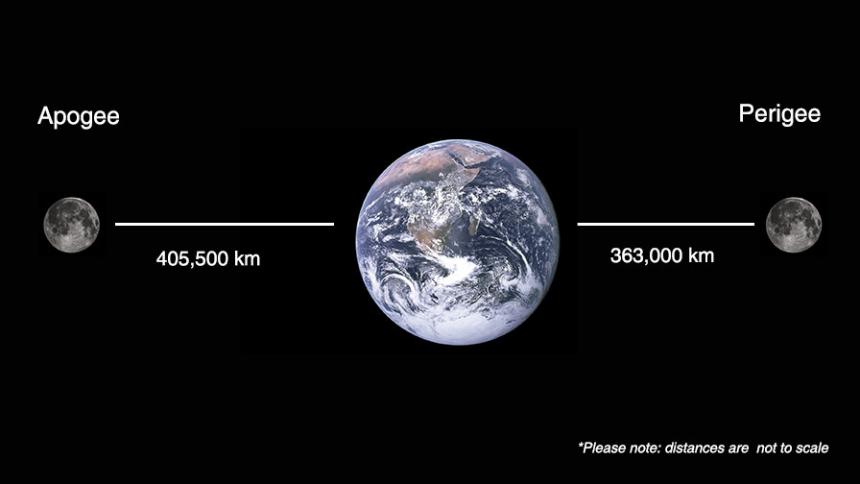
The distance between the Moon and the Earth varies by around 50,000 kilometers. When the Moon is at its closest point to the Earth, the perigee, a supermoon occurs. In the apogee, at which the maximum distance of more than 400,000 kilometers is achieved, a minimoon is observed.
But “supermoon” is neither a historically coined nor an astronomical or generally a scientific term. Rather, it was an astrologer, Richard Nolle, who first wrote in 1979 about a supermoon that was supposed to be responsible for earthquakes and volcanic eruptions – namely, whenever the Earth’s satellite is particularly close to the Earth at a full Moon or new Moon.
But even if Nolle’s considerations are not based on scientific principles – they cannot be completely dismissed. The tidal forces of the Moon and the sun not only lead to ebb and flow, but also to movements in the Earth’s crust.
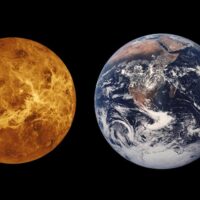
If the sun, Earth, and Moon are almost in a straight line, the tidal forces of the sun and Moon add up and particularly strong spring tides occur. The high tides, often colloquially referred to as spring tides, are about 20 percent higher than ordinary high tides. In fact, strong earthquakes also occur more frequently in parallel with spring tides, as a team led by geologist Satoshi Ide showed in 2016 by analyzing more than 10,000 earthquakes.
However, since the Moon does not move in a circular but an elliptical orbit around the Earth, not all spring tides are the same. The distance of the Moon from Earth varies between 221.456 miles (356.400 km) and 252.711 miles (406.700 km). It is therefore quite obvious that the effects of the tides are stronger when the Moon is also close to the Earth during a spring tide. However, this influence is very small: On average, spring tides are only about two percent stronger when the Moon is close to the Earth. Accordingly, a connection between the supermoon and earthquakes has not yet been proven.
Bigger and Brighter
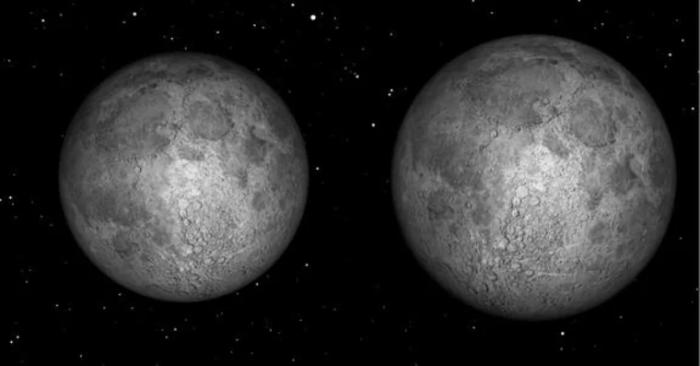
Nevertheless, the term supermoon was recently taken up in the past years but is still different than originally meant by Nolle. Today, a supermoon does not refer to the alleged effects of earthquakes or volcanic eruptions any longer. Instead, it simply refers to a full Moon in a near-Earth position and the associated size and brightness of the Earth’s satellite in the night sky.
This is because when the Moon is close to Earth, its apparent diameter is up to 14 percent larger than that of a Moon far from Earth – a so-called minimoon. And with the larger area that the supermoon occupies in the night sky, the perceived brightness of the Earth’s satellite also increases. The Moon appears up to 30 percent brighter near the Earth than far away.
However, these are extreme values. The Moon’s orbit is by no means invariable but varies due to the gravitational forces of the sun and the major planets. The distance of the Moon from the Earth at perigee, the closest point to the Earth in the respective orbit, varies between 221,456 mi (356,400 km) and 230,155 mi (370,400 km).
Therefore, those theoretically possible extreme values occur only rarely. This raises the question of when a full Moon is considered a super full Moon. Nolle himself has changed his definition again and again over the decades – currently, he uses an arbitrarily chosen distance of less than 229,056 mi (368 630 km) at the full Moon as a limit.
Only a Near Full Moon Is Also a Supermoon
There are two to four supermoons each year. After the first supermoon on May 16, the Earth’s satellite was 222,238 mi (357,658 km) away from the Earth for the second time on June 14, 2022. On the following full Moon on July 13, the Moon was even a tiny bit closer to the Earth and only one month after on August 11 there was the fourth (and last) supermoon of 2022 that occurred.
The November 14, 2016 supermoon was the closest recent supermoon since January 26, 1948, and will not be exceeded until November 25, 2034. The closest ever supermoon of the 21st century will be on December 6, 2052. Supermoons and complete lunar eclipses may occur together. The last time was May 2022; the next time will be October 2032.
A Worthwhile Observation?
So whether a particular full Moon is “super” or not is consequently debatable. Also the phenomenon “super moon” has no special scientific meaning. But isn’t it nevertheless worthwhile to have a look at the Earth’s satellite when it is particularly close to us? After all, the differences in apparent size and brightness are quite remarkable. However, the differences between a normal full Moon and a supermoon can hardly be seen with the naked eye in the night sky due to the lack of objects to compare them with. Thus, a supermoon standing high in the sky does not appear much different to the observer than any other full Moon.
Nevertheless, motivated by news of the supermoon, many people go outside in the evening hours and are amazed at the size of the Moon when they see it near the horizon shortly after it rises. The seemingly enormous size of the Moon on the horizon is due to a completely different phenomenon: An optical illusion makes the Moon appear larger near the horizon than when they are high in the sky. So this has nothing to do with the supermoon itself.
Sources:
- Phillips, Tony (May 2, 2012). “Perigee “Super Moon” On May 5–6″. NASA Science News. NASA.
- Espenak, Fred. “Full Moon at Perigee (Super Moon): 2001 to 2100”. astropixels.com.
- “What is a Supermoon? Facts vs. Fiction”. Sky & Telescope. November 8, 2016.
- “Super Full Worm Moon Lights Up the March Sky”. www.timeanddate.com.
- “Closest supermoon since 1948!”. EarthSky. November 12, 2016.