The study of biological structure, or “anatomy,” is fundamental to understanding how the body works. Early anatomists cut up dead bodies for even the smallest reasons of curiosity. Later, technology like the microscope helped doctors make detailed maps of the body.
- Origins of Anatomy
- Historical Timeline of Anatomy
- 1600 BC – Mummification
- 500 BC – Early Greek Anatomy
- 180 BC – Galen Circulation
- 12th Century – Islamic Physicians Refute Galen’s Wisdom
- The 1300s – Mondino de Luzzi
- Late 15th Century – New Observations
- 1543 – Father of Anatomy
- 1665 – Compound Microscopes
- 1770 – Microtome
- 19th Century – Comparative Anatomy
- 1895 – X-ray
- The 1940s – 1950 – MRI scan
Origins of Anatomy
In the ancient world, anatomists dissected and studied animals because it was thought that human bodies were sacred and shouldn’t be touched. As a result, Galen (129–200 AD), Rome’s most successful physician, noted that false ideas about human anatomy were circulating because they were based on animal anatomy. With permission to examine human cadavers, Galen’s ideas on anatomy could be directly compared.
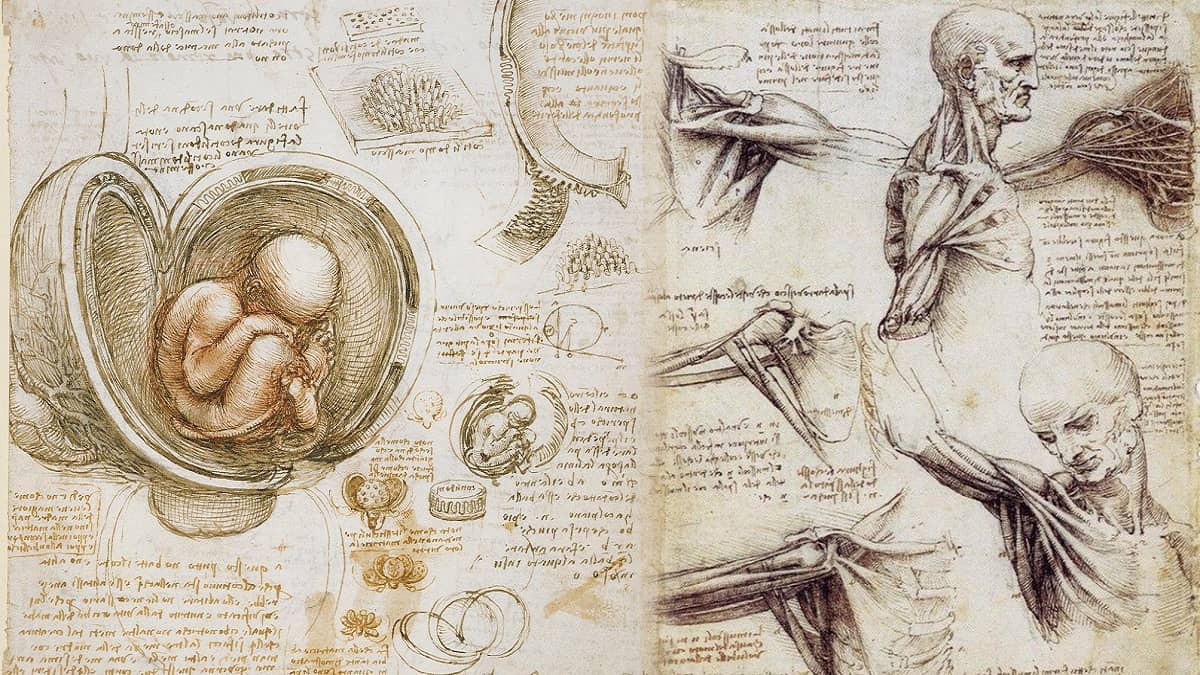
Since artists such as Leonardo da Vinci were able to depict bodies in precisely realistic drawings, each new anatomical publication could show new structures, named and sketched. The Flemish anatomist Andreas Vesalius marked his time with his work De Humani Corporis Fabrica.
In 1600, with the discovery of the microscope, anatomists could see that organs were made up of cells. When X-rays were found around 1900, it was the start of a new era in the study of anatomy. Today, powerful electron microscopes can display detailed structures, and new imaging techniques can reveal 3D images of internal structures without the need to cut open the body.

Historical Timeline of Anatomy
1600 BC – Mummification
In ancient Egypt, bodies were mummified. For religious reasons, the organs were taken out and put in canopic jars to help keep them “alive”.
500 BC – Early Greek Anatomy
The Greek doctor Hippocrates thought it was a good way to learn about the human body to cut up and look at dead animals.
180 BC – Galen Circulation
Galen, a doctor who was born in Greece, thought that the body was always making blood, but this wasn’t proven until the 17th century.
12th Century – Islamic Physicians Refute Galen’s Wisdom
In the Islamic world of the Middle Ages, there were no rules against dissecting and studying the human body. In fact, doctors like Ibn Zuhr did autopsies all the time. Ibn Zuhr confirmed some of Galen’s work on human anatomy (which was based on the Barbary macaque).
The 1300s – Mondino de Luzzi
In 1315, the doctor Mondino de Luzzi was the first person to look at a dead body in public. However, his catalog of anatomy was full of old, wrong ideas.
Late 15th Century – New Observations
Leonardo da Vinci began his study of the human body with the doctors who argued against Galen. Italian physician Berengario da Carpi’s Anatomia Carpi ushered in a new era of original anatomical observations.
1543 – Father of Anatomy
Flemish painter Andreas Vesalius participated in cadaver studies in order to draw accurate pictures for his De Humani Corporis Fabrica.
1665 – Compound Microscopes
Anatomists such as Marcello Malpighi, Jan Swammerdam, and Robert Hooke used sophisticated microscopes to record cells, capillaries, and tissues.
1770 – Microtome
The microtome was invented to cut tissue into very thin, almost transparent slices. This process allows tissue samples to be examined under powerful light microscopes.
19th Century – Comparative Anatomy
After Charles Darwin‘s theory of evolution was published in 1859, many anatomists searched for evidence of speciation.
1895 – X-ray
German physicist Wilhelm Röntgen used his discovery of x-rays to reveal his wife’s hand bones, demonstrating a way to examine internal bone structures without the need to dissect the body.
The 1940s – 1950 – MRI scan
In 1946, American physicists found a way to detect signals from atoms that allowed the soft internal structure of human bodies to be imaged.