A single snowflake drifts gently to the ground, where it may join the others of its kind. One snowflake follows another, and then a few million more, until the whole rooftop is blanketed in white. Snowflakes may fall from the sky by the billions, yet no two snow crystals are ever the same, as the old saying goes. In the same way that every person is different, each of these objects is also unique. But how accurate is that?
It’s indeed exceedingly rare that any two complicated snow crystals would look precisely the same. It’s so improbable that you probably wouldn’t even find carbon duplicates if you looked at every crystal ever produced. That is the essence of this query. It depends on what you mean by the “same” and what you mean by the term “snow crystal.” Because the matter is really a lot more complicated than that.
When does a snowflake form?
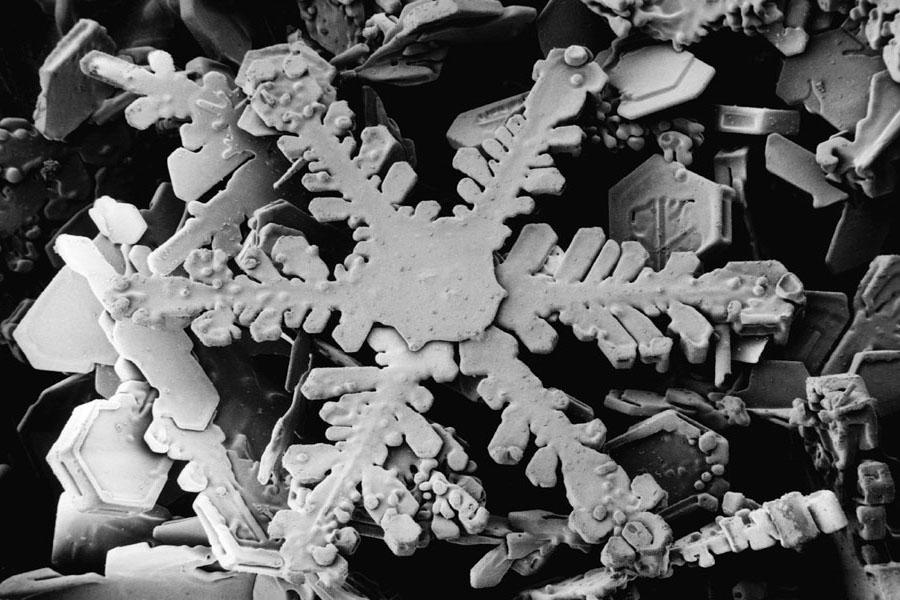
It is actually possible for two snow crystals made of just a few water molecules to be identical. There, the crystals are still too small to be seen with the naked eye or with a microscope.
If more water molecules bind to one of the two mini-crystals, causing them to grow bigger as they fall from the cloud to Earth, the likelihood is that one of the crystals will grow at a different rate than the other ones. Changing the environment just a little bit—for instance, by altering the temperature or the humidity—can produce a snowflake with whole new characteristics.
Also, different crystals form even if kept under the exact same circumstances. This is because the atoms never align with perfect regularity, which means they are prone to producing differences.
The development of a snowflake is to stock 10 items on a rack so that there are 10 possible positions for the first item, 9 for the second item, and 8 for the third item.
There are more than a billion possible arrangements for only 10 items. And as the items on the rack expand, the total combinations climb infinitely. This is also true with snow crystals. When they are bigger, that is, when they gather more atoms, it is less probable that two identical forms will be generated.
Do identical snow crystals exist?
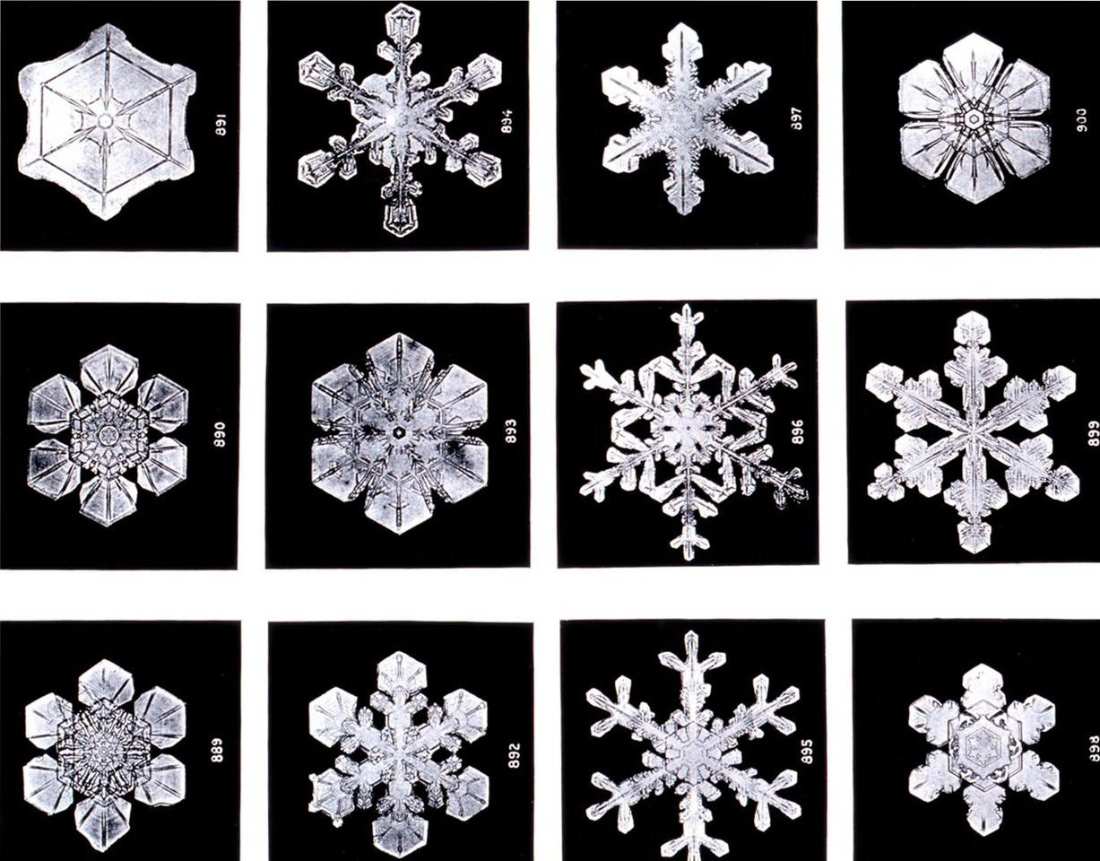
Almost a century and a half ago, farmer Wilson Bentley (1865–1931) planted the idea that no two snow crystals are alike. In his lifetime, he examined innumerable snowflakes and took hundreds of photographs of these crystals under a microscope. When he examined snowflakes in 1922, he said, “Every crystal was a masterpiece of design, and no one design was ever repeated. When a snowflake melted, that design was forever lost.” It would seem that throughout his lifetime, Bentley never came across any two snowflakes that were the same.
Nobody ventured to cast doubt on this plausible idea for quite some time. In the 1980s, Nancy Knight of the U.S. National Center for Atmospheric Research released photos of two snow crystals that, under the microscope, appeared exactly the same. It seemed like a dogma had been debunked.
The question is whether or not the likeness in appearance implies a likeness in character. Because an optical microscope can’t resolve the atomic detail. And if you go through a reasonable number of snow crystals, it’s not hard to envisage finding two that are indistinguishable under the microscope. Furthermore, identical snow crystals could be manufactured artificially, and although they may seem similar, they won’t be identical at the subatomic level.