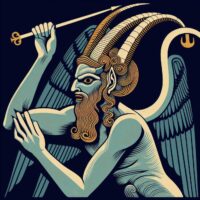
In the earliest literary tablets of ancient Mesopotamia, carved in cuneiform across the clay of Sumer during the third and second millennia BC, the mountains to the east of the Tigris and Euphrates rivers were viewed as a chaotic frontier inhabited by monstrous forces. Foremost among these primordial terrors was Asag, a hideous subterranean and mountain demon whose physical presence was so toxic and supernaturally hot that his arrival boiled the fish alive inside the rivers, dried up the groundwater, and spread febrile plagues across the civilized cities of the plain.
The Unholy Birth From Heaven and Earth
The primary mythological source for the story of Asag is the great Sumerian epic poem Lugale, known by its opening line “O King, Storm Whose Splendor Is Heroic,” composed around the twenty-first century BC during the reign of Gudea of Lagash or the Third Dynasty of Ur. According to the poem, Asag was not an ordinary creature; he was born from the primordial union of An, the supreme Sumerian god of the sky, and Ki, the primordial goddess of the earth.
Raised inside the rugged Zagros Mountains—referred to by the Sumerians as the Kur, a word meaning both the rebellious eastern highlands and the dark underworld—Asag grew into an indestructible abomination. His skin was impervious to bronze weapons, his skull was solid rock, and his sheer malignancy poisoned the ecosystems around him. Whenever Asag stirred in the mountains, venomous serpents slithered ahead of him, thick dust clouds blotted out the sun, and the mountain streams turned to steaming brine, killing every fish in the marshes.
Mating With the Kur and the Army of Living Stones
Seeking to overthrow the divine kingship of the Mesopotamian pantheon and seize throne-room authority for himself, Asag mated with the very mountain range itself, the Kur, to engender a terrifying army of living stone warriors. Without the need of a wild boar’s vigor or an ox’s strength, the earth gave birth to legions of animated boulders—basalt, limestone, flint, alabaster, and hematite—that rolled down from the mountain passes like an avalanche to crush the irrigation canals and mudbrick cities of Sumer.
These stone soldiers crowned Asag as their king in the rebel highlands and raided the borderlands, roaring like thunder and tearing down fortifications without feeling pain. Word of this geological rebellion reached the city of Nippur via Sharur, the sentient, talking battle-mace wielded by Ninurta, the fierce Sumerian god of agriculture, war, and the south wind, who was the son of the chief deity Enlil.
The Epic Battle With Ninurta and the Talking Mace Sharur
Furious at the threat to cosmic order, Ninurta mounted his storm chariot and charged into the eastern mountains to confront Asag. The initial clash was nearly catastrophic for the young god. Asag rose into the sky like a roaring cyclone, tearing the flesh of the earth and hurling scorching boulders that forced even Ninurta to halt on the mountainside while his faithful mace Sharur flew back to Nippur to seek the counsel and storm-weapons of Enlil.
Equipped with the seven hurricanes and celestial tempests granted by his father, Ninurta renewed the assault. Blinding Asag with a whirlwind of dust and driving rain that cooled the demon’s boiling heat, Ninurta charged through the ranks of living stones and struck Asag down, slicing the demon’s rock-hard body to pieces. Following the demon’s death, Ninurta used the heaped carcass of Asag and the defeated mountain rocks to build a massive stone embankment called the Hursag across the foothills—an ancient mythological explanation for why the seasonal melting snows of the Zagros Mountains no longer flooded the plains destructively, but instead flowed smoothly into the Tigris River to irrigate the fields of Sumer.
The Judgment of the Stones and the Asakku Disease Demon
In the second half of the Lugale epic, Ninurta sat in judgment over Asag’s defeated stone soldiers, pronouncing curses upon the rocks that had fought most viciously alongside the demon and blessings upon the stones that had refused to join the rebellion. For their treachery, flint and shamir stone were cursed to be shattered, ground down, and chipped away by human craftsmen forever, while loyal stones such as lapis lazuli, carnelian, and diorite were blessed to be polished into royal statues and temple ornaments.
Even after his physical destruction by Ninurta, Asag’s name lived on in later Babylonian and Assyrian medical texts as the Asakku, one of the most feared classes of disease demons in Mesopotamia. Ancient physicians and exorcists believed the Asakku demon entered the human body through the wind, causing raging fevers that made a patient’s skin burn like Asag’s boiling rivers, accompanied by splitting headaches and stiffening muscles that felt as if the victim were turning to stone.