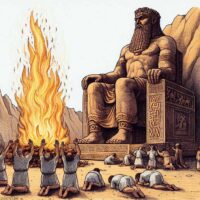
In the history of ancient technology, no invention illustrates the dark perversion of engineering creativity more chillingly than the Brazen Bull—also known as the Bronze Bull or the Sicilian Bull. Designed in the sixth century BC on the island of Sicily for the infamous Greek tyrant Phalaris of Acragas, this life-sized, hollow cast-bronze statue of a bull functioned simultaneously as a human roasting oven and a macabre acoustic musical instrument: converting the agonizing screams of a victim locked inside its metal belly into the realistic, bellowing roar of an enraged bull.
Phalaris of Acragas and the Sculptor Perillos of Athens
Around 570 BC, the wealthy Greek colony of Acragas (modern Agrigento, on the southern coast of Sicily) fell under the rule of a cunning, notoriously sadistic tyrant named Phalaris. Having seized absolute power while serving as chief contractor for the construction of the Temple of Zeus Atabyrius on the city’s acropolis, Phalaris maintained his grip on the city for sixteen years through ruthless terror.
Seeking to win a handsome royal reward by catering to the tyrant’s reputation for cruelty, a brilliant bronze-founder and sculptor named Perillos of Athens (Perilaus in Latin) approached Phalaris with a masterpiece of metallurgical art and acoustic engineering that he had cast in hollow bronze:
- The Trapdoor in the Flank: Cast in the exact life-sized dimensions of a muscular bull, the statue was completely hollow inside and fitted with a tight-sealing hinged bronze door cut into its side or between its shoulders.
- The Fire Beneath the Belly: Once a condemned prisoner was shoved inside the pitch-black bronze cavity and the door was bolted shut, executioners stacked dry firewood directly underneath the bull’s metal belly and lit a roaring blaze, heating the bronze until it glowed yellow-red and slowly roasted the prisoner to death inside.
- The Acoustic Pipes in the Nostril: To spare the dining tyrant and his guests from having to listen to human screams of pain—which might spoil their mood—Perillos installed a complex labyrinth of convoluted brass acoustic tubes and resonators leading from the bull’s interior up through its throat and out of its open nostrils. As the prisoner shrieked inside, the brass pipes filtered and modulated the human voice so that what came out of the bull’s snout sounded like “the tenderest, most pathetic, and melodious bellowings” of a real bull, while scented incense smoke drifted from the nostrils to mask the smell of burning flesh!
Poetic Justice: The Inventor Becomes the First Victim
As recorded by the first-century BC Sicilian Greek historian Diodorus Siculus in his Bibliotheca Historica (Book 9) and celebrated in the odes of Pindar and the satires of Lucian and Ovid, when Perillos proudly explained the acoustic pipes to Phalaris and waited for a bag of gold coins, even the brutal tyrant Phalaris was disgusted by the sculptor’s cold-blooded depravity.

Smiling thinly, Phalaris told Perillos that if the acoustic pipes inside the bull’s head were truly as ingenious as the sculptor claimed, Perillos himself was the only artist qualified to give the first musical demonstration:
- Phalaris ordered his guards to grab Perillos, climb the steps, and shove the terrified inventor inside his own bronze bull, bolting the hatch shut behind him.
- Kindling the wood beneath the belly, Phalaris stood back to listen as Perillos’s screams echoed through the brass nostril pipes—proving that the acoustic mechanism worked exactly as advertised!
- Before Perillos actually died inside the oven, however (so that the sacred bronze statue would not be ritually polluted by a corpse inside it), Phalaris ordered the half-roasted sculptor pulled out of the hatch and thrown to his death off the top of a steep rocky cliff.
The Fate of Phalaris, the Carthaginian Theft, and Historical Debate
In 554 BC, sixteen years after seizing power, the citizens of Acragas finally rose up in a popular revolution led by Telemachus (the ancestor of the famous fifth-century BC Roman-era philosopher Empedocles and general Theron) and overthrew the hated tyrant. Fittingly, the victorious citizens dragged Phalaris himself to his famous bronze bull, cut out his tongue, and roasted the tyrant to death inside the very machine he had used on his enemies!
Did the Brazen Bull physically exist, or was it a moral fable? While some twentieth-century revisionists wondered if it was purely an invention of anti-tyrant rhetoric, the ancient historical trail of the physical object is remarkably specific: Diodorus Siculus recorded that when the Carthaginian general Himilco sacked Acragas in 406 BC, the Carthaginians looted the actual Brazen Bull and shipped it across the sea as a war trophy to Carthage—and 260 years later, when the Roman general Scipio Aemilianus conquered and destroyed Carthage in 146 BC, Scipio found the ancient bronze bull inside the city and shipped it back home to the citizens of Acragas in Sicily, where Diodorus himself noted it still stood on public display in the first century BC (and where later Christian martyrologies claimed the Roman Emperor Hadrian’s officials executed Saint Eustace and Saint Antipas of Pergamon inside similar bronze bulls).