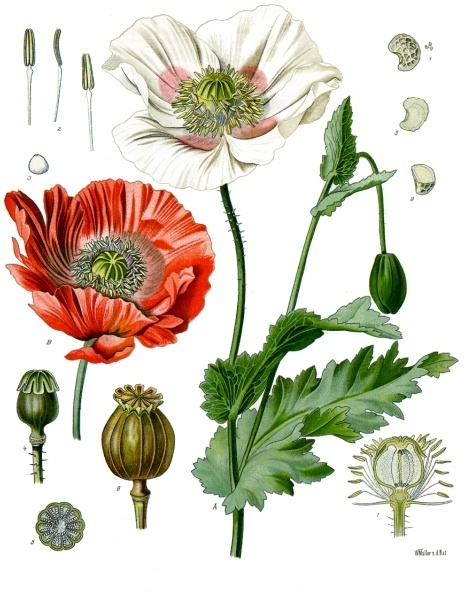
Opium » Used for its soothing, sedative, dreamlike, and even divinatory properties, opium—whose most well-known derivatives include morphine, codeine, and semi-synthetic heroin—has fascinated humanity for over 5,000 years. Across millennia, the milky sap of the white poppy, Papaver somniferum, has been consumed in various ways: drunk, smoked, eaten, inhaled, absorbed through massage, and injected. Because it induces euphoria, relieves pain, reduces hunger and thirst, induces sleep, and dispels anxiety, it has always been regarded as a universal panacea.
Opium might have remained the “remedy of God” praised by American writer and drug expert Edward Brecher. But this psychoactive narcotic, rich in alkaloids, eventually became a scourge of humanity in the 19th century as the “black poison” spread in increasingly potent forms.
Ancient Cultivation
The history of opium dates back to the Neolithic era. The cultivation of the opium poppy is attested as early as 5200 BCE in northern Europe. More recent opium poppy seeds and capsules have also been found at pile-dwelling sites along the shores of Lake Neuchâtel. However, the geographical origin of the cultivated plant remains debated: it could be in the Mediterranean, Iran, or even Central Asia.
Initially, the poppy was likely grown as a food source for its oil and seeds.

By the late Neolithic period, its therapeutic and psychoactive properties were also exploited, as evidenced by the discovery of opium in bone remains and dental tartar at the Can Tintorer site in Catalonia. A Sumerian clay tablet from around 2100 BCE, found in Nippur, refers to it as the “plant of joy.”
The Egyptian Ebers Papyrus, dating to the 16th century BCE and one of the oldest known medical texts, includes a recipe to soothe children’s crying using “poppy capsules” and “wasp droppings.” By the 13th century BCE, Theban opium was renowned.
In Homer’s Odyssey, Helen is given a poppy-based drug, nepenthes, by the Egyptian Polydamna to ease pain, calm anger, and dissolve all sorrows. Hippocrates, the father of medicine, used opium as an analgesic, antidiarrheal, and soporific.
In the 1st century, Roman naturalist Pliny the Elder and pharmacologist Dioscorides described opium alongside other drugs like mandrake, belladonna, datura, hemlock, aconite, wine, and cannabis. During Nero‘s reign (54-68 CE), the narcotic gained popularity. Nero’s physician, Andromachus, is credited with creating the famous theriac, a potent antidote containing over fifty ingredients, including a significant dose of opium, which remained in use in various forms until the 20th century. Opium was freely accessible, with Rome boasting no fewer than 800 shops selling it by the 4th century. The cocetum, a poppy-based drink, was also prepared for young Roman women before marriage.
Lucrative Trade
Credit: Public Domain
Considered a simple medicine in the Byzantine Empire, opium later became a valuable commodity in the Arab spice trade, gradually spreading to India, Southeast Asia, and China. Used as a remedy and, notably, as an aphrodisiac, it entered imperial courts and began to be smoked, enhancing its psychoactive effects. By the 16th century, the precious “black perfume” was transported from Bengal by the Portuguese, followed by the Dutch from Java. The Dutch also introduced pipes, discovered in America, to China.
Highly interested in this lucrative trade, the British took over with Indian opium. Despite imperial edicts banning its import, they smuggled 40,000 chests of opium (2,400 tons) into China in 1838. When warned, Queen Victoria refused to comply. Lin Zexu, the commissioner of Canton, destroyed 23,700 chests and blockaded trading posts, sparking the First Opium War in 1839. The British secured the opening of five commercial ports and Hong Kong. A Second Opium War in 1856, involving France, led to the legalization of opium. This flood of imports into the Chinese market caused a surge in addiction.
It also gave rise to a “refined culture symbolized by the art of the opium den,” which inspired London’s smoking dens and contributed to the growth of American Chinatowns.
Poets’ Fascination
Europe, starting with Britain supplied by India, was not left out. By the late 18th century, recreational opium gained popularity in the form of laudanum, a highly addictive alcoholic tincture of opium invented in the 16th century by Swiss physician Paracelsus. Initially appealing to the gentry, this unregulated and inexpensive drink soon permeated the working class. Beloved by writers and popularized by Thomas de Quincey—who himself became addicted—it fueled the Romantic era. In France, the opium craze was more tied to Orientalist passion.
However, with the discovery of morphine in 1804 (used medically from the 1830s and popular among the aristocracy until the Belle Époque) and the synthesis of heroin from morphine in 1874, the “gift of the gods” turned into a global scourge. According to the latest WHO estimates, around 125,000 people died from opioid overdoses in 2019.