One of the most important festivals observed on December 25 in Poland is Christmas, which is known as Boże Narodzenie (“Birth of God”) in Polish. Although most Poles see Christmas more as a secular family celebration than a religious one, everyone celebrates the holiday in their own unique way. Most Polish people’s idea of a good Christmas is spending time with loved ones. Before breaking the Christmas wafer, Poles meet for a communal feast on Christmas Eve, December 24. They swap presents and best wishes. The Christmas Mass, or “pasterka,” is celebrated in churches on the evenings of December 24th and 25th. Christmas markets are held in several Polish cities all through December.
See also: 48 Countries That Celebrate Christmas Widely
Advent
A four-week season of fasting and preparation known as Advent precedes Christmas in Poland, as it does in other Catholic nations. During this season, Christians are encouraged by the Catholic Church to repent and do acts of kindness. Compared to an earlier figure of almost 90%, today, 70% of Poles are Catholic.
Polish churches celebrate morning masses honoring the Virgin Mary, known as “Roraty” (a votive mass), every day of Advent (with the exception of Sundays). The service starts at the crack of dawn, with the only light from the parishioners’ candles.
Important Advent Symbols:
- Advent wreaths: Advent wreaths crafted from fir branches and embellished with candles, illuminated one by one throughout the season.
- Christmas calendar: Traditional Christmas calendars would start counting down the days until Christmas Eve at the start of Advent.
- Christmas lanterns: Square or rectangular Christmas lanterns adorned with biblical images or Christian motifs. A light bulb or candle is placed within.
Christmas Eve: Sochelnik
December 24th, often known as Christmas Eve (Sochelnik in Polish) is related with many Christmas rituals. The majority of Poles take the day off from work, and businesses close early or stay open for a reduced schedule.
Traditionally, on Christmas Eve, the Poles gather with their families to celebrate. As soon as the first star appears in the sky, devout families start reading the Bible and praying. This is in observance of the Star of Bethlehem, which, according to the New Testament, led the magi to the infant Jesus.
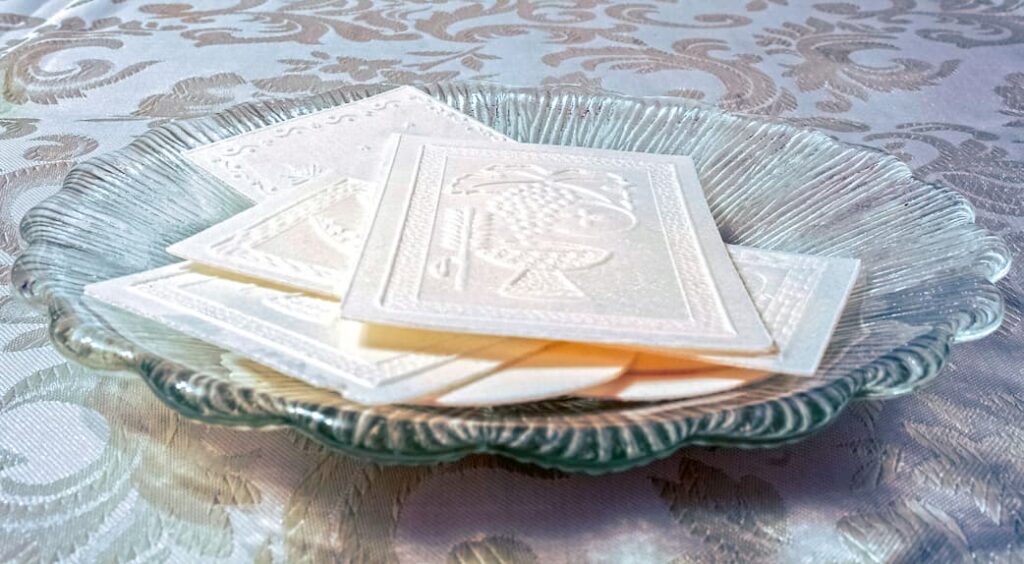
As is customary, the Christmas wafer (opłatek) is passed around and wishes exchanged. It is a thin Polish tradition of a rectangular loaf of unleavened bread or waffle. Instead of coloring them as in the past, it’s now traditional to bake white wafers with embossed designs of Christmas scenes. Christians remember the sacrament of the Eucharist by the practice of breaking the wafer, which also represents unity and reconciliation.
-> See also: All 15 Countries That Don’t Celebrate Christmas
Family members who are unable to join the celebration often send wafers over the mail as a token of their importance to the custom. After then, one seat remains empty at the table while all the participants take their seats. The seat is saved for an unnamed visitor and the host is prepared to welcome and feed any stranger this evening. Furthermore, a particular setting is laid out on the table in honor of family members who have passed away.
The Polish traditionally have two courses prepared for the Christmas table: one for those who fast and one for those who consume meat. Due to the continued fasting on December 24th, no meat is served until the following day. Fasting supper on Christmas Eve is the most important celebratory meal, but the diversity and complexity of the dishes more than make up for the constraints. There should be twelve dishes, representing the number of apostles, and everyone at the table is expected to sample them all, according to tradition.
Typical starters for the feast include borscht with dumplings or mushroom soup, followed by pies, dumplings, stewed cabbage, different fish dishes, gingerbread, kutya with nuts, raisins, and honey, and a compote of dried fruits for dessert. In remembrance of the manger where Jesus was laid, a little amount of hay is often put underneath the white tablecloth that covers the table. Even though the Vatican Congregation for the Doctrine of the Faith decided in 2003 that Christmas Eve fasting is not obligatory, most Polish Christians nevertheless follow the customary fasting.
Pasterka: “The Shepherds’ Mass”
In remembrance of the shepherds who came to worship the infant Jesus Christ, many Poles attend church on the evenings of December 24th and 25th for the Christmas service, which is referred to as “Shepherd’s Mass” or “Pasterka” (from the word “pasterz” meaning shepherd). Even though Christians have been holding night services since the fifth century, the practice almost died out in Western Europe during the eighteenth century.
Two centuries later, during the pontificate of John Paul II, the Catholic Church resumed the tradition of celebrating night Mass in Poland, making it one of the few nations that maintained this practice. At midnight (or perhaps earlier), Polish churches hold Pasterka, which lasts for about 1.5 hours.
Every church has a traditional Christmas crib where the priest traditionally sets a figurine of the Baby Jesus during the ceremony. There is an air of seriousness in the liturgical songs sung throughout this Mass. Several thousand Christians are drawn to the Shepherd’s Mass at the Jasna Góra Monastery in Częstochowa, which is the greatest gathering of its kind.
Christmas Traditions in Poland
Holiday Decorations and Present Exchange
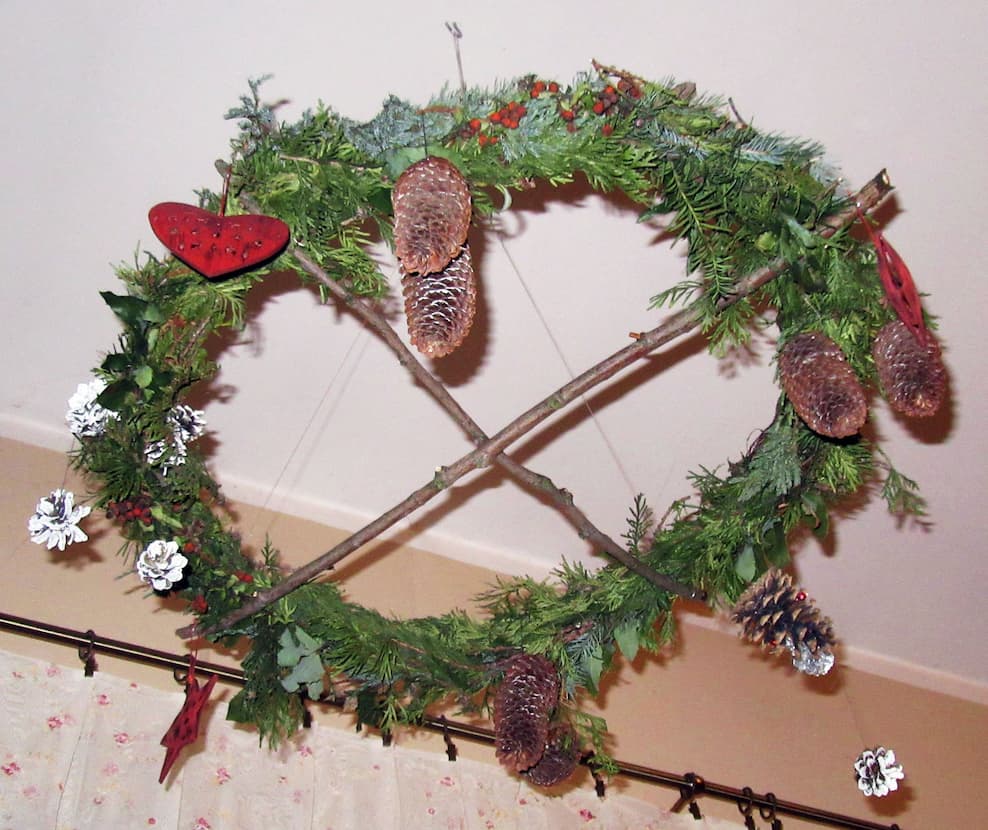
Polish Christmas trees and streets are decked up with multicolored lights, much as in other European countries. This is especially meaningful for Catholics on Christmas Eve, when the tree is decked up with beautiful ornaments to represent the tree of paradise bearing fruits, and December 24th is the day Adam and Eve were created.
It is another common practice to exchange gifts on Christmas Eve (December 24th). Tradition holds that Saint Nicholas bestows presents upon children in Poland; however, the specific figure may differ depending on where one lives. In Western Poland, it is Gwiazdor (meaning “star” in Polish), in Lesser Poland, an angel, in the southwest of Poland, asterisk or little star, and in Silesia, the Baby Jesus. Also, Polish Orthodox Christians are visited by the famous Russian figure Ded Moroz (“Father Frost”).
Caroling and Music
- Bóg się rodzi (God Is Born), the text of which was written in 1792 by Franciszek Karpiński.
- Lulajże Jezuniu (Sleep Jesus), a 17th century children’s song.
- W żłobie leży (Infant Holy, Infant Lowly), 16th-17th century Christmas carol, with text attributed to the Polish writer Piotr Skarga (1536–1612).
Polish Christmas music traditionally features carols, of which over 1,500 have been officially recorded in Poland. Historians of music generally agree that the composition and performance of celebratory songs describing the birth of Jesus started in Poland somewhere between the late fourteenth and early fifteenth centuries. ‘Zdrow bądź, krolu anielski’ (‘Hail, Angelic King’) is the first line of the oldest surviving Polish Christmas song, which goes back to 1424. Carols range from very serious to more lighthearted, with lyrics that might be sarcastic or comical.
‘Oj, maluśki, maluśki’ (‘Oh, little one, little one’), ‘Dzisiaj w Betlejem’ (‘Today in Bethlehem’), ‘Gdy śliczna Panna’ (‘When the Beautiful Virgin’), and the world-renowned ‘Silent Night’ are among the most famous carols. Starting on Christmas Eve and continuing through the night Mass on Christmas Day, carols are sung until February 2.
On December 26, the feast of Saint Stephen the First Martyr, which falls on the second day of Christmas, Poles start caroling, performing house-to-house carol concerts. There was a time when people thought that caroling helped bring about the springtime blooms in nature, and now many think that singing brings good fortune and harmony to the home. Carolers would often travel with domestic animals, but as time went on, they would often be joined by people dressed as similar animals, such as bulls, goats, horses, etc.
Similarly, it was common practice to dress like figures from the Bible, most notably King Herod and the Magi. A huge, multicolored star strung from a pole is known as a “star procession,” and it is still a popular tradition. Giving carolers refreshments or a little money is common practice; sometimes, the gathered monies are used for charity causes. It is common practice for Polish Catholic priests to visit the homes of their parishioners either before or after Christmas to sing carols and socialize with the congregation. There are distinct traditions for caroling in each area of Poland.
Nativity Scenes
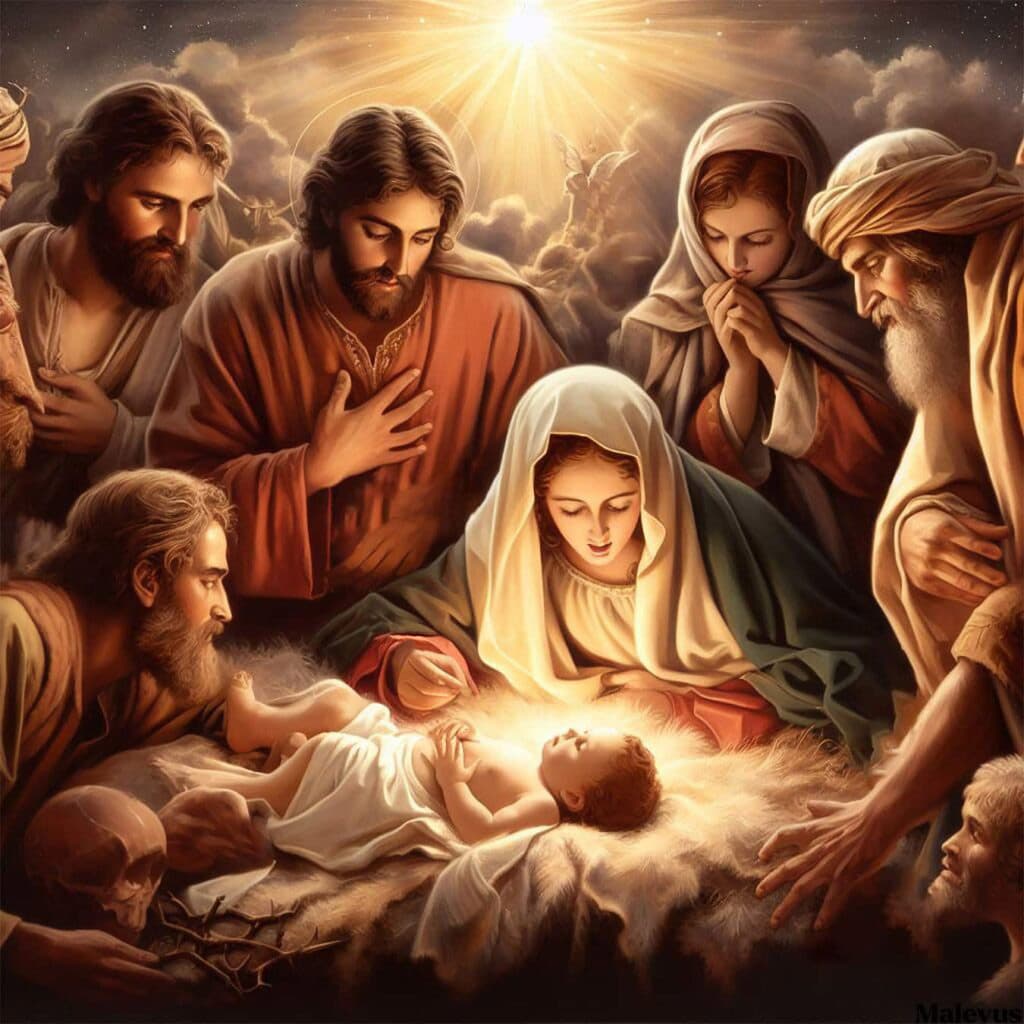
Lithuanian Christmas nativities, called szopka in Polish, have been around since the Middle Ages. During the Christmas season, they are placed in every church and portray the scene of Christ’s birth. The szopka of Krakow has become a well-known and unique folk-art style. Usually depicting one of Krakow’s famous locations, these two-tiered sculptures show biblical figures on the upper level and historical or current individuals on the lower level. On the first Thursday of December, the Market Square hosts a szopka competition, the winner of which is chosen by the Krakow Historical Museum.
Competitors range from students and other novices to seasoned artisans who have honed their techniques over the years and passed them on to their descendants. As of 2018, the Krakow szopka was officially recognized as an intangible cultural heritage by UNESCO. Particularly noteworthy are the nativities in Kudowa and Olsztyn, which also have a high number of figurines and moving parts, and the biggest nativity in Europe, housed inside a church.
The nativities in the hamlet of Wambierzyce comprise 800 wooden figures, 300 of which are animated. The dimensions of the structure—59 feet in height, 115 feet in width, and 33 feet in depth—are those of the Franciscan Cathedral in Katowice.
Holiday Markets
Christmas markets are a December tradition in most Polish towns, and they’re becoming more and more popular every year. Decorative and applied art, knitted socks, a variety of confectionery, jewelry, and Christmas decorations are all for sale in tents or wooden cottages. Kids may enjoy rides, carousels, and other forms of entertainment. In a typical Polish market, you may have grilled ‘oscypek,’ a cheese from Polish highlanders, accompanied with cranberry jam. Warsaw, Wroclaw, Krakow, Gdansk, and Katowice all have enormous and stunning markets, however the exact times vary from city to city.
Christmas Foods in Poland
Guests from outside the family were required to have one empty seat at the Christmas Eve supper since the number of courses had to be odd (often thirteen) and the number of table settings had to be even. Instead of meat, there should be twelve vegetarian options on the Christmas Eve menu (to represent the following year’s months). Some examples of these dishes include seafood macaroni, filled dumplings, carp, cabbage with peas, and mushroom soup.
Sweet Treats
- Opłatek: ‘Opłatek,’ a delicate wafer adorned with a religious picture, is a traditional Polish dessert. It is customary for the family patriarch to give out opłatek to all members of the family and the cattle in the days leading up to the Christmas Eve meal. The act of sharing opłatek within a family represents selflessness and the readiness to divide up the rewards of everyday labor. Although the practice of serving opłatek to families has its roots in the 18th century, the custom of making it in the Middle Ages is far older.
- Kutya: Wheat, hazelnuts, raisins, and honey are the main ingredients of kutya, a traditional Polish Christmas dessert.
- Piernik: Piernik, a honey cake in a variety of shapes (heart, animal, or St. Nicholas) is also a traditional Polish Christmas treat.
- Makowiec: Polish poppy seeds, or “mak” in Polish, represent joy and plenty and they are a hallmark of this traditional Christmas dessert.
Christmas Drinks
Traditionally, dried fruits (such as plums) are used to make kompot, a traditional Polish Christmas drink.
Polish Christmas Folk Traditions
Szopka, Nativity Scene: Polish Christmas traditions revolve on the nativity scene, or “szopka,” which is put up throughout the holiday season. The practice of making little houses adorned with Nativity scenes and placing them under the Christmas tree became popular among Krakow’s masons and laborers in the 18th century as a means of supplementing their income. Krakow hosts an annual competition to crown the most exquisite nativity displays. The “puppet nativity scene,” is a unique kind of Polish nativity scene that has its roots in the 18th-century arrangement by Polish priests. A similar tradition is seen in Hungary and Ukraine.
The First Star: As soon as the first star of Christmas Eve appears in the sky, the traditional Christmas Eve feast is started. This relates to the Star of Bethlehem, which the three wise men supposedly saw in the sky when they came to see the baby Jesus. At the beginning of the meal, someone reads a portion about Jesus’ birth from either Matthew or Luke’s Gospel.
Hay Under the Tablecloth: Traditionally, a handful of hay is placed beneath the white tablecloth. This tradition has its roots in pagan times, when it was associated with an old agricultural celebration; the pagan idea was that it would bring prosperity to the household in the next year. Jesus was born into poverty, and the hay represents that.
An Extra Seat at the Table: It is common practice to reserve one more seat at the table in comparison to the total number of guests. This act represents holding a seat for someone who shows up unannounced, paying tribute to a loved one who has passed away, or honoring someone who is unable to attend.
Christmas Tree: Polish Christmas trees had their origins in the 18th century, when the custom was brought to the country. ‘Podłaźniczka,’ a comparable tradition that existed prior to the Christmas tree, included suspending the fir tree’s top from a beam or the barn door. Polish nationalists responded to the arrival of the German Christmas tree custom by designing ornaments based on Polish folklore.
Pajaki: Traditional embellishments also include ‘pająki,’ which are stars or eggs that have been adorned.
Gift Bearers: “The Star Men, or ‘gwiazdor,'” are one of the traditional gift-givers with Santa Claus.