The luminous sun ball moves towards the horizon and gradually bathes the sky in a breathtaking play of colors: bright yellow, rich orange, and flaming red—a spectacular and very popular scenery. Ironically, however, the most beautiful and romantic sunsets are said to occur not in remote natural paradises, but precisely where the air is dirtiest. The more dust, the more colorful the evening sky, they say. But is this actually true? Or how does it work at all?
Intense colors during a sunset
It all depends on the size of the particles. In fact, particularly intense colors are created during sunset if there are a lot of small dust particles floating in the air, just like small soot particles from car exhaust. When a light wave hits such a particle, it is scattered, i.e. deflected from its straight path. But a long-wave light beam, which your eye perceives as red, is scattered less strongly than a blue short-wave light beam.
The dust particles filter out the last parts of the cold blue from the evening sunlight, and only the warm colors remain at the end. With many small dirt particles in the air, the red tones, therefore, come out more than they usually do in an evening sky, and the red color becomes fuller and stronger.
In the evening, when the sun is just above the horizon, the light rays have a much longer distance to travel through the Earth’s atmosphere. The short-wave light waves collide with particles so often along the way that they are completely lost by the time the light reaches us. What remains, apart from a few remnants, are only the long-wave red light waves, and it is this color that you see in the sky.
Volcanic eruptions beautify the sky
Very small dust particles in the air have the same effect on light waves as air molecules. However, when they are too large, they no longer scatter sunlight but absorb it. In this case, they don’t produce beautiful colors but simply darken the sky. Large particles can also reflect light. Then the sky tends to brighten, with whitish reflections.
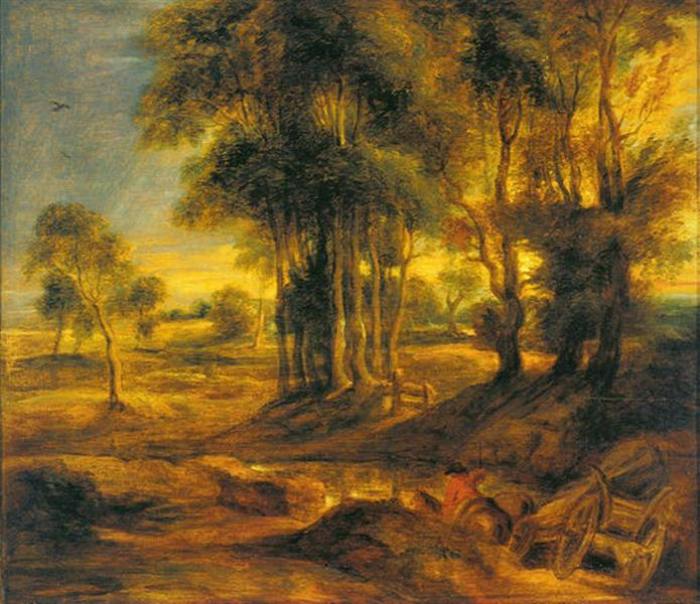
There are particularly beautiful sunsets a few days after volcanic eruptions, namely when the large ash particles have settled and only the very fine particles remain suspended in the atmosphere. That’s even given researchers the idea to look for past volcanic eruptions in old paintings.
Christos Zerefos of the University of Athens and his colleagues studied many hundreds of paintings of sunsets painted by Rubens, Rembrandt, and other artists. The meteorologists used a computer to analyze the red-green values of the depicted horizons. In fact, according to the researchers, the pictures with the reddest and thus most beautiful sunsets were created in the years that followed a documented volcanic eruption.